Our Top Picks
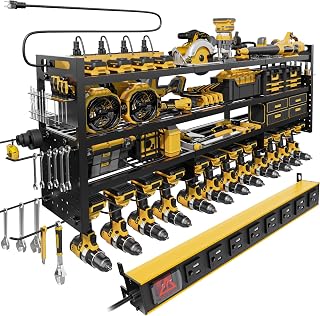
 POKIPO Large Power Tool Organizer Wall Mount withLarge8.5 x 33 x 15.7 Inches16 poundsCheck on Amazon
 STURDIFLOW Large 49''Wide Power Tool Organizer Wall Mount49''Width (POWER STATION)7.9 x 49 x 16.5 inches18 PoundsCheck on Amazon
 STURDIFLOW Large 49'' Wide Power Tool Organizer Wall49''Width (LARGE)7.9 x 49 x 16.5 inches17 poundsCheck on Amazon
 POKIPO Large Power Tool Organizer Wall Mount36.4 x 11.7 x 8 inches17.3 x 5 x 5.5 inches12.06 poundsCheck on Amazon

What's inside
As an Amazon Associate I earn from qualifying purchases. This post may contain affiliate links at no extra cost to you.
Most garages fail at power tool storage for garage use for one reason: the storage was chosen by appearance instead of by load, depth, and access. A pegboard rated for light hand tools sags under a 7-pound circular saw. A 24-inch-deep cabinet swallows an impact driver into a black hole you never dig through again. Batteries end up scattered across three surfaces and two of them are always dead. The tools are fine. The system around them is the problem.
This guide sorts garage storage the way a supply house would: by what the equipment is actually rated to do, what depth suits the tool, and what belongs on a wall versus in a drawer versus on wheels. Everything here assumes a typical attached garage or single-bay shop with concrete floor, drywall or bare stud walls, and a car you would like to keep parking inside.
As an Amazon Associate we earn from qualifying purchases at no extra cost to you.



Sections
Storage Formats At A Glance
The separating criterion between formats is not capacity, it is retrieval cost. How many seconds and how many movements does it take to get the tool in your hand and put it back one-handed while the other hand holds a workpiece?
| Format | Best For | Typical Depth | Watch Out For |
|---|---|---|---|
| Slat wall or track system | Frequently used cordless tools, chargers | 4 to 8 in | Per-hook and per-panel weight limits |
| Steel rolling cabinet | Corded tools, blades, accessories | 18 to 24 in | Drawer slide rating, caster diameter |
| Wall cabinets, upper | Seldom used tools, chemicals | 12 to 16 in | Stud anchoring, reach height |
| Open shelving | Cased kits, sanders, vacuums | 16 to 24 in | Shelf deflection under point loads |
| Systainer or packout stacks | Kits that leave the garage | Varies | Cross-brand incompatibility |
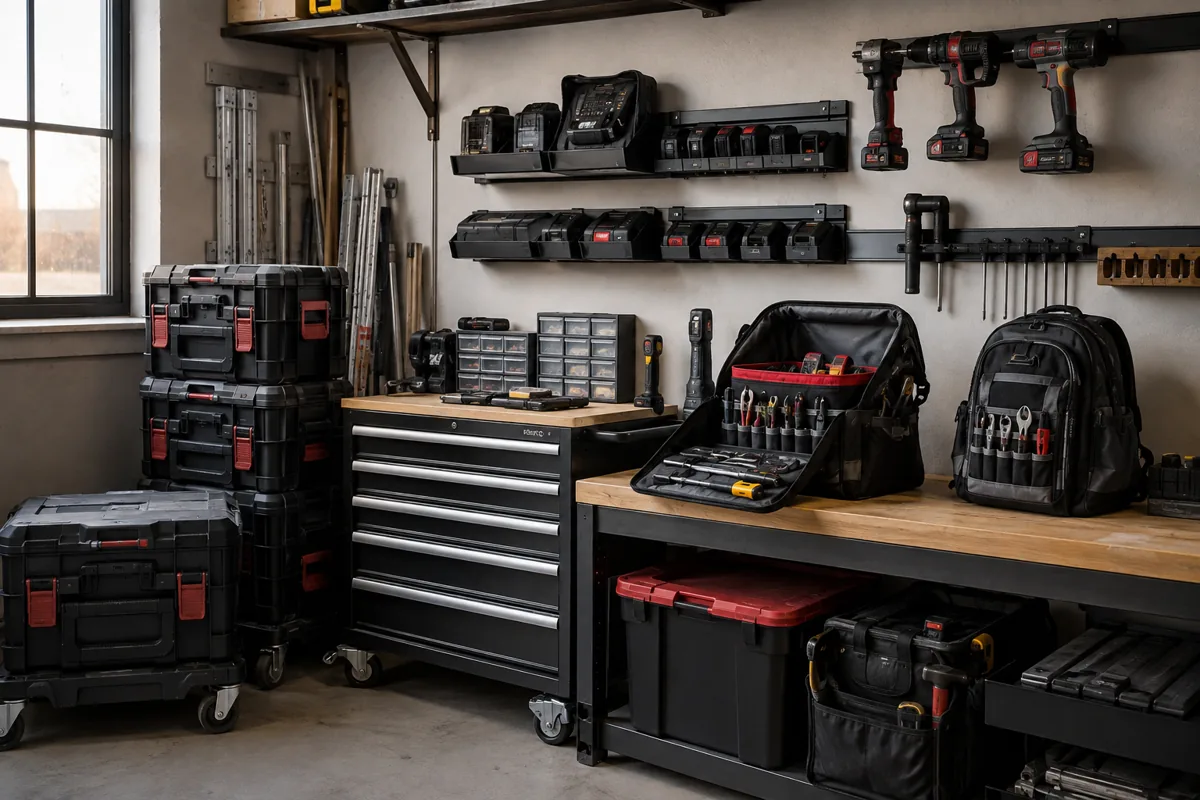
The pattern most garages land on is a hybrid: a vertical band of wall storage between roughly 40 and 70 inches off the floor for daily drivers, a rolling cabinet under the bench for anything with a cord or a blade, and upper cabinets for the seasonal stuff. What you should resist is buying a single format and trying to make it do all three jobs.
Wall Systems: Judge Them By Rated Load, Not Hook Count
The criterion here is published load rating per hook and per linear foot, anchored into structure. Hardboard pegboard with 1/4-inch peg spacing is a hand tool product. It is not the right substrate for a 5-pound drill plus a 5-Ah battery hanging on a single hook, and the holes will elongate over a season of use.
Better options in ascending order of capacity: high-density polymer slat wall, extruded aluminum track, and welded steel French cleat or grid panels. Look for a stated per-hook rating, usually somewhere between 25 and 75 pounds for consumer slat wall, and a per-panel or per-foot rating that assumes fasteners land in studs at 16 inches on center. If a product only advertises “heavy duty” with no number, treat it as light duty.
Fastening matters as much as the panel. Into wood studs, use structural screws long enough to reach at least 1-1/2 inches of embedment. Into concrete or block, use rated sleeve or wedge anchors rather than plastic conical plugs. Drywall alone, even with toggles, is a poor host for tool weight because the failure mode is progressive rather than sudden, so you get sag and cracking rather than an honest drop.
Garage Slat Wall Panel Kits
Slat wall is the sweet spot for most garages because hooks reposition in seconds without new holes. Buy enough panel to cover a full 4 to 8 foot run rather than a small starter pack, confirm the per-hook rating in the specs, and budget separately for hooks since bundled hook assortments are usually the cheap part of the package.
Rolling Cabinets And Drawers: The Slide Rating Is The Product
For anything corded, bladed, or accessory-heavy, drawers beat hooks. The criterion that separates a cabinet you will still like in five years from one you will not is drawer slide rating and caster size, not gauge steel or paint quality.
Look for full-extension ball-bearing slides with a stated per-drawer rating. Roughly 60 to 100 pounds per drawer is normal for mid-tier garage cabinets and adequate for hand tools and small power tools. Heavier ratings matter for a drawer full of router bits, clamps, or a benchtop tool. Full extension is not a luxury; a 3/4-extension slide hides the back four inches of every drawer, which is exactly where things go to die.
Casters: 5-inch or larger diameter rolls over an extension cord and a concrete expansion joint. Anything smaller stalls. Two locking swivels plus two fixed is the configuration that both maneuvers and stays put. Confirm the total load rating of the caster set, and remember that a loaded cabinet can approach several hundred pounds.
Drawer liners are worth the small cost. Non-slip foam liner keeps steel from sliding into a pile every time you roll the cabinet, and it dampens the noise that makes you think something broke.
- ✔ Full-extension slides expose the entire drawer, so nothing is lost at the back
- ✔ Closed drawers keep concrete dust and sawdust off precision tools
- ✔ Rolling base lets you bring tools to the work instead of the reverse
- ✔ Top surface doubles as a staging bench when the main bench is buried
- ✘ Deep cabinets encourage stacking, which defeats the purpose
- ✘ Loaded units get heavy enough that small casters bind on floor cracks
- ✘ Steel cabinets in unheated garages can sweat during spring temperature swings
- ✘ Costs more per cubic foot of storage than open shelving
Battery Charging Stations And Fire Safety Basics
The criterion for a charging station is dedicated circuit capacity and clearance around the chargers, not how tidy the shelf looks. Lithium-ion packs from the major cordless lines, DeWalt XR, Milwaukee FUEL, Makita LXT, Ryobi ONE+, all charge with meaningful heat output, and multi-bay chargers stacked in a closed cubby are working against their own cooling.
Practical guidance that holds across brands: mount chargers on an open shelf with a few inches of air above and behind, keep them off the floor where they collect dust and water, and avoid daisy-chained power strips. Check the amperage draw printed on each charger and add it up before putting four fast chargers on one 15-amp garage circuit, which also often feeds the door opener and a freezer.
Standards and ratings worth citing when you shop: look for UL listing or UL Recognized components on chargers and power strips, and note that quality battery packs are typically tested to UN 38.3 for transport safety. Garage temperature matters too. Most manufacturers specify a charging range in the neighborhood of 40 to 105 degrees Fahrenheit, so an unheated garage in a cold climate is a reason to bring packs inside overnight rather than a reason to buy a heater. Storage at partial charge, around half, is generally kinder to packs than storing them full or empty for months.
Cordless Tool Battery Charging Station
A dedicated charging shelf with cord management solves the single most common garage annoyance: never knowing which pack is charged. Pick one sized for the number of chargers you actually own plus one bay, verify it mounts into studs, and prefer open-back designs over enclosed boxes so heat has somewhere to go.
Cases, Kits, And Deciding What Never Goes On A Shelf
The criterion for keeping a tool in its case is whether it leaves the property. Tools that travel stay cased. Tools that live in the garage come out of the case, because a stacked case system means two extra motions and a latch every single time you reach for a driver.
Modular box systems are excellent for job site transport and terrible as primary garage storage for daily tools. If you already own a stack, put the ones you use weekly on a low shelf at waist height and the rest above. Note that cross-brand stacking is inconsistent even when footprints look similar, so committing to one ecosystem saves frustration later.
For blades, bits, and abrasives, small parts organizers with removable bins beat any drawer arrangement, because the bin travels to the tool. Label by size, not by brand.
Frequently Asked Questions
How much wall space do I need for a usable setup? A single 4-foot run of slat wall handles roughly six to ten cordless tools with batteries if you space hooks properly. An 8-foot run plus a rolling cabinet covers most homeowner and remodeler collections. Plan the vertical band between about 40 and 70 inches off the floor for anything you touch weekly.
Is it safe to store lithium-ion batteries in an unheated garage? Storage in cold is generally less harmful than charging in cold, but repeated deep freezes and high summer heat both shorten pack life. If your garage regularly falls below freezing or climbs past about 100 degrees Fahrenheit, keep packs indoors and only bring them out to work. Never charge a pack that is visibly swollen, cracked, or wet.
Should I buy a cabinet system or build a French cleat wall? Build the cleat wall if you own a table saw and want infinitely adjustable custom holders for a few hours of shop time and a sheet of plywood. Buy the cabinet system if you want closed, dust-free storage for corded tools and accessories, or if you rent and want something that leaves with you. Most well-organized garages end up with both.
Start with the wall band for your five most-used tools, add a charging shelf on an open circuit, then buy drawer storage once you know which accessories you keep hunting for. That order costs less than buying a full system up front and it produces a layout shaped by how you actually work.
Check prices on Amazon →