Our Top Picks
 JUNNUJ Power Tool Organizer Cart with Charging Station6 ft Power Cord11.8 x 17.7 x 34.3 inchesCheck on Amazon
 POKIPO Large Power Tool Organizer Wall Mount withLarge8.5 x 33 x 15.7 Inches16 poundsCheck on Amazon


What's inside
As an Amazon Associate I earn from qualifying purchases. This post may contain affiliate links at no extra cost to you.
Most shops do not have a battery problem, they have a battery location problem. Packs migrate to the bottom of a tool bag, a windowsill, a coffee can on the bench, and the door pocket of a truck that sits at 130 degrees in July. The predictable result is three packs on hand and none of them charged, plus one 5.0Ah pack that will not wake up at all. Good battery storage ideas for power tools are not about pegboard aesthetics. They control three variables: charge state, temperature, and what the terminals can touch.
Use that as the filter. A rack earns its wall space if you can walk up and tell, without touching anything, which packs are ready, which are charging, and which ones you have quarantined. Otherwise it is just a shelf.
As an Amazon Associate we earn from qualifying purchases at no extra cost to you.


| Storage approach | Best for | Main limitation |
|---|---|---|
| Open wall rack or French cleat | Daily drivers you grab constantly | No dust or temperature buffer |
| Enclosed cabinet with charger inside | Cold, dusty, shared shops | Needs vents and clearance |
| Drawer inserts in a rolling chest | Shops with no free wall | Charge state gets lost |
| Bins in a modular stacking case | Van, trailer, jobsite fleets | Adds weight to the stack |
| Steel box or fire-resistant bag | Swollen or retired packs | Storage only, never charging |
Sections
Start With The Manual, Not The Pegboard
The criterion is the published storage window. Every major platform prints one, and it is tighter than most people assume. Ideal long-term storage for lithium-ion packs sits in a room-temperature band, broadly 40 to 80 degrees Fahrenheit, with absolute limits that stretch further and shorten pack life the closer you live to them. Charge windows are narrower still, which is why a charger in an unheated garage in February throws a fault instead of charging: the pack is below its permitted charge temperature and the protection circuit is working correctly.
The ratings worth knowing are UL 2054 and IEC 62133 at the pack level, plus UN 38.3, the transport test series every shipped pack has to pass. None of them promise a pack is safe in a 140 degree attic or on a bed of sawdust. Building a bank of a dozen packs or more? Skim NFPA 855. Its residential thresholds do not apply to a hobby shop, but the logic of non-combustible surfaces, spacing, and clear exits scales down well.
Battery Storage Ideas For Power Tools That Survive A Real Shop
The criterion is whether the mount grips the pack by its rails. Anything that lets a pack rest loose eventually lets it slide onto concrete.
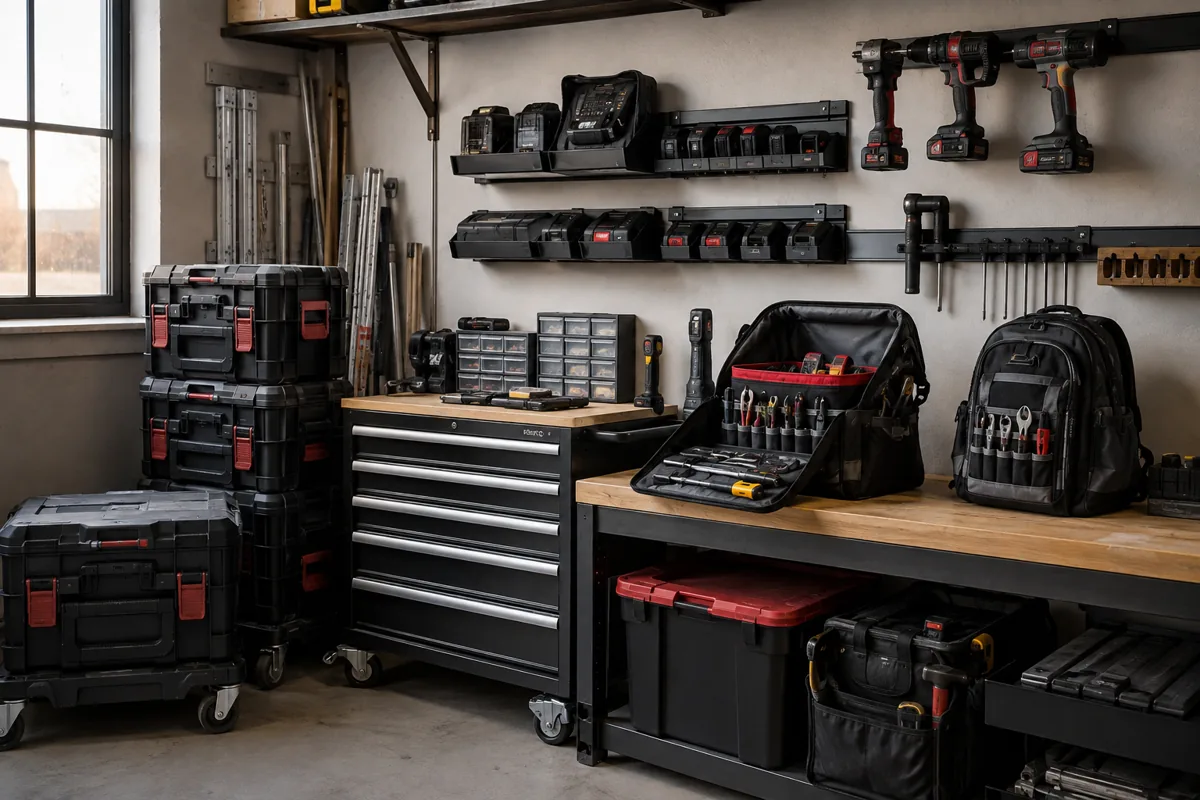
Slide-in wall mounts copy the tool’s own dovetail, so packs click in and stay there, and a strip of them on a French cleat moves when your layout does. Slotted plywood shelves do the same job for the price of a 3/4 offcut, with a kerf a hair wider than the rail. Chargers above, packs below is the layout that scales, since charger heat rises away from stored packs instead of into them. In a rolling chest, dividers that stand packs upright keep terminals off stray fasteners. For van fleets, bins inside a modular stacking case beat loose packs in a tote.
Slide-in wall mounts for tool battery packs
Buy by platform, not brand loyalty: a mount cut for one voltage line will not hold another. Check that the plastic wraps the full rail rather than a short lip, and screw them into a plywood backer, since drywall anchors sag under a full bank.
Charging Stations: Heat, Clearance, And The Circuit Behind Them
The criterion is airflow plus a circuit that is not already loaded. Fast chargers make real heat, and four of them shoulder to shoulder in a closed cabinet will throttle, stretch charge times, and age cells. Leave a few inches around every vent, back the station with sheet metal or cement board, and vent the top of any enclosed cabinet.
Garage and unfinished basement receptacles require GFCI protection under NEC 210.8, surge strips should carry a UL 1449 listing, and power taps are not meant to be daisy chained. Add up the nameplate amps of everything running at once and stay near 80 percent of the circuit rating rather than at it. Keep the station away from dust collection and out from under a bin of shavings.
Rolling charging cart with mounted power strip
The move when your bench relocates but your outlets do not. Look for a steel top, a strip fastened to the frame so no cord trails underfoot, and open shelves rather than closed cubbies so charger heat can escape. Lock the casters.
Temperature, Dust, And Knowing Which Pack Is Ready
The criterion is swing, not average. A garage that averages a pleasant 65 degrees while running 20 to 105 across the year is harder on packs than a consistently cool basement. A foam-board liner inside a cabinet buys several degrees of buffer for almost nothing. If your shop freezes, keep a rotating bin indoors and let cold packs warm up before charging so condensation is not sitting on the contacts. The old warning about concrete floors came from lead-acid batteries and does not apply here.
Then make charge state visible. Mark each pack with a paint pen, purchase month and year plus a letter, and run the rack like a FIFO shelf: charged at one end, spent at the other, always pull from the same side. Packs you will not touch for months keep best partway up the gauge, not full and not empty, with a top-up two or three times a year.
Open wall racks, weighed honestly:
- ✔ Charge state is obvious at a glance, so packs actually get rotated
- ✔ Costs a plywood offcut and four screws to start
- ✔ Best airflow of any option, for packs and chargers alike
- ✘ No buffer against dust, humidity, or temperature swings
- ✘ Terminals sit exposed near metal shelving and loose fasteners
- ✘ Nothing keeps kids, pets, or shop visitors out of the bank
Damaged Packs: Isolate Before You Store
The criterion is separation. A pack that has lost obvious runtime, runs hot on easy work, refuses a charge, or shows any case swelling has told you it is finished, and it does not belong back on the wall beside good ones. Tape the terminals, set it in a steel container away from anything that burns, and move it out on your next errand. Retailer drop-off bins and the Call2Recycle network take tool packs at no charge, and most states treat them as universal waste, so the household trash and the curbside cart are both wrong.
Fire-resistant lithium battery storage bag
A containment layer for a pack you already suspect, not a home for your working fleet. Size it so the pack lies flat with the closure fully shut and treat it as temporary, since the goal is recycling. A steel ammo can does much the same job.
Battery Storage FAQ
Should I leave packs on the charger all the time? Not dangerous, since modern chargers stop and switch to a maintenance state, but it holds cells warm at a high state of charge, which is the combination that ages them fastest. Charge, then move the pack to the rack.
What charge level is best for winter storage? Middle of the gauge, somewhere cool and dry, with a top-up every few months so no pack drifts into a deep discharge the protection circuit cannot recover from.
Can I store different brands and voltages together? Yes, as long as each pack sits in a mount cut for its own platform and no terminal can touch another pack or bare metal. Group by platform anyway, because mixed racks are why people grab the wrong battery.
Match the tier to the shop: slotted plywood and slide-in mounts if you are graduating from a coffee can, a vented cabinet if your garage swings hard, a rolling cart if the bench never stays put. Label everything and pull from one side.
Check prices on Amazon →