Our Top Picks
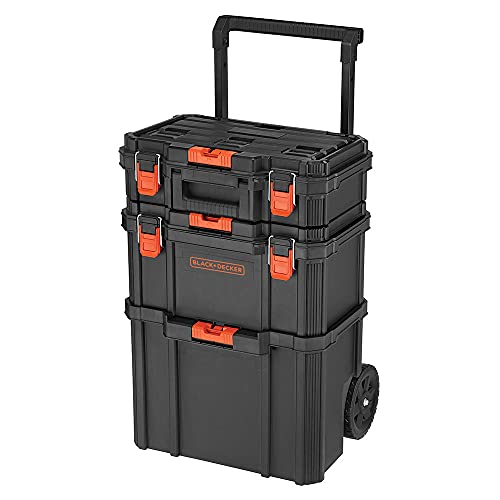 beyond by BLACK+DECKER BLACK+DECKER BDST60500APB Stackable Storage SystemSmall20 x 15.75 x 29 InchesCheck on Amazon
 CRAFTSMAN VERSASTACK XL Rolling Tower Tool Storage System22.1 inches22.1 x 17.98 x 33.3 inches33.9 PoundsCheck on Amazon
 DEWALT TSTAK Tool Storage Organizer with Double Drawers17.3 x 12.3 x 6.9 inches9.2 PoundsCheck on Amazon
 POKIPO Large Power Tool Organizer Wall Mount withLarge8.5 x 33 x 15.7 Inches16 poundsCheck on Amazon


What's inside
- Modular stack, rolling chest or wall rack: which type do you need?
- Quick picks by need
- Pick one system and stay in it
- Best Modular Tool Storage System for the Price, by Budget Tier
- PACKOUT vs TOUGHSYSTEM 2.0 vs TSTAK: head-to-head
- Seven More Modular Tool Storage Systems Compared
- How We Chose These Tool Storage Systems
- How to read a tool storage spec sheet
- Small parts organisers
- Setting up the inside of each box
- Tool bags still have a place
- Site security
- Van and truck organisation
- Starter stacks by trade
- Keeping tools dry and rust-free inside sealed boxes
- Making a modular system last
- Common mistakes
- FAQ
- More Questions About Modular Tool Storage Systems
- Related Guides
- Modular stack, rolling chest or wall rack: which type do you need?
- Quick picks by need
- Pick one system and stay in it
- Best Modular Tool Storage System for the Price, by Budget Tier
- PACKOUT vs TOUGHSYSTEM 2.0 vs TSTAK: head-to-head
- Seven More Modular Tool Storage Systems Compared
- How We Chose These Tool Storage Systems
- How to read a tool storage spec sheet
- Small parts organisers
- Setting up the inside of each box
- Tool bags still have a place
- Site security
- Van and truck organisation
- Starter stacks by trade
- Keeping tools dry and rust-free inside sealed boxes
- Making a modular system last
- Common mistakes
- FAQ
- More Questions About Modular Tool Storage Systems
- Related Guides
As an Amazon Associate I earn from qualifying purchases. This post may contain affiliate links at no extra cost to you.
Nobody photographs their tool boxes for social media, and yet loading and unloading is where a significant slice of every working day disappears. A modular system that stacks, locks and rolls over gravel pays for itself in weeks.
Storage gets bought badly because the decision looks like a box decision when it is really an ecosystem decision. A single case is judged on latch strength, lid stiffness and price. A tool storage system is judged on whether the pieces you buy in three years still clip onto the pieces you bought this week, and whether the accessory you eventually need — a deep organiser, a drawer unit, a bag that mounts to the stack — exists at all. Get that part right and the individual boxes almost stop mattering.
As an Amazon Associate we earn from qualifying purchases at no extra cost to you.


What follows is the way the choice gets made on a working van: which criteria carry real weight, what each price band actually buys, and who should skip modular storage entirely. The honest summary up front is that most of the systems on the shelf are competent. The purchases people regret are rarely about build quality.
| System | Strength | Weakness | Best for |
|---|---|---|---|
| Milwaukee PACKOUT | Largest accessory range, very rigid | Heavy, expensive | Trades building a full system |
| DeWalt TOUGHSYSTEM 2.0 | Strong, good value, IP65 rated | Fewer accessory types | DeWalt users, general trades |
| Makita interlocking | Light, tidy | Smallest ecosystem | Makita-centric kits |
| Ridgid / budget modular | Cheapest entry | Latches wear faster | Occasional site work |
| Open tote + bags | Fast access | No protection or stacking | Second-fix and service work |
Updated October 2026 — The best modular tool storage system for the price is the one whose accessories you will actually buy. For most working trades that means DeWalt TOUGHSYSTEM 2.0 (IP65 lidded boxes at a lower price than PACKOUT), for budget starters the Keter Stack N Rolling 3-Piece or DeWalt TSTAK, and for anyone building a full system over years, Milwaukee PACKOUT, which has the largest accessory range on the market.
In short, the top three picks are the Milwaukee PACKOUT 22″ Rolling Tool Box (48-22-8426) as the foundation for a full professional stack, the DeWalt TOUGHSYSTEM 2.0 3-Drawer Unit (DWST08330-1) for drawer access inside a sealed system, and the Keter Stack N Rolling 3-Piece set as the cheapest complete starter stack. If you want an IP65 rolling base without the PACKOUT premium, the ToughBuilt StackTech Rolling Tool Box and Klein Tools MODbox 54100MBX are the two value alternatives added in this update.
Sections
- Modular stack, rolling chest or wall rack: which type do you need?
- Quick picks by need
- Pick one system and stay in it
- Best Modular Tool Storage System for the Price, by Budget Tier
- PACKOUT vs TOUGHSYSTEM 2.0 vs TSTAK: head-to-head
- Seven More Modular Tool Storage Systems Compared
- How We Chose These Tool Storage Systems
- How to read a tool storage spec sheet
- Small parts organisers
- Setting up the inside of each box
- Tool bags still have a place
- Site security
- Van and truck organisation
- Starter stacks by trade
- Keeping tools dry and rust-free inside sealed boxes
- Making a modular system last
- Common mistakes
- FAQ
- More Questions About Modular Tool Storage Systems
- Related Guides
Modular stack, rolling chest or wall rack: which type do you need?
The picks above cover three different kinds of storage, and they solve different problems. Deciding which one fits your work comes before deciding which brand to buy.
Modular stacking systems are built for tools that travel. Each box latches to the one below it, the whole stack rolls on a wheeled base, and you unclip only what the job needs. They suit anyone who loads a van or truck most days, from site carpentry to maintenance rounds. The trade-off is access: anything in the bottom box means unstacking the boxes above it, which is why drawer units and organisers matter so much in these ranges.
Rolling chests and cabinet sets, such as the steel garage cabinet systems in the list, are built for a fixed workshop. Drawers give instant access to hand tools, steel carcasses take far more weight than plastic, and a long run of cabinets doubles as a work surface. They do not travel, and they are only as useful as the floor space you can give them.
Wall racks and charging stations keep cordless tools and batteries visible and charged in one place. They are the best fit for a garage or shop where drills, drivers and impact tools come off the wall for each job and go back at the end of the day.
Many workshops end up with a combination: a wall rack for daily cordless tools, a cabinet for hand tools and consumables, and a three-piece modular stack for anything that leaves the building. If you work only from home or one shop, a modular system may be the wrong first purchase.
Quick picks by need
If you already know what problem you are solving, this is the short version of the list above and the two system pieces covered further down.
- Best all-round starter stack: Keter Stack N Rolling 3-Piece, a weatherproof rolling set with all-terrain wheels and a telescoping handle.
- Best low-cost starter set: BLACK+DECKER 3-Piece Stackable System, with a small box, a deep toolbox and a rolling tote.
- Best rolling tower for a garage-to-van routine: CRAFTSMAN VERSASTACK XL 4-Piece.
- Best budget all-terrain rolling box: AIRAJ 3-Tier Rolling Tool Box with removable dividers.
- Best for small parts on a budget: DeWalt TSTAK Double Drawer Organiser.
- Best cheap large lidded box: DeWalt TSTAK Extra Large with removable tray.
- Best for cordless tools and charging in the garage: POKIPO wall-mounted power tool rack with drill holders and power strips.
- Best fixed workshop storage: Torin 9-Piece Garage Cabinet System with steel drawers and a locking cabinet.
- Best foundation for a professional system: Milwaukee PACKOUT 22″ Rolling Tool Box.
- Best drawer module for a professional stack: DeWalt TOUGHSYSTEM 2.0 3-Drawer Unit.
Pick one system and stay in it
Modular boxes only work when they interlock. Mixing PACKOUT with TOUGHSYSTEM gives you two half-systems that will not stack together, which defeats the entire purpose. Choose based on the accessories you will actually use — organisers, coolers, tool bags, radios — not on the base box price.
The criterion that separates good from bad: the depth of the accessory range, not the quality of the first box you buy. Every major system sells a rolling base, a mid box and a small case, and all of them are fine. The differences only show up later, when you want a drawer unit, a bulk case, a mounted bag or a van-wall rack and find the catalogue stops short.
So audit before you spend. Write down what you carry daily, what you carry weekly, and what only ever loads for one type of job, then count the pieces that list becomes. If the answer is three, buy on price. If it is six and climbing, the accessory catalogue is the whole decision, and paying more for the widest range is rational rather than sentimental.
Modular stacking tool boxes
Rolling base, mid box, organiser on top. Start with three pieces and expand as you find gaps.
What each price band actually buys
At the bottom of the market the plastic is thinner, the latches are the weak point and the wheels fail first. That is not automatically wrong — if the boxes live in a garage and go out occasionally, the money saved is real. What fails is putting a budget system under daily site abuse and expecting the latches to survive a winter of cold mornings and dropped lids.
The middle band is where most working trades should shop. You get sealed lids with a published IP rating, reinforced latch points, wheels big enough to cross rubble, and enough accessories to cover normal work. Judge value here on whether the lid stays flat under a loaded stack and whether the latch still closes hard after a year.
At the top you pay for rigidity, the widest accessory range and resale value, and you pay in weight. A fully loaded premium stack is genuinely heavy, which is fine on a flat site and miserable on a third-floor fit-out with no lift. If the budget only stretches to one good decision, spend it on the rolling base — wheels and a stiff frame do more for a working day than any upgrade above them.
Best Modular Tool Storage System for the Price, by Budget Tier
Value in tool storage is not the cheapest box; it is the lowest cost for the stack you will still be using in five years. These tiers group every system in this guide by what a usable three-piece setup costs, with one line of key specs per pick so you can compare at a glance.
Best tool storage system under $150 (complete starter stack)
- Keter Stack N Rolling 3-Piece — rolling cart · tool box · small parts organiser · weather-resistant resin · telescoping handle
- BLACK+DECKER BDST60500APB 3-Piece — small box · deep toolbox · rolling tote · one purchase covers the starter trio
- DeWalt TSTAK Double Drawer (DWST17804) + TSTAK Extra Large (DWST17806) — 16.5 lb drawer unit · removable tray · lightest shells in this guide · stacks with original CRAFTSMAN VERSASTACK
- Bosch L-BOXX 136 — 13 L case · 55 lb (25 kg) in-box load · 220 lb (100 kg) top load · fits Sortimo van racking
What to expect at this tier:
- Thinner resin shells and all-plastic latches; latches are the first part to wear.
- Small hard wheels on most rolling pieces, fine on concrete, poor on gravel.
- No published IP65 rating on most pieces; treat them as splash-resistant only.
- Short accessory catalogues, so plan on the first three pieces being most of the system.
- Good fit for a garage, a home workshop or occasional site work.
Best modular tool storage system for the price, $150 to $300 (the working-trade sweet spot)
- ToughBuilt StackTech Rolling Tool Box — IP65 silicone gasket · 250 lb capacity · 9 in all-terrain wheels · 3,271 cu in · removable handle
- Klein Tools MODbox 54100MBX — IP65 · 250 lb capacity · 10 in solid rubber wheels · side accessory rails · steel-reinforced lock point
- CRAFTSMAN VERSASTACK XL 4-Piece (CMST60420) — four interlocking pieces in one box · rolling tower · the only full stack in this tier from a single purchase
- FLEX STACK PACK 3-Drawer Tool Box (FS1105) — 70 lb capacity · auto-locking drawers · onboard security bar · 24 dividers included
What to expect at this tier:
- A rolling base rated around 250 lb with wheels of 9 to 10 inches, which is what makes gravel and kerbs manageable.
- IP65 lidded boxes become standard; drawer units usually stay unrated.
- Metal-reinforced corners and lock points that accept a real padlock.
- Usually one base plus one box for the money, not a full three-piece stack.
- Catalogue depth varies widely, so check the organiser and drawer options before you commit.
Best premium tool storage system ($300 and up for a working stack)
- Milwaukee PACKOUT 22″ Rolling Tool Box (48-22-8426) + PACKOUT Large Tool Box (48-22-8425) — IP65 · 250 lb base · 100 lb box · largest accessory range
- DeWalt TOUGHSYSTEM 2.0 3-Drawer Unit (DWST08330-1) — three drawers · latches into a 2.0 stack · access without unstacking
- Makita MAKTRAK Large Toolbox (T-90015) — 3,854 cu in · 100 lb capacity · 31.6 in long · lid opens from either side
- Festool Systainer³ SYS3 M 187 — 15.9 L · 44 lb (20 kg) per case · connects to every Systainer generation · fits bott vario3 van racking
What to expect at this tier:
- Stiffer shells that stay flat under a loaded stack, plus heavier empty weights.
- The widest choice of drawers, organisers, bags, wall plates and van mounts.
- Better resale value and easier replacement of wheels, latches and handles.
- A three-piece stack that can pass the cost of a mid-range cordless drill kit.
| System | Typical first piece | Lidded-box sealing | Rated load | Connects with | Price tier |
|---|---|---|---|---|---|
| Milwaukee PACKOUT | 22″ Rolling Tool Box 48-22-8426 | IP65 | 250 lb (rolling base) | PACKOUT only | Premium |
| DeWalt TOUGHSYSTEM 2.0 | Rolling toolbox or 3-drawer unit | IP65 | 250 lb (rolling base) | TOUGHSYSTEM 2.0 | Upper-mid |
| DeWalt TSTAK | Double Drawer DWST17804 | IP54 | 16.5 lb (drawer unit) | TSTAK, original CRAFTSMAN VERSASTACK | Budget |
| Klein Tools MODbox | Rolling Toolbox 54100MBX | IP65 | 250 lb | MODbox | Mid |
| ToughBuilt StackTech | Rolling Tool Box | IP65 | 250 lb | StackTech | Mid |
| FLEX STACK PACK | 3-Drawer Tool Box FS1105 | IP65 on lid boxes; drawers unrated | 70 lb (drawer box) | STACK PACK | Mid |
| Makita MAKTRAK | Large Toolbox T-90015 | Weather seal, no published IP rating | 100 lb | MAKTRAK | Upper-mid |
| Festool Systainer³ | SYS3 M 187 | No published IP rating | 44 lb per case, 88 lb connected | All Systainer generations, Makita MAKPAC | Premium per piece |
| Bosch L-BOXX | L-BOXX 136 | No published IP rating | 55 lb in-box | L-BOXX, Sortimo racking | Budget to mid |
| Keter Stack N Rolling | 3-piece set | Weather-resistant | Not listed per piece | Keter Stack N Roll | Budget |
Read the table as a shortlist rather than a ranking. A plumber who works in the rain should filter on the sealing column first. An electrician who lives out of drawers should look at the drawer-unit options of each platform. A cabinetmaker who already owns Festool or Makita MAKPAC cases gets the most value from Systainer³, because the cases they already own keep working.
PACKOUT vs TOUGHSYSTEM 2.0 vs TSTAK: head-to-head
These three ranges come up in almost every storage decision. They do not interlock with each other, so this is a choice of platform rather than of box. The table sticks to what each range is built for; check the individual listing for the exact rating of any single piece, because drawer units and organisers are usually sealed to a lower standard than lidded boxes.
| Feature | Milwaukee PACKOUT | DeWalt TOUGHSYSTEM 2.0 | DeWalt TSTAK |
|---|---|---|---|
| Weather sealing (lidded boxes) | IP65 | IP65 | IP54 |
| Construction | Impact-resistant polymer with metal-reinforced corners | Heavy-duty polymer, wide box footprint | Lighter, more compact shells |
| Catalogue depth | Largest range, big third-party accessory market | Broad range with strong drawer units | Organiser and drawer focused |
| Price level | Highest | Upper-middle | Entry level |
| Weight per empty box | Heaviest | Heavy | Light |
| Best fit | Full-time trades building a system over years | Working trades who want sealed boxes at a lower price | Light site work, workshop small parts, vans with tight shelving |
Two practical points decide most close calls. First, look at the specific accessory you will lean on most, whether that is a deep organiser, a drawer unit or a mounted bag, and confirm the range sells it. Second, check where you can buy replacement and add-on pieces locally, because a system you cannot easily extend becomes a dead end.
Milwaukee PACKOUT 22″ Rolling Tool Box — Best foundation for a full system
As an Amazon Associate we earn from qualifying purchases at no extra cost to you.
The rolling base is the piece every PACKOUT stack sits on, and it is where the range earns its reputation. The 48-22-8426 is a 22-inch rolling box with IP65 weather sealing, metal-reinforced corners and locking points, large all-terrain wheels and an industrial telescoping handle. Milwaukee lists its weight capacity at 250 lb, so a fully loaded three or four-box stack can ride on it without the frame flexing.
It suits tradespeople who expect to keep adding pieces for years: organisers, drawer units, bags, crates and mounting plates all clip on top. The cost is weight and price. The empty box is heavy before you load a single tool, and the base alone usually costs $170–$200, so a full stack is a significant spend.
Pros
- Stiff frame and reinforced corners stand up to daily loading
- IP65 sealing and big wheels for rough ground
- Widest choice of compatible add-on pieces
Cons
- Heavy even when empty
- Premium price for the base and every add-on
DeWalt TOUGHSYSTEM 2.0 3-Drawer Unit — Best drawer module for a working stack

Drawer units solve the biggest weakness of any stack: digging through a lidded box to find one tool. This TOUGHSYSTEM 2.0 three-drawer unit latches into a 2.0 stack and gives you three separate drawers for bits, hand tools, fixings or meters, so you can work out of the stack without unclipping anything above it. Drawer modules are often cited as one of the stronger parts of the TOUGHSYSTEM 2.0 range.
It suits electricians, joiners and maintenance staff who reach for small items constantly through the day. Keep the heaviest tools in the boxes below it and keep the drawers for lighter, frequently used kit. Drawer units are usually less weather-tight than sealed lidded boxes, so check the listed rating before leaving it exposed in an open truck bed. Expect to pay roughly $170–$210.
Pros
- Access to tools without unstacking
- Locks into a TOUGHSYSTEM 2.0 stack as one unit
- Three drawers keep small items separated
Cons
- Less weather protection than a lidded box
- Only works with the 2.0 generation of the range
Milwaukee PACKOUT Multi-Depth 3-Drawer Tool Box (48-22-8447) — Best PACKOUT drawer module

If you build a PACKOUT stack, a drawer unit is the second piece worth buying after the rolling base, and the Multi-Depth 3-Drawer Tool Box is the one built for mixed contents. The three drawers are different depths, so hand tools, fixings and small power-tool accessories each get a drawer that fits them instead of sharing one shallow tray. Milwaukee lists connectivity with all PACKOUT components, so it latches onto the 22″ Rolling Tool Box or sits between two lidded boxes.
Capacity is the limit to plan around. Milwaukee rates the unit at 50 lb, below the 70 lb of the FLEX STACK PACK FS1105, so keep the heaviest tools in the lidded boxes and use the drawers for kit you reach for repeatedly. Expect to pay roughly $170–$210.
- Capacity: 50 lb
- Drawers: three, multi-depth, on all-metal ball-bearing slides
- Security: locking bar that lets you padlock the drawers shut for transport
- Dividers: three sets of Quick-Adjust Dividers included (6 large and 18 small)
- Build: impact-resistant polymer with metal-reinforced corners
- Warranty: limited lifetime
Pros
- Different drawer depths keep tools and fixings separated
- Padlockable bar secures every drawer during transport
- Connects with the rest of the PACKOUT range
Cons
- 50 lb capacity is lower than the FLEX STACK PACK FS1105 at 70 lb
- No IP rating is listed on Milwaukee’s product page, so keep it out of open truck beds in rain
Skip it if… you have chosen DeWalt TOUGHSYSTEM 2.0, where the DWST08330-1 3-drawer unit is the matching piece, because drawers and boxes from different platforms do not interlock.
Other systems worth knowing about
Beyond the big two, several ranges are worth a look depending on your tools and budget. Makita’s interlocking cases suit a Makita-heavy kit in a workshop or tidy van. Ridgid, Husky, Craftsman and Klein each sell modular lines of their own, with Klein’s drawer-based units aimed squarely at electricians. Budget systems such as Keter Stack-N-Roll, BLACK+DECKER and AIRAJ cover garage and occasional use at the lowest entry price. The rule is the same for all of them: check how far the catalogue goes before you buy the first piece.
Seven More Modular Tool Storage Systems Compared
PACKOUT and TOUGHSYSTEM get most of the attention, but several other platforms now offer IP65 rolling bases, better drawer units or a better fit with van racking. These are the pieces worth knowing about in October 2026, each judged on the same criteria as the picks above.
ToughBuilt StackTech Rolling Tool Box — Best IP65 rolling base for the price

- Capacity: 250 lb
- Sealing: IP65 silicone lid gasket
- Wheels: 9 in all-terrain
- Storage: 3,271 cu in with one inner tray
- Size: 22.3 x 19.7 x 26 in (W x D x H), about 27 lb empty
- Build: steel-reinforced lid, powder-coated steel corners, tool-free steel accessory rails
The ToughBuilt StackTech Rolling Tool Box matches the headline specs of the PACKOUT and TOUGHSYSTEM 2.0 rolling bases (IP65, 250 lb, large wheels) and usually sells for less. The telescoping handle detaches so the box fits under most pickup tonneau covers, and an automatic slide switch shows when the stack above is locked. The weakness is the catalogue: StackTech is broad overseas, but US expansion has been slow, so check that the organisers and drawer units you want are sold locally before committing.
Pros:
- Premium-tier specs at a mid-tier price
- Removable handle for truck beds with covers
- One-handed centre latch and two lock points
Cons:
- Smaller US accessory range than PACKOUT or TOUGHSYSTEM
- Fewer local stockists for replacement parts
Skip it if… you already own two or more boxes from another platform; mixing systems costs more than it saves.
Klein Tools MODbox 54100MBX Rolling Toolbox — Best for electricians

- Capacity: 250 lb
- Sealing: IP65, impact-resistant polymers
- Wheels: 10 in solid rubber, removable telescoping handle
- Size: about 22 x 20.8 x 27 in with handle stowed
- Extras: side rails for MODbox attachments, V-groove and ruler in the lid, headlamp bracket
The MODbox 54100MBX is the current item number for Klein’s MODbox rolling box; some retailers still list it under the older 54802MB number. Its value is the side-rail system: tape holders, parts bins and small attachments clip to the outside of the box, so an electrician’s most-used items stay reachable without opening a lid. The lid doubles as a cutting surface with a V-groove and molded ruler. MODbox drawer units such as the 3-drawer 54823MB stack on top for meters and terminals.
Pros:
- Side rails add storage without adding stack height
- Big solid wheels never go flat
- Electrician-focused accessories that other platforms lack
Cons:
- Narrower general-trade catalogue than PACKOUT
- Orange polymer shows site dirt quickly
Skip it if… you carry mostly large power tools and saws; the MODbox range is built around hand tools and small parts.
FLEX STACK PACK 3-Drawer Tool Box (FS1105) — Best heavy-duty drawer module

- Capacity: 70 lb
- Drawers: three, auto-locking during transport, rust-resistant rails
- Security: onboard security bar locks all drawers and stows when not in use
- Size: 22 x 15.1 x 16.3 in, about 29.5 lb empty
- Included: 6 long and 18 short dividers
- Sealing: no IP rating on the drawer box (lid-style STACK PACK boxes are IP65)
The FS1105 is one of the few drawer units with a lockable bar across every drawer, which matters if the stack lives in an open truck bed or on a shared site. Seventy pounds is a high rating for a drawer box, so it can carry hand tools and fixings rather than just bits. FLEX’s lidded STACK PACK boxes are IP65, but the range has grown more slowly than PACKOUT since launch, so confirm the add-ons you want are still sold.
Pros:
- Lock bar secures all three drawers at once
- Drawers cannot slide open in transit
- Generous divider set in the box
Cons:
- No weather rating on the drawers
- Heavy before you load it
Skip it if… the stack rides uncovered in rain; pick a lidded IP65 box for that position.
Milwaukee PACKOUT Large Tool Box (48-22-8425) — Best second piece for a PACKOUT stack

- Capacity: 100 lb
- Sealing: IP65 weather seal
- Size: 22.1 x 16.1 x 11.3 in outside, 19.7 x 13.2 x 8.5 in inside
- Weight: about 12.1 lb empty
- Build: metal-reinforced corners, handle and lock point, interior tray, mounting spot for a tracker tag
Once the 22″ rolling base is in place, the Large Tool Box is the piece most PACKOUT owners add next. It is deep enough for cased drills and a circular saw, sealed to the same IP65 standard as the base, and it latches on without tools. It is also the cheapest way to test whether PACKOUT suits you before buying the rolling base.
Pros:
- Same seal and latch system as the rest of PACKOUT
- Interior depth fits most cased power tools
- Good entry point to the platform
Cons:
- No wheels; needs the rolling base for transport
- Single tray limits small-parts sorting
Skip it if… you need drawer access; a PACKOUT drawer unit is the better second piece for small tools.
Makita MAKTRAK Large Toolbox (T-90015) — Best for long tools

- Capacity: 100 lb, 3,854 cu in
- Size: about 31.6 x 22.2 x 9.9 in and 22 lb per retailer listings (Makita lists these as packaged figures)
- Lid: hinged on both sides and removable, opens from either side without unstacking
- Build: impact-resistant copolymer, glove-friendly latches, metal-reinforced lock points, hidden tracker slot
- Included: large storage tray and an 8 in MOLLE panel divider
MAKTRAK is Makita’s newer, larger-format system, separate from the Systainer-style MAKPAC cases. The Large Toolbox is wide and shallow, which suits levels, long bar clamps, reciprocating saws and multi-tool kits that will not lie flat in a 22-inch box. Makita describes the boxes as weather sealed, but a formal IP rating had not been published at the time of writing.
Pros:
- Longest box in this guide
- Lid opens from either side, even mid-stack
- MOLLE divider for bags and pouches
Cons:
- No published IP rating yet
- Young platform with a short accessory list
Skip it if… you want a proven, deep catalogue today; MAKTRAK is still filling gaps.
Festool Systainer³ SYS3 M 187 — Best for workshop-to-van cabinetmakers

- Capacity: 44 lb (20 kg) per case, 88 lb (40 kg) when connected
- Lid load: 220 lb (100 kg)
- Size: 15.6 x 11.7 x 7.4 in outside, 15.9 L volume
- Weight: about 3.75 lb empty
- Compatibility: all previous Systainer generations, Festool dust extractors, bott vario3 van racking
Systainers are not a rolling stack in the PACKOUT sense; they are a standard-size case family that slides into van racking and clips onto dust extractors and carts. For a finish carpenter or cabinetmaker who already owns Festool tools, adding plain Systainer³ cases for hardware, router bits and sanding supplies keeps everything on one footprint.
Pros:
- Light cases with a very strong lid
- One-hand open, close and connect
- Backwards compatible with older Systainers
Cons:
- High cost per litre of storage
- No published weather rating; not a site box for rain
Skip it if… you carry heavy power tools over rough ground; a 250 lb rolling base is the better tool.
Bosch L-BOXX 136 — Best budget case for van racking

- Load: 55 lb (25 kg) inside, 220 lb (100 kg) on top
- Size: 17.5 x 14.2 x 5.9 in outside, 13 L volume
- Weight: about 4.2 lb (1.9 kg) empty
- Fit: Sortimo in-vehicle racking without an adapter
The L-BOXX 136 is a light ABS case with top, front and side handles. Its value is in vans: it slides straight into Sortimo shelving and clicks onto other L-BOXX sizes. Bosch launched a separate L-BOXX Contractor line in 2026 (US shipments began in August), so check that any add-on piece you want is part of the line you buy. L-BOXX and Systainer cases do not stack together.
Pros:
- Light and inexpensive per case
- Strong top load for a thin shell
- Slots into Sortimo van racking
Cons:
- No published IP rating
- Rolling options are carts and dollies, not a sealed rolling box
Skip it if… your van has no racking and boxes ride loose; a rolling stack is the better buy.
Two platforms that competitors mention are left off as picks. RIDGID Pro Gear 2.0 is a solid, value-priced system, but it is sold mainly through one home-center chain and is hard to buy elsewhere. RYOBI LINK is aimed at garage wall storage more than site transport. Both are worth a look if you already own pieces.
How We Chose These Tool Storage Systems
This guide is research-based. The picks were not put through our own physical trials; they were chosen by comparing published manufacturer specifications, retailer spec sheets and independent trade coverage of each platform. We weighted five things, in this order:
- Catalogue depth and momentum: how many organisers, drawer units, bags and mounts the platform sells, and whether it is still adding pieces in 2026.
- Published sealing: an IP rating stated by the maker, not a marketing word like “weatherproof”.
- Rolling-base load and wheel size: 250 lb and 9 inches or larger for site use.
- Security: metal-reinforced lock points and whole-stack locking.
- Value per usable piece: what a working three-piece stack costs, not the cheapest single box.
Specs that the maker does not publish, such as an IP rating for MAKTRAK, are marked as not listed rather than guessed.
How to read a tool storage spec sheet
Listings for modular storage use the same handful of specifications. Knowing what each one actually tells you saves a lot of guesswork.
- IP rating: the first digit covers dust and the second covers water. IP54 means dust-protected and resistant to splashing from any direction. IP65 means dust-tight and resistant to water jets, which is what you want for a truck bed in the rain. Neither rating means the box can be submerged.
- Weight capacity: check whether the figure applies to a single box or to the whole stack on the rolling base. A stack rating is the number that matters for a loaded trolley.
- Wheel size and type: larger wheels roll over gravel, kerbs and site debris far more easily. Solid wheels never go flat; small hard wheels struggle on anything but concrete.
- Latch design: metal latches and reinforced latch points last longer than all-plastic ones, especially in cold weather when plastic becomes brittle.
- Interior depth: a box can look large and still be too shallow for a circular saw or a cased drill. Measure your bulkiest tool before choosing a box size.
- Empty weight: heavier shells are usually tougher, but every extra pound is lifted on every job. Check it if you carry boxes up stairs.
Small parts organisers
The single most useful piece in any system. Removable clear-lid bins for screws, anchors, connectors and bits. Buy two before you buy anything else — most wasted site time is spent looking for fasteners.
What separates a good organiser from a bad one is whether the bin walls meet the underside of the lid. If there is a gap, fasteners migrate every time the case travels on its side, and a case that sorts itself back into one mixed pile is worse than a tub. Press the closed lid and watch for bin movement before you commit.
After that it is detail: a handle that clears a gloved hand, mixed bin sizes rather than a grid of identical squares, and a latch that holds when the case is lifted full. Clear lids stop being clear once they are dusty, so label the outside regardless.
Small parts organisers
Clear lids so you can see contents without opening. Label the outside anyway.
Setting up the inside of each box
A tidy stack can still waste time if every box is a jumble inside. The interior layout matters as much as the system you choose, and it costs very little to get right.
- Foam inserts for precision tools: cut-to-shape layered foam holds levels, squares, meters and measuring tools in place and shows at a glance when something is missing. It works best for tools that always come back to the same box.
- Dividers for power tools: removable dividers or small crates inside a large box stop drills and saws sliding into each other on the drive. Keep each tool with its own bits or blades.
- Bins inside bins: small lidded cups or zip bags inside a deep organiser stop the smallest fixings mixing when a compartment is shared.
- One job per box: group tools by task rather than by type, for example a hanging kit, a fixing kit or a testing kit, so a single box can come off the stack for a single job.
- Labels on the outside: a label on the front of every box and drawer saves opening the wrong one, especially when boxes in the same range look identical.
- Space for growth: leave around a fifth of each box empty when you first set it up. A box packed to the lid on day one will not close once a new tool arrives.
Review the layout after the first month of use. The tools you reach for most should sit in the top box or the drawers, and anything you have not touched in a month can move down the stack or back to the workshop.
Tool bags still have a place
For second-fix, service and maintenance work, a good open-top tote or bag beats a hard box — you can see everything and grab it one-handed. Hard boxes win when tools travel in a truck bed or get stacked.
Service engineers, maintenance staff and anyone whose day is a run of short calls should skip hard cases for the carry kit entirely. Every closed box costs you a latch, a lid and a lift, and on the tenth call of the day that adds up to real minutes. Look for a reinforced base that survives wet concrete, sides stiff enough to stand open, and pockets deep enough that a driver does not tip out in the van.
Open tool totes and bags
Reinforced base, tall sides, external pockets. Cheap, fast, and easier than a box for a short call-out.
Site security
A site box that locks is not theft-proof but it raises the effort enough to matter. Look for reinforced hasps, hidden hinges and the ability to chain it to something fixed. Keep a written inventory with serial numbers — it makes insurance claims survivable.
Treat a lock as friction rather than protection. The useful questions are whether an opportunist can lift the whole box into a car, whether the hasp accepts a decent closed-shackle padlock, and whether the stack locks as one unit instead of box by box. The inventory does more work than the hardware: serial numbers and photographs take one afternoon and turn a theft into a claim rather than a write-off.
Van and truck organisation
The system only pays off if the vehicle around it is organised, and the rules are boring and consistent.
- ✔ Shelving on one side, open floor on the other for materials
- ✔ Heaviest items low and over the axle
- ✔ A dedicated bin for offcuts and rubbish, emptied daily
- ✔ Consumables at the door, tools deeper in
- ✔ Nothing loose — a tool box becomes a projectile in a crash
Restraint is the part people skip. Straps, a bulkhead or a cargo bar stop being optional once you carry a stack, and a braked rolling base still slides on a painted floor.
Starter stacks by trade
The three-piece rule in the FAQ below holds for almost everyone, but the right three pieces depend on the work. These are sensible starting points before the gaps name themselves.
- Carpenters and joiners: rolling base for saws and cased power tools, a large lidded box for routers, planers and jigs, and a deep organiser for screws, hinges and fixings. Add a long-handled tote later for first-fix days.
- Electricians: drawer unit for testers, terminals and small hand tools, a small parts organiser for connectors and glands, and a compact box or bag for drills and drivers. A rolling base matters less if you mostly work from a van floor.
- Plumbers and heating engineers: rolling base with sealed lid for press tools and heavier kit, a deep organiser for fittings, and a bag or open tote for the daily carry. Prioritise sealing, because wet floors and leaking systems are part of the job.
- Service and maintenance staff: a quality open tote or tool bag as the main carry, plus one small parts organiser. Hard boxes stay in the van as stock rather than coming into each call.
- Home workshop and DIY: a budget three-piece stack or a single drawer unit beside a wall rack. Spend the savings on organisers rather than on heavy-duty boxes that never leave the garage.
Keeping tools dry and rust-free inside sealed boxes
A weather seal keeps rain out, but it also keeps moisture in. A box packed with damp tools after a wet day, or moved from a cold van into a warm house, can collect condensation that sits against bare steel for days.
- Wipe tools down and let them dry before closing a sealed box at the end of a wet day.
- Drop a reusable silica gel pack into each lidded box and dry it out when it changes colour.
- Use corrosion-inhibiting emitters or paper in boxes that hold chisels, plane irons, drill bits and other bare steel for long periods.
- Open boxes that live in an unheated van or garage every few weeks to let them air out.
- Keep batteries and chargers out of boxes that regularly collect moisture.
Making a modular system last
A good system should outlive several sets of tools, but only if the parts that wear get a little attention. Wheels, latches and seals fail long before the shells do.
- Wheels and axles: pick out grit and wrapped string from the hubs every few months. A seized wheel drags, wears flat and puts strain on the axle mounts.
- Latches: blow out sawdust and grit from latch mechanisms and connection points. Debris is the main reason boxes stop clipping together cleanly.
- Seals: wipe the lid gasket and its seating edge clean. A single screw head or chip of plaster trapped in the seal is enough to let water in.
- Handles: extend and retract the telescoping handle fully from time to time and keep it clean. Grit in the tubes is what makes them stick.
- Load limits: stay within the rated capacity of the rolling base and keep the heaviest box at the bottom. Overloaded bases are the usual cause of cracked frames.
When the system lives at home between jobs, it helps to give it a fixed parking spot. Most of the larger ranges sell wall plates or floor mounts so a box clips onto the wall like it clips onto the stack, which keeps organisers visible in the workshop and ready to drop onto a trolley in the morning. Before you buy into a range, check whether it offers that kind of mounting, because it turns the same boxes into workshop storage as well as site storage.
Finally, keep the receipts and model numbers. Several manufacturers sell replacement wheels, latches or handles for their premium ranges, and having the exact part number makes a worn latch a quick fix rather than a reason to replace the whole box.
Common mistakes
- Buying boxes before accessories. Pick the organiser or drawer unit you cannot work without, then buy whatever base it clips onto.
- Sizing for the biggest job you will ever do. A stack built for a full kitchen gets carried half-empty the rest of the year. Size for normal work and add a case for outliers.
- Treating an IP rating as waterproofing. Seals shed rain on a truck bed. Nothing here is submersible, and a soaked box of steel fasteners rusts from the inside.
- Loading heavy tools into the top box. Weight belongs low. A top-heavy stack tips on the first kerb and takes your wrist with it.
- Never emptying it. Every system silently fills with dead consumables. Half an hour a month recovers more space than another box.
FAQ
Is PACKOUT worth the premium? If you are building a system over years and want the widest accessory range, yes. If you need three boxes and nothing more, cheaper systems are fine.
Are these weatherproof? The better systems carry IP ratings and will handle rain on a truck bed. None should be considered submersible.
Rolling base or not? Rolling, always, if you carry more than two boxes. Gravel-capable wheels matter more than the box itself.
How many pieces should I start with? Three: a rolling base, a mid box for power tools, an organiser for fasteners. Work out of that for a month and the gaps name themselves.
Compare storage systems →Do PACKOUT and TOUGHSYSTEM boxes stack together?
No. The two systems use different connection designs and do not interlock. Third-party adapter plates exist for some combinations, but they add height and weight and remove the main benefit of a single system. Pick one and stay in it.
Can I use PACKOUT or TOUGHSYSTEM if I own a different brand of power tools?
Yes. The storage is independent of the tools, and plenty of trades keep one brand’s tools in another brand’s boxes. Only a few powered accessories, such as radios, lights and battery chargers built into the system, tie you to that brand’s batteries.
Does TOUGHSYSTEM 2.0 work with original TOUGHSYSTEM boxes?
Do not assume so. The 2.0 range was redesigned, and whether it connects to original boxes depends on the piece and generation. If you already own original boxes, confirm the connection on the product listing or with DeWalt before mixing generations, and avoid buying a 2.0 base expecting older boxes to latch on.
Are TSTAK and TOUGHSYSTEM 2.0 compatible?
They are separate DeWalt ranges with different sizes and duty levels, and they do not stack together as standard. TSTAK makes sense on its own as a lighter, cheaper system for small parts and light tools.
What is the cheapest sensible way to start?
Buy a budget three-piece set with a rolling base, or buy only the organiser you need most and add a base later. Avoid buying a cheap system for daily heavy site use, because latches and wheels are the first parts to fail and they can rarely be replaced.
Is a steel tool chest better than a plastic modular system?
For a fixed workshop, often yes: steel drawers carry more weight and give faster access. For tools that travel, a sealed modular stack is lighter, weather-resistant and far easier to load into a vehicle. Many trades use both.
More Questions About Modular Tool Storage Systems
What is the best tool storage system for the price?
DeWalt TOUGHSYSTEM 2.0 is the best tool storage system for the price for most working trades: IP65 boxes and a 250 lb rolling base for less than PACKOUT. On a tight budget, the Keter Stack N Rolling 3-Piece or DeWalt TSTAK cover garage and occasional site use. If you want an IP65 rolling base on its own at a lower cost, the ToughBuilt StackTech Rolling Tool Box is the value alternative.
Which modular tool box system has the most accessories?
Milwaukee PACKOUT has the largest accessory range of any modular system in 2026, and it is still adding pieces. It also has the biggest third-party market for inserts, mounts and adapters. DeWalt TOUGHSYSTEM 2.0 and Klein MODbox are the next most developed, with Klein focused on electrical work.
Are Festool Systainers and Bosch L-BOXX cases compatible?
No, Festool Systainer and Bosch L-BOXX cases do not stack or latch together. They are separate standards with different footprints and corner shapes, so foam inserts do not swap either. Makita MAKPAC cases do connect with classic Systainers, and Systainer³ connects to all earlier Systainer generations.
Is FLEX STACK PACK waterproof?
FLEX STACK PACK lidded boxes are IP65 rated, but the drawer boxes such as the FS1105 carry no IP rating. IP65 means dust-tight and resistant to water jets, which covers rain in a truck bed. No modular box in this guide is rated for submersion.
Is Makita MAKTRAK worth it over PACKOUT?
Makita MAKTRAK is worth it mainly if you need long, wide boxes; the Large Toolbox is 31.6 inches long and holds 100 lb. It is a young platform with no published IP rating yet, so PACKOUT remains the safer choice for a full system with deep accessory support.
Do CRAFTSMAN VERSASTACK and DeWalt TSTAK fit together?
Yes, DeWalt TSTAK and the original CRAFTSMAN VERSASTACK boxes interlock, because both come from the same parent company and share the connection design. Check the listing of any XL or newer VERSASTACK piece before buying, since newer sizes can use a different footprint.
Which modular tool storage system is best for the price under $150, from $150 to $300, and above $300?
Under $150, the Keter Stack N Rolling 3-Piece is the best complete starter stack. From $150 to $300, the ToughBuilt StackTech Rolling Tool Box, the Klein Tools MODbox 54100MBX and the CRAFTSMAN VERSASTACK XL 4-Piece (CMST60420) lead the field. At $300 and up, the Milwaukee PACKOUT 22″ Rolling Tool Box (48-22-8426) with the PACKOUT Large Tool Box (48-22-8425) gives the widest accessory range.
Do PACKOUT drawer boxes fit on the PACKOUT rolling tool box?
Yes. Milwaukee states that its PACKOUT drawer boxes, including the Multi-Depth 3-Drawer Tool Box (48-22-8447), connect with all PACKOUT components. That means a drawer box latches onto the 22″ Rolling Tool Box or the Large Tool Box and stays locked as part of the stack. Mixing in boxes from another platform removes that connection.
How much weight can a PACKOUT drawer box hold?
Milwaukee rates the PACKOUT Multi-Depth 3-Drawer Tool Box at 50 lb, and the 2-Drawer Tool Box (48-22-8442) at 50 lb as well. Treat that as a limit for the whole unit, load the heavier tools into the lidded boxes lower in the stack, and use the drawers for fixings, meters and hand tools.