Our Top Picks



What's inside
As an Amazon Associate I earn from qualifying purchases. This post may contain affiliate links at no extra cost to you.
Most back pain from a tool belt is not caused by the belt. It is caused by 18 pounds of tools hanging off one hip bone with no vertical support, worn eight hours a day. The best tool belt for you is the one that gets weight off a single pressure point and spreads it across your hips, shoulders, or both, and that means the buying decision is mostly about the suspension system and the pouch layout, not the stitching quality everyone argues about online.
Tool belts split into four practical categories, and picking the wrong category is the expensive mistake. A framer hauling a hammer, speed square, chalk line, and 400 nails needs a completely different rig than a trim carpenter carrying a 15-gauge nailer’s fasteners and a pencil. Below is how the categories compare on the things that actually matter when you are standing on a joist at 3 p.m.
As an Amazon Associate we earn from qualifying purchases at no extra cost to you.




| Belt Type | Practical Load Range | Best For | Main Tradeoff |
|---|---|---|---|
| Hip belt, no suspenders | Up to about 10 lb | Trim, cabinet install, punch list | Digs into hips once loaded heavy |
| Belt plus suspenders (rig) | 15 to 25 lb | Framing, decking, remodel | Warm, more straps to snag |
| Suspender-only harness | 15 to 20 lb | Anyone with disc or hip issues | Loads shoulders and neck instead |
| Apron or vest style | 5 to 12 lb | Finish work, homeowners, shop | Limited capacity, no big pouches |
Sections
The Buying Criterion That Separates Good From Bad: Load Path
Ask one question before anything else. Where does the weight go? On a bare hip belt, all of it lands on your iliac crest and lumbar spine, and your body compensates by tilting. That tilt is the injury, not the pounds. Once your loaded belt clears roughly 10 to 12 pounds, suspenders stop being a comfort upgrade and become the whole point.
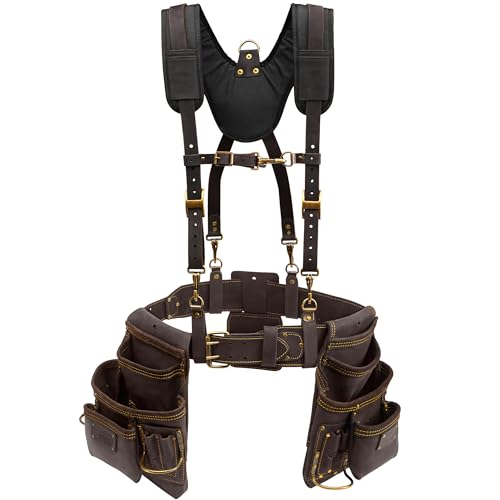
Good suspenders share two traits. The shoulder pads are at least two inches wide with real padding, not webbing straps, and they attach at four points rather than two so the belt cannot rotate. Cheap suspenders attach at two clips in front and let the back of the belt sag, which puts you right back where you started. Look for a crossed or H-back design over a simple Y, because the Y concentrates load between the shoulder blades.
Belt width matters for the same reason. A 2-inch web belt is fine for a light apron. For a loaded rig, a 3-inch belt with a contoured padded backer distributes pressure over noticeably more surface area, and that is measurable in how you feel at the end of the week.
Framing Rig: Belt with Padded Suspenders
If you carry a hammer, nails, a square, and a tape all day, buy the rig and not the belt alone. Spend on wide shoulder pads and a four-point attachment before you spend on leather grade. Expect to pay roughly two to three times what a bare hip belt costs, and expect it to be worth it if your loaded weight is above 12 pounds.
Leather, Nylon, or Suede: Pick by Trade, Not by Pride
Full-grain leather rigs break in to your body, resist punctures from screws and chisels, and last a decade or more with occasional conditioning. They also weigh two to three pounds empty before you add a single tool, they hold water, and they stiffen if you let them dry hard. Leather makes sense for framers, deck builders, and anyone who abuses gear and keeps it for years.
Ballistic nylon and polyester rigs weigh less, dry faster, cost less, and offer more pockets per dollar. The failure points are predictable: stitching at pouch corners and plastic hardware. Nylon is the right call for remodelers, electricians, HVAC techs, and anyone who works indoors or swaps pouches often. Look for 1680D or heavier fabric, bar-tacked stress points, and metal buckles rather than molded plastic on any belt you plan to load past 15 pounds.
Suede sits in the middle. It is lighter than full-grain, more comfortable against clothing, and softer on drywall and finished surfaces, which matters more than people expect on interior trim jobs. It also stains and abrades faster.
- ✔ Full-grain leather resists punctures from screws, blades, and chisels
- ✔ Nylon rigs run one to two pounds lighter empty, which is real over a shift
- ✔ Modular nylon systems let you drop pouches you are not using that day
- ✔ Suede is gentler on finished walls and cabinetry
- ✘ Leather adds significant dead weight before you load a single tool
- ✘ Plastic hardware on budget nylon rigs is the most common failure point
- ✘ More pockets encourages carrying more than the job needs
- ✘ Suspenders shift load to shoulders and neck, which is not free either
Pouch Layout and Capacity Guidance
Pouch count is a trap. Twenty pockets means you will fill twenty pockets. The useful spec is arrangement, and there are three rules worth following.
Keep the dominant hand side light. Your hammer loop, tape, and utility knife go on the dominant side. Fasteners, which are the heavy items, go on the off side so the weight balances against your swing.
Match pouch depth to your fasteners. A deep nail bag suits 16d framing nails and screws in bulk. Shallow, structured pockets suit brad and finish nail strips for 15, 16, and 18 gauge nailers, which bend and jam if they tumble loose in a deep bag. If you run a finish nailer daily, look for divided pockets sized for collated strips rather than one big cavity.
Leave the back panel clear. Anything mounted at the small of your back becomes a pressure point the moment you lean on a ladder rail or sit in a truck. Keep pouches forward of your hip bones.
On sizing, measure over your work clothes and tool belt layer, not your jeans waist. Most belts are sold in ranges, and you want your buckle landing near the middle of the range, not the last hole. If you are between sizes, size up: a belt cinched at its final hole has no adjustment left for a jacket in November.
Load Limits and How Much Weight Is Actually Reasonable
There is no OSHA rating on tool belts the way there is a duty rating on ladders, so nobody stamps a number on the box. Use these working ranges instead. Under 10 pounds is comfortable on a bare hip belt for most people. From 10 to 20 pounds you want suspenders and a 3-inch padded belt. Above 20 pounds you have stopped wearing a tool belt and started wearing a load-bearing rig, and at that point a bucket organizer or a rolling tool bag for the bulk items plus a light belt for the constant-use tools is the better setup.
A rough audit helps. A framing hammer runs about 2 pounds, a 25-foot tape about half a pound, a cordless impact driver with a compact battery about 2 to 3 pounds, and a pound of 16d nails is a pound. Two pounds of loose fasteners plus a drill plus a hammer plus a square already puts you near the suspender threshold. Weigh your loaded belt once on a bathroom scale. Most people are carrying three to five pounds they never use.
Lightweight Nylon Belt for Trim and Punch Work
For finish carpentry, cabinet install, and homeowner projects, a single-pouch nylon belt or a suede apron beats a full rig. You carry less, you snag less on door casings, and you are not hauling three pounds of empty leather. Add a separate drill holster only if you actually holster the drill instead of setting it down.
Choosing the Best Tool Belt for Your Trade
Framers and deck builders: leather or heavy nylon rig, four-point suspenders, deep bulk nail pouches, hammer loop on the dominant side. Prioritize durability and load path over pocket count.
Trim and finish carpenters: light hip belt or suede apron, divided pockets for collated brad strips, no back panel bulk, soft materials that will not mark casing or cabinets.
Remodelers and general contractors: modular nylon system with removable pouches so the rig can go from demo weight to punch-list weight in thirty seconds.
Electricians and low-voltage: tall narrow pockets for drivers and pliers, dedicated tape and lineman’s slots, and a tool belt you can wear over a harness without the two fighting each other.
Homeowners and shop users: an apron. You are not on a ladder for six hours, and a canvas apron with four pockets solves the problem for a fraction of the money.
Anyone with an existing back, hip, or disc issue: suspenders are mandatory, and consider moving fasteners and heavy items off the body entirely into a bucket organizer or a stand-up parts caddy you reposition as you work.
Frequently Asked Questions
Do tool belt suspenders really prevent back pain? They redirect load rather than eliminate it. Suspenders take weight off your hip bones and lumbar spine and move it to your shoulders and upper back, which most people tolerate far better. They help most above roughly 12 pounds of carried weight. They do not fix a rig that is simply overloaded, and they will make your shoulders sore if you keep adding tools.
Leather or nylon, if I can only buy one? Buy nylon if you work indoors, change tasks often, or want the lightest empty weight. Buy full-grain leather if you frame, work outdoors, and expect to keep the rig for many years. Nylon costs less and gives you more pouch options per dollar; leather survives more abuse and molds to you over time.
Should I hang a cordless drill or impact driver on my belt? Only if you use it constantly and it has a compact battery. A drill and holster together commonly add two to four pounds on one hip, which is the single fastest way to unbalance a belt. For occasional use, keep the driver in a bag or on a nearby surface and save the belt weight for what you reach for every minute.
Weigh your current loaded belt, remove anything you did not touch yesterday, and buy suspenders before you buy a nicer belt. That order fixes more back pain than any specific brand does.
Check prices on Amazon →