Our Top Picks

What's inside
- Base construction: the single criterion that separates good from bad
- Pocket architecture, not pocket count
- Weather resistance and what the ratings actually mean
- Suspension, load limits and the ladder problem
- Matching the bag to the work: who this is for
- Brand ecosystems and one honest warning
- Frequently asked questions
- Base construction: the single criterion that separates good from bad
- Pocket architecture, not pocket count
- Weather resistance and what the ratings actually mean
- Suspension, load limits and the ladder problem
- Matching the bag to the work: who this is for
- Brand ecosystems and one honest warning
- Frequently asked questions
As an Amazon Associate I earn from qualifying purchases. This post may contain affiliate links at no extra cost to you.
Most bags fail in the same place. The base collapses, the bag tips over on the truck floor, and every screwdriver, wire nut and connector migrates into one corner. Choosing the best tool backpack for electricians comes down to structure before it comes down to pocket count: if the bag cannot stand upright, loaded, on an uneven basement floor, nothing else about it matters. Everything else is refinement.
Electrical work is unusual in the trades because the tool list is long but individually light. You are not hauling a 90 lb rotary hammer. You are hauling forty small items that all need to be found in under five seconds, plus a multimeter that costs more than the bag, plus consumables that never stop multiplying. That combination favors backpacks over open totes, and it favors specific construction details that a general contractor’s bag does not need.
As an Amazon Associate we earn from qualifying purchases at no extra cost to you.




| Bag type | Best for | Typical pocket count | Watch out for |
|---|---|---|---|
| Molded-base backpack | Daily service and commercial rough-in | 40-60 | Weight climbs fast when full |
| Soft-bottom backpack | Light residential, trim-out, punch lists | 25-40 | Sags and tips once loaded |
| Hard-shell top compartment | Meter and tester protection | 30-50 | Less flexible for odd shapes |
| Rolling backpack hybrid | Long hospital or campus corridors | 40-70 | Wheels add weight and bulk on ladders |
| Open-top tote backpack | Fast in-and-out on one-tool calls | 15-25 | No closure means dropped contents |
Sections
- Base construction: the single criterion that separates good from bad
- Pocket architecture, not pocket count
- Weather resistance and what the ratings actually mean
- Suspension, load limits and the ladder problem
- Matching the bag to the work: who this is for
- Brand ecosystems and one honest warning
- Frequently asked questions
Base construction: the single criterion that separates good from bad
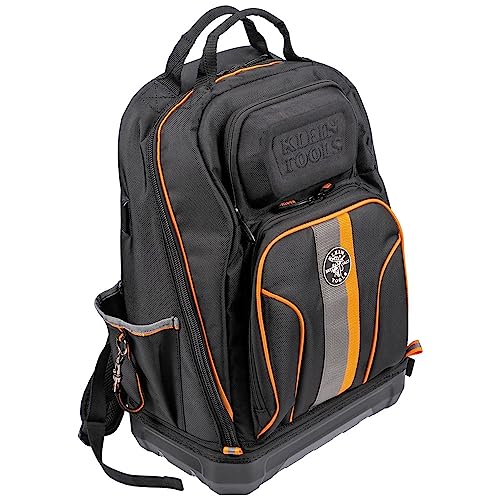
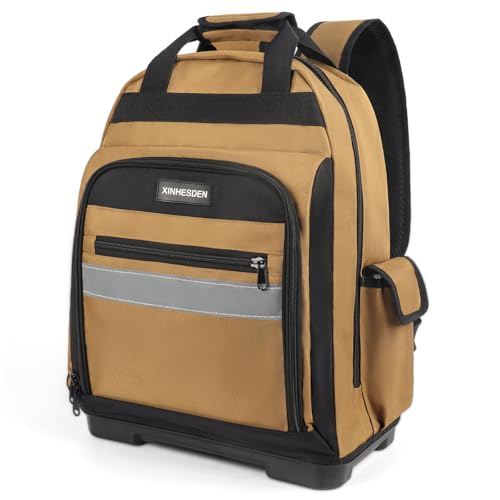
Pick up any candidate bag and press the bottom with your thumb. A molded thermoplastic base resists and holds its shape. A reinforced fabric base flexes and creases. The molded base is what lets you set the bag down in standing water in a mechanical room, drag it across a parking lot, and still have it stand up straight while you work out of it. Many quality bags use hard bases with integrated feet or runners, which raises the fabric off wet concrete.
Beyond water, the base determines whether the bag functions as a work surface. A rigid bottom plus a stiffened back panel means the pack stays open and vertical when you unzip it. Soft bags flop, and a flopped bag means digging. If a bag only has a padded bottom rather than a structural one, treat it as a light-duty option for trim work and service calls where you carry a short list.
Pocket architecture, not pocket count
Marketing copy loves a big number. Fifty pockets sounds thorough until you discover that thirty of them are identical elastic loops sized for nothing you own. What actually matters is the distribution across three zones.
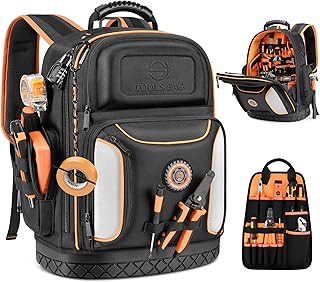
The outer front zone should hold your fast-access items: strippers, linesman pliers, a couple of screwdrivers, a voltage tester. These need open-top sleeves, not zippers. The interior main compartment should have tall, deep sleeves along both walls for nut drivers, files, and torpedo levels, plus open floor space for a hole saw kit or a small drill. The lid or top compartment is where a padded, dedicated meter pocket belongs, ideally suspended so the meter is not sitting on the base absorbing every impact.
Check the sleeve depth against a real screwdriver. Shallow sleeves let long-shank drivers tip and fall out when the bag is carried on one shoulder. Also look for at least one zippered mesh or clear pocket for consumables. Wire nuts and staples in an open pocket end up loose in the bottom of the bag within a week.
Molded-Base Electrician Tool Backpack
This is the category to shop first if you do daily service or commercial rough-in. Look for a hard thermoplastic bottom, a stiff back panel that keeps the pack upright, and 40 or more sleeves distributed across interior walls rather than crammed into the front flap. Expect to pay noticeably more than a soft bag, and expect it to outlast two or three of them.
Weather resistance and what the ratings actually mean
Bags do not carry IP ratings the way tools do, so you are judging materials and closures instead. The two numbers worth reading are fabric denier and coating. Denier describes the fiber weight of the fabric: 600D polyester is the common budget spec, 1200D to 1680D ballistic nylon is what you want on a bag that gets thrown in a truck bed. Higher denier resists abrasion and puncture from the tools inside as much as from the world outside.
For water, look for a TPU or PVC laminate on the base and lower panels, plus either a storm flap or a coated zipper on the main compartment. A weather flap over the zipper does more real-world good than a water-resistant zipper alone. If you work outdoors in the Pacific Northwest or the Southeast, budget for a separate rain cover; almost no tool backpack is genuinely waterproof at the seams.
One safety note that gets overlooked: if you work roadside, on airport ramps, or in any area governed by high-visibility requirements, your bag does not satisfy anything. ANSI/ISEA 107 applies to garments, not equipment. Reflective trim on a backpack is a nice-to-have for visibility when you set the bag down, nothing more.
Suspension, load limits and the ladder problem
A full electrician’s pack routinely lands between 25 and 40 lb once you add a cordless drill, a meter, a hole saw kit, and a day’s worth of devices. General ergonomic guidance from NIOSH and most safety programs puts sustained backpack loads at roughly 10 to 15 percent of body weight, which means the average tech is over the line before lunch. The suspension is what decides whether that shows up in your shoulders or not.
Look for contoured shoulder straps at least two inches wide with dense closed-cell foam rather than open-cell padding, a sternum strap, and a genuine load-lifter geometry where the straps attach high on the back panel. A padded, breathable back panel with air channels matters more than it sounds in an attic in July. A waist belt is useful only if it is stiff enough to transfer load; a thin webbing strap does nothing.
Then there is the ladder. A metal hook or a reinforced webbing loop on the top handle lets you hang the pack from a rung or a rail rather than climbing with 35 lb on your back, which is both a safety and a convenience issue. OSHA’s ladder rules require you to maintain three points of contact and to keep hands free for climbing, so hoisting the bag separately or hooking it is the correct method, not an optional nicety.
- ✔ Hard molded base keeps the bag upright and out of standing water
- ✔ Weight distributes across both shoulders on long walks and stair climbs
- ✔ Dedicated padded meter pocket protects your most expensive item
- ✔ Zipped closure means nothing spills when the bag tips in the truck
- ✘ Slower single-tool access than an open tote or bucket
- ✘ Easy to overload past a healthy carrying weight
- ✘ Deep main compartment can swallow small parts without organizers
- ✘ Quality molded-base bags cost multiples of a basic soft pack
Matching the bag to the work: who this is for
Service and troubleshooting techs should prioritize the meter pocket, front fast-access sleeves, and a bag that opens wide and stands on its own. You are in and out of a dozen locations a day and you want the whole kit visible at a glance.
Commercial rough-in crews should prioritize volume and base durability over pocket refinement. You are carrying more consumables and fewer precision instruments, and the bag lives on concrete and deck.
Low-voltage, data and controls techs benefit from hard-shell top compartments and clear zip pouches, since your kit skews toward testers, connectors, and small terminations that are easy to lose. Apprentices should buy the sturdiest base they can afford and accept fewer pockets; you will replace a sagging bag long before you outgrow a rigid one.
Hard-Shell Top Tool Backpack
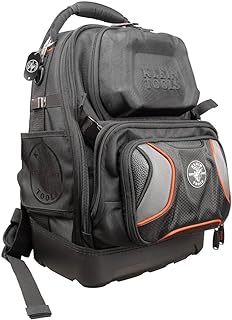
If your daily driver is a clamp meter, a multimeter and a set of testers, the hard-shell lid design earns its keep. The rigid top compartment takes the impact when the bag gets set down hard, and it separates instruments from the greasy end of your tool list. Slightly less accommodating for oddly shaped items in the main body.
Brand ecosystems and one honest warning
Most major tool lines now sell storage that matches their platform aesthetics, and several offer bags that clip into modular box systems. If you already run a stackable box system in the van, buying into the same ecosystem is legitimately convenient. Names worth searching in this space include the usual suspects behind DeWalt, Milwaukee, Makita LXT accessories, plus dedicated bag makers that have made electrician-specific packs for decades.
The warning: brand name on a bag is a much weaker quality signal than it is on a tool. Bags are commodity-manufactured, and the same factory pattern shows up under several labels with different logos and prices. Judge the base, the fabric weight, the stitching at the strap anchors, and the zipper hardware. Reinforced bar-tacking where the shoulder straps meet the body is where cheap bags fail second, right after the bottom fails first.
Rolling Tool Backpack Hybrid
Worth considering if your work means hospital corridors, university campuses, or airports where you park far from the panel. The telescoping handle and wheels solve a real problem, but you pay for it in dead weight and bulk, and the straps are usually an afterthought. Skip it if you spend real time on ladders or in crawl spaces.
Frequently asked questions
How much should an electrician’s tool backpack weigh when loaded? Aim to stay under about 15 percent of your body weight for anything you carry for more than a few minutes. For a 180 lb tech that is roughly 27 lb. Most fully loaded service packs exceed that, so the practical answer is to split your kit: a core pack plus a separate box for consumables and specialty tools that stays in the van.
Is a tool backpack better than a bucket organizer or an open tote? For anyone walking distances, climbing stairs, or working multi-story jobs, yes, because the load sits on both shoulders and your hands stay free. Buckets and totes win on single-call speed and on cost. Plenty of techs run both and load the bucket for one-off tasks.
What fabric weight should I look for? Treat 600D polyester as entry level and acceptable for light residential use. Look for 1200D to 1680D nylon on anything that rides in a truck bed or gets dragged across concrete daily, and check that the base panel has a TPU or PVC coating rather than bare fabric.
Shop the base first, the suspension second, and the pocket layout third. Get those three right in that order and the bag will still be standing upright on a wet floor three years from now.
Check prices on Amazon →