Our Top Picks
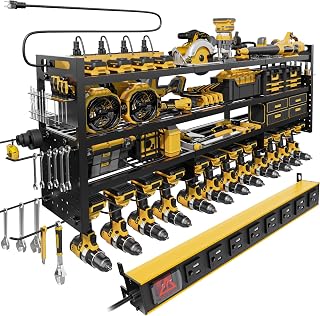
 POKIPO Large Power Tool Organizer Wall Mount withLarge8.5 x 33 x 15.7 Inches16 poundsCheck on Amazon
 Spampur Power Tool Organizer for Tool Storage3 shelves 7 slots7 x 13 x 8 inches7.7 PoundsCheck on Amazon
 STURDIFLOW Large 49'' Wide Power Tool Organizer Wall49''Width (LARGE)7.9 x 49 x 16.5 inches17 poundsCheck on Amazon
 STURDIFLOW Large 49''Wide Power Tool Organizer Wall Mount49''Width (POWER STATION)7.9 x 49 x 16.5 inches18 PoundsCheck on Amazon

What's inside
As an Amazon Associate I earn from qualifying purchases. This post may contain affiliate links at no extra cost to you.
Five drills in a milk crate and two chargers stacked on a dead pack. That is where most cordless collections end up, and it is not a tool problem, it is a wall problem. Good cordless tool wall storage answers three questions: what the fasteners and framing can actually carry, whether you can grab and return a tool one-handed, and whether the chargers get air. The rest is decoration.
Below is a format-by-format catalogue with the deciding criterion at the top of each section. Retail prices and stock move weekly, so this stays in categories and ranges.
As an Amazon Associate we earn from qualifying purchases at no extra cost to you.




Sections
Cordless Tool Wall Storage Formats at a Glance
Five formats cover almost every garage wall in the US market. They differ on load handling, how easily a holder moves after install, and how much of your weekend the build costs.
| Format | Best For | Load Handling | Main Drawback |
|---|---|---|---|
| French cleat on 3/4 in plywood | Full walls you rearrange often | Highest here when cleats land on studs | Needs a saw and a few hours |
| Slatwall panels (PVC or MDF) | A clean install in one afternoon | Rated per linear foot, so read the spec | Cheap MDF sags in damp garages |
| Pegboard (1/4 in hardboard or steel) | Drivers, blades, accessories | Light to moderate only | Thin 1/8 in board and loose hooks pull out |
| Steel track and rail | Rented walls and tall runs | Moderate to heavy at the framing | Proprietary hooks add up |
| Wall plates for modular boxes | Tools that already live in cases | All depends on the plate and fasteners | Eats wall depth |
Load Rating Is the Line Between Storage and Decor
The failure point is almost never the hook, it is the fastener and whatever sits behind the drywall. Garage framing is usually 16 inches on center, with 24 inches on center in some newer builds. Scan for studs, then confirm with a small pilot hole before you commit a row of holders. Half-inch drywall carries very little on its own, and while good hollow-wall anchors do publish ratings, those are static values measured in a test wall. Tool walls are not static, so derate anything you read.
The best upgrade is a sheet of 3/4 inch plywood lagged into the studs. It spreads load across bays and lets you move holders anywhere later. When you shop, read the number and not the adjective: credible systems publish a per-bracket rating or a uniformly distributed load per linear foot, while heavy duty means nothing at all. Weight builds fast, because a mid-torque impact wrench with a high-output pack runs into double-digit pounds.
French Cleat Hardware and Holders
Buy plywood locally and spend online on fasteners, holders, and aluminum cleat extrusion if you want to skip the bevel-ripping step. Aluminum costs more per foot than ripping your own, but it installs level and holds well.
What Each Format Actually Does Well
French cleat
Criterion: rearrangeability. A 45 degree bevel in 3/4 inch plywood, with wall cleats screwed into studs, means any holder drops on anywhere and lifts off in a second. It carries the most weight of anything here because load goes straight into framing. The cost is shop time.
Slatwall
Criterion: panel material. Extruded PVC ignores humidity and holds its rating, while low-density MDF is cheaper and eventually sags under loaded holders in an unconditioned garage. Screw into studs, not just drywall. Slatwall wins on install speed and holder selection, including cradles shaped for DeWalt XR, Milwaukee FUEL and Makita LXT tools.
Pegboard
Criterion: board thickness. Quarter-inch tempered hardboard or steel pegboard is worth using; 1/8 inch is for garden tools. Mount on furring strips so hooks clear the wall, and use locking hooks. Great for accessories and blades, mediocre for a 15 pound saw that swings as you grab it.
Steel track and rail
Criterion: how many holes you are allowed to drill. One horizontal rail lagged into studs clears a bench with minimal wall damage, which makes it the renter’s answer. Budget separately for hooks.
Wall plates for modular boxes
Criterion: whether your tools already live in stacking cases. If they do, this is the fastest grab-and-go wall there is. If not, you are buying cases to solve a storage problem plywood already solves.
PVC and Steel Slatwall Panel Kits
The pick if you want a tool wall this weekend and do not own a table saw. Confirm the listed load per linear foot, check that trim and screws are included, and pass on panels described only as composite.
- ✔ Load transfers straight into studs
- ✔ Holders move in seconds with no new holes
- ✔ Lowest cost per square foot if you rip your own
- ✔ Extend it one sheet at a time
- ✘ Wants a table saw or track saw for clean bevels
- ✘ Holders stand off the wall and cost you depth
- ✘ Not renter friendly once cleats are lagged in
- ✘ A weekend of building before anything gets stored
The Charging Wall Is Its Own Problem
Criterion: heat first, then the circuit. Chargers dump waste heat, so one sealed in a tight cubby or stacked under another will throttle or fault. Leave clearance at the vents and keep the shelf uncarpeted. Lithium-ion packs also refuse to fast charge when they are too hot or too cold, which is why a charging shelf on an interior wall beats one on an exposed exterior wall in January.
On the electrical side, look for a UL or ETL listing mark on any power strip or charging station you mount, and remember that the National Electrical Code requires GFCI protection for garage receptacles, so a permanent station belongs on a proper circuit installed by an electrician. Skip daisy-chained extension cords, and give every shelf a front lip so a pack cannot walk off onto concrete.
Wall Mount Tool Holders and Charging Shelves
The cheapest way in: a handful of individual cradles plus one vented shelf for two chargers. Choose steel brackets over molded plastic for anything carrying a large pack, and check that the screw pattern can reach a stud.
Who Each Setup Is For
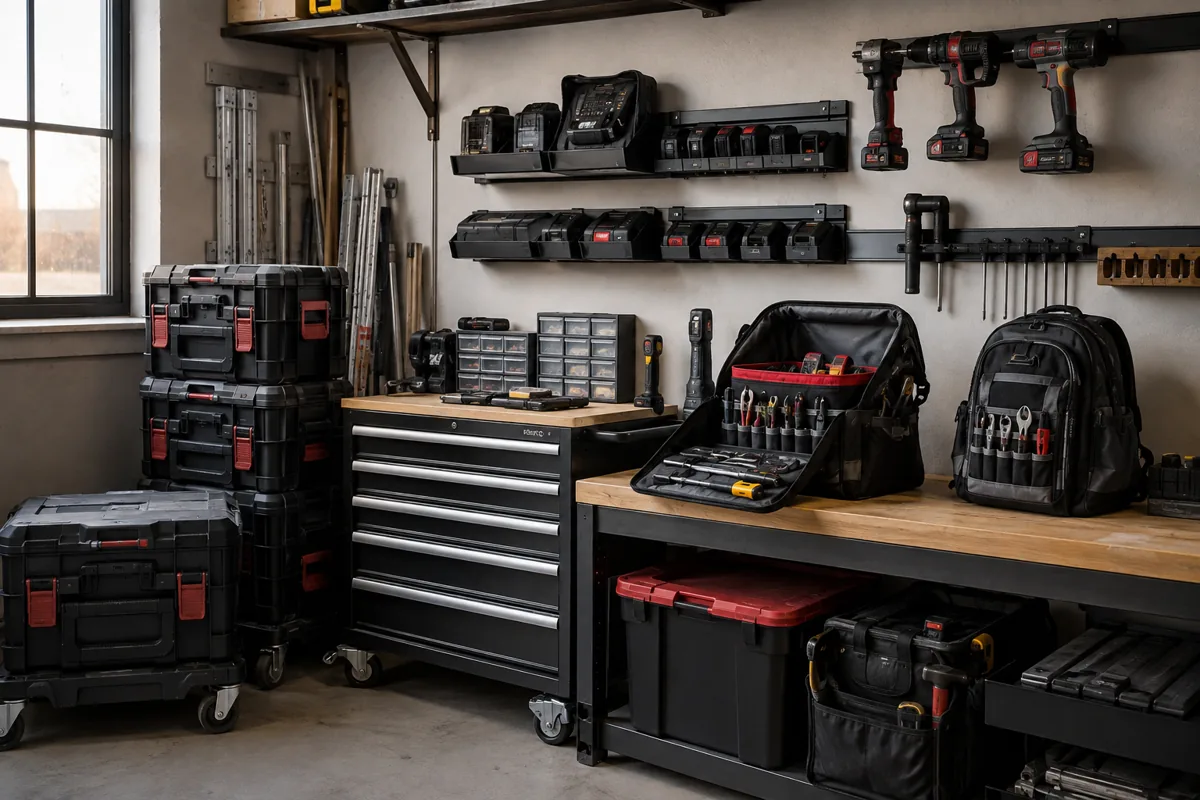
Criterion: how permanent the wall is and how often the tools leave the building. Renters and shared garages want a single steel rail or a small slatwall section, lagged into studs with a countable number of patchable holes. Two-car garage woodworkers with a growing kit get the most from plywood and French cleats, which absorb new tools without a redesign. Small basement or shed shops should choose slatwall for density. Pros loading a van each morning are better served by wall plates that hold the same stacking boxes the vehicle carries. Mixed-brand collections should stay with universal cradles rather than brand-shaped ones.
Frequently Asked Questions
Can I hang cordless tools on drywall without hitting studs? For light items such as drivers, blades, and bare packs, good hollow-wall anchors used inside their published rating will hold. For drills, circular saws, and anything with a large battery attached, find framing or add a plywood backer.
Is it safe to leave batteries on the charger all the time? Modern chargers stop and hold at a maintenance state, so it is generally fine, but heat shortens lithium-ion life. Follow your brand’s manual, keep the charger vented, and park long-term spares off the charger at a partial charge somewhere that does not freeze or bake.
Slatwall or French cleat if I build only one? Slatwall for install speed, a tidy look, and off-the-shelf holders. French cleat for maximum load, unlimited rearranging, and the lowest cost per square foot, assuming you can cut a clean bevel.
Choose the format by how permanent your wall is, verify a published load number before hanging anything heavy, and give the chargers room to breathe. A wall built on those three rules will still be working when the next battery platform lands.
Check prices on Amazon →