Our Top Picks


What's inside
As an Amazon Associate I earn from qualifying purchases. This post may contain affiliate links at no extra cost to you.
Most hole saw kits disappoint on the first real job. You open the case for a recessed light cutout and find the set jumps from 3 inches straight to 4-1/2. Or the teeth that ripped through pine stall out and turn blue two minutes into a stainless sink deck. The best hole saw kit is not the one with the most pieces in the molded tray, it is the one whose tooth material, arbor threads, and size steps match the holes you actually cut.
What follows is arranged like a catalogue rather than a leaderboard. Find the row that describes your work, buy the tightest set that covers it, and add a specialized set later. That is almost always cheaper than replacing a 20-piece kit you outgrew in a month.
As an Amazon Associate we earn from qualifying purchases at no extra cost to you.


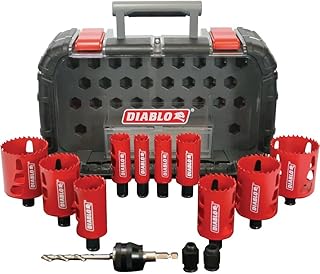


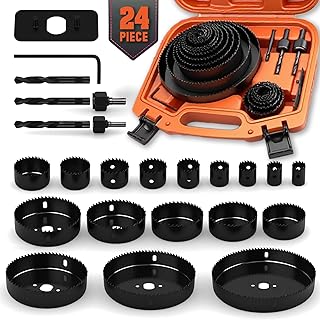
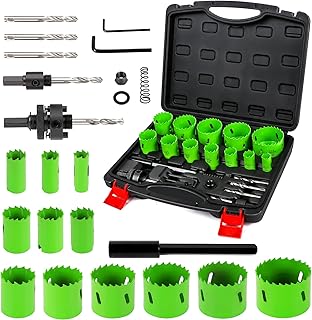
| Kit type | Tooth material | Typical size span | Who it is for |
|---|---|---|---|
| General-purpose remodel set | M3 or M42 bi-metal | 3/4 in. to 2-1/2 in., 13 to 18 pieces | Handyman work, wood, drywall, thin mild steel |
| Electrical set | Bi-metal, knockout-matched sizes | 7/8 in. to 2-1/2 in. | Box and panel knockouts, EMT and cable runs |
| Rough-in carbide set | Brazed tungsten carbide teeth | 1-3/8 in. to 4-3/8 in. | Plumbers, HVAC, nail-embedded lumber, fiber cement |
| Tile and stone set | Electroplated or vacuum-brazed diamond | 1/4 in. to 3-1/8 in. | Porcelain, glass tile, granite, stone |
| Door hardware set | Bi-metal cups plus a jig | 1 in. and 2-1/8 in. | Locksets and deadbolts to standard door prep |
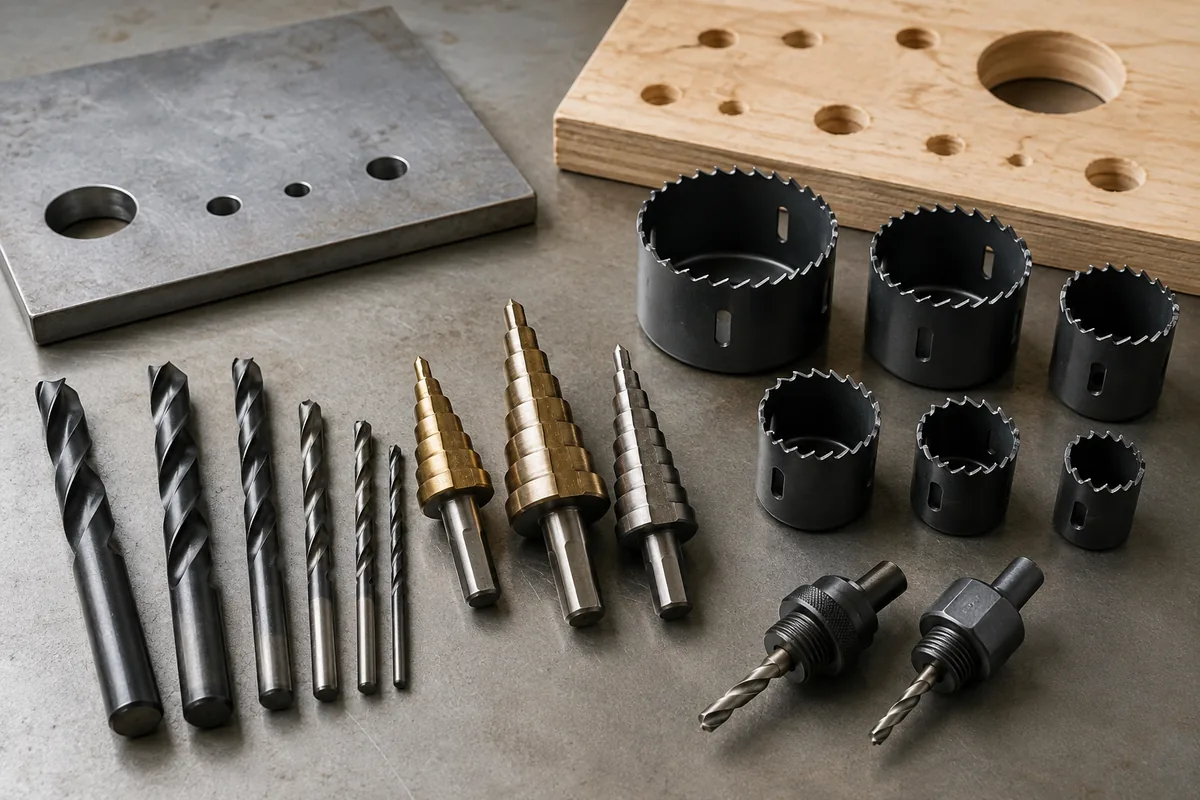
Sections
What Separates the Best Hole Saw Kit From the Rest
The dividing line is metallurgy, not piece count. Bi-metal cups are built by welding a high-speed steel tooth strip onto a tougher alloy steel body, and the grade of that strip is the whole story. M3 high-speed steel is the budget standard and is fine in wood, drywall, and mild steel. M42 carries roughly 8 percent cobalt, which holds hardness at higher temperatures, so it survives stainless, cast iron, and long runs. A kit that names the grade is telling you something. A kit that only says bi-metal usually means M3.
Tooth pitch is the second filter. Variable pitch around 4 to 6 TPI clears chips fast in wood and composites. Finer pitch near 8 to 10 TPI keeps at least three teeth engaged in sheet metal, which is what stops the saw from snatching and skipping across the surface.
Cutting depth. Standard bi-metal saws cut about 1-5/8 inches deep. That clears one 2x plate and nothing else. Doubled top plates, 4x posts, and stacked subfloor call for a deep-cut version near 2 to 2-3/16 inches, or a dedicated 4-inch-deep saw. This one spec sends more people back to the store than any other.
Arbor threads. Almost every bi-metal cup sold in the US follows the same convention: 1/2-20 threads under 1-1/4 inches, 5/8-18 at 1-1/4 inches and up. Because of that standard, a Lenox cup threads onto a Milwaukee arbor. Proprietary quick-change collars are the exception, and they tie your future replacement cups to one brand, so check before you commit.
Bi-metal general-purpose kit, 13 to 18 pieces
If you are buying one kit and next year’s work is unknown, this is the class to buy. Filter for M42 or cobalt in the description, two arbors covering both thread sizes, and slotted cups for plug removal. Skip any listing that will not print the exact diameters included.
Tooth Material Decides What You Can Cut
Bi-metal: the default
Milwaukee Hole Dozer, Lenox Speed Slot, Bosch, Starrett, and DeWalt all sell sets in this class, and the real differences are plug ejection slots, case quality, and whether the cups are M42. Expect clean work in wood, plywood, plastic, drywall, and steel up to roughly 1/8 inch. Expect a short life in tile, cast iron, or reclaimed lumber full of fasteners.
Carbide-tipped: abrasive and nail-embedded work
Brazed tungsten carbide teeth, as found in the Milwaukee Big Hawg and Diablo carbide lines, are what plumbers and HVAC installers reach for. They shrug off the occasional nail, cut fiber cement and OSB, and hold an edge well past where bi-metal quits. The tradeoff is brittleness.
- ✔ Survives nails, screws, and grit that ruin bi-metal teeth
- ✔ Holds an edge far longer in OSB, hardwood, and fiber cement
- ✔ Cuts efficiently at low rpm, which is easier on the drill
- ✘ Teeth chip if the saw binds, chatters, or gets levered sideways
- ✘ Higher cost per cup, so wide sets get expensive fast
- ✘ Overkill for occasional softwood and drywall holes
Carbide-tooth rough-in set
Worth the premium if you drill remodel framing where hidden fasteners are a fact of life. Buy the two or three diameters your rough-in actually specifies rather than a broad set, because the skipped sizes will sit in the case unused while you pay for them.
Diamond: tile, glass, and stone
Neither steel nor carbide will cut porcelain. Electroplated diamond cups are cheap and quick at first, then glaze smooth. Vacuum-brazed or sintered diamond costs more and lasts several times longer. Both want water, low speed, and hammer action switched off. Most sets run 1/4 inch to 3-1/8 inches, which covers shower valves, mixer taps, and supply lines.
Diamond hole saw set for tile and stone
Look for vacuum-brazed or sintered construction plus a guide plate or water feed in the kit. Electroplated sets are acceptable for a handful of holes in soft ceramic wall tile, but they dull quickly in porcelain and dense natural stone.
Size Steps That Match Real Holes
The criterion here is coverage of the exact diameters your trade specifies, not the spread between the smallest and largest cup.
Electrical. Knockouts follow conduit trade size, not nominal diameter: 7/8 inch for 1/2-inch conduit, 1-1/8 for 3/4, 1-3/8 for 1 inch, 1-3/4 for 1-1/4, 2 inch for 1-1/2, and 2-1/2 for 2-inch. A set missing 7/8 and 1-1/8 is not an electrical kit regardless of the label.
Doors. The ANSI A115 prep that most residential hardware is built around uses a 2-1/8 inch cross bore and a 1 inch edge bore, with a 2-3/8 or 2-3/4 inch backset. Nearly every door lock installation kit is those two cups plus a jig.
Plumbing and HVAC. Boring for PEX, 2-inch DWV, and 4-inch waste puts you in the 1 inch through 4-1/2 inch band, which is exactly where bi-metal sets end and carbide sets begin.
Lighting. Recessed can and wafer cutouts vary by manufacturer. Read the housing instructions for the cutout diameter instead of assuming 4 and 6 inches will fit.
Speed, Feed, and the Habits That Make a Kit Last
The criterion is heat. Most dead hole saws were cooked, not worn out. Use the drill’s low gear, and let diameter set the rpm: small cups in wood tolerate moderate speed, while large diameters in steel want well under 500 rpm. Manufacturers print speed charts on the case or the packaging, and they are worth reading once.
Flood any ferrous cut with cutting fluid, keep steady pressure, and never let the teeth dwell in stainless, because it work hardens the instant they stop cutting. Back out to clear chips rather than forcing the cup deeper. Keep the 1/4 inch pilot drill sharp; a dull pilot wanders and starts the chatter that chips carbide. Finally, respect the torque. A 4-inch cup that grabs will twist your wrist before you release the trigger, so use a side handle and, ideally, a drill with an anti-kickback clutch such as Milwaukee’s AUTOSTOP or DeWalt’s E-Clutch.
Hole Saw Kit FAQ
How many pieces does a kit really need? Eight to 18 covers most users. Counts above 20 are often padded with arbors, pilot bits, and diameters nobody specifies. Compare the printed size list against your work and check how many steps land in the 1 inch to 2-1/2 inch band where most rough-in happens.
Will a bi-metal kit cut a stainless sink? An M42 cobalt cup will, with cutting fluid, low rpm, and pressure that never lets the teeth idle. M3 cups can usually manage one hole in thin stainless and are finished afterward. For repeat work in stainless or cast iron, move to carbide.
Can I run hole saws in an impact driver? Only cups sold as impact rated on a hex arbor, and only in small diameters. Anything past roughly 1-1/2 inches belongs in a drill with low gear and a side handle, where the clutch and grip can absorb a bind.
Buy for the diameters on the drawing and the material under the cup, and a modest kit will outlast a bloated one. Start with a bi-metal set that names its steel grade, then add carbide or diamond when a specific job demands it.
Check prices on Amazon →