Our Top Picks
 WEN 6800-Watt Dual Fuel RV-Ready Electric Start Portable22.8 x 16.6 x 19.7 inches99.2 poundsCheck on Amazon
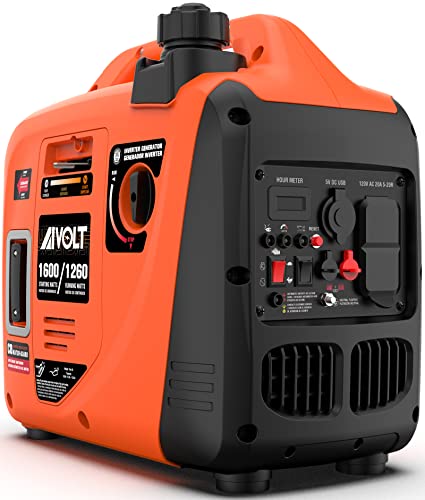 AIVOLT 1600W Super Quiet Inverter Generator 28lbs Portable16.93 x 9.92 x 15.75 inches28 poundsCheck on Amazon
 Pulsar PGD40ISCO Ultra Light Quiet 4000W Portable Gas18.9 x 11.4 x 17.3 Inches47.3 poundsCheck on Amazon


What's inside
As an Amazon Associate I earn from qualifying purchases. This post may contain affiliate links at no extra cost to you.
The generator that stalls every time your miter saw spins up was not undersized on paper. Most buyers choose a generator for power tools by adding nameplate watts together, then learn that one 15-amp saw pulls two to three times its running load for the half second the motor takes to reach speed. Total wattage is the wrong target. What matters is whether the unit can absorb the inrush of your largest single motor while the rest of your cords stay plugged in.
The second failure mode damages tools instead of tripping breakers. Battery chargers, soft-start track saws and brushless controllers are switching electronics, and they care about waveform quality in a way an old universal-motor drill never did. Shop surge capacity and power quality first. Fuel, wheels and noise come after. Here is how the size classes behave in the field.
As an Amazon Associate we earn from qualifying purchases at no extra cost to you.


| Class | Continuous Output | What It Realistically Runs | Who It Suits |
|---|---|---|---|
| Inverter 2,000-2,400W | about 1,600-1,900W | one 15A tool at a time, chargers, lights | trim and punch-list work |
| Inverter 3,500-4,500W | about 2,800-3,600W | a 15A saw plus a dust extractor | remodelers, one-person shops |
| Open frame 5,000-7,500W | about 4,500-6,500W | table saw plus compressor, some 120/240V | framing crews, deck builds |
| Open frame 8,000W and up | 7,000W and up | several 20A circuits, 240V gear | full site power, small mills |
Sections
How to Size a Generator for Power Tools
The criterion separating a right-sized unit from a frustrating one is locked-rotor draw, not the sum of the labels. Universal motors, the kind in circular saws, routers and grinders, spike briefly to roughly 1.5 to 2 times running watts. Induction motors in contractor table saws, dust collectors and air compressors are the real problem, with locked-rotor current commonly three to six times the running figure. Size to the largest single surge plus the running watts of everything that stays energized, then add 20 to 25 percent headroom.
Two derating factors get skipped. Engines lose roughly 3 percent of output per 1,000 feet of elevation, and spec sheets quote both a continuous rating and a short-term maximum good for about 30 minutes. Buy on the continuous number.
| Tool | Typical Running Watts | Typical Startup Surge |
|---|---|---|
| 7-1/4 inch circular saw | 1,400-1,900 | 2,000-3,000 |
| 10 to 12 inch miter saw | 1,500-2,000 | 2,500-3,500 |
| Contractor table saw at 15A | 1,800-2,200 | 3,500-5,000 |
| Pancake air compressor | 1,200-1,600 | 2,000-3,500 |
| Dust extractor or shop vacuum | 900-1,400 | 1,200-2,000 |
| Two cordless chargers | 150-400 | negligible |
Compact Inverter, 2,000-2,400W Class
The size that lives in a truck bed and runs one corded tool at a time alongside a bank of chargers. Right for finish work and lighting, wrong for anything with a big induction motor.
Power Quality: THD Protects Your Chargers
The dividing line is published total harmonic distortion at rated load. Inverter generators typically list under 3 percent, the best under 1.5 percent, comparable to household power. Conventional open-frame units regulated by an AVR often sit in the 8 to 25 percent range and distort further during load steps. Many lithium chargers read that waveform, throw a fault and refuse to charge. Others charge anyway, run hot and fail early.
Check voltage regulation and frequency stability too. Plus or minus 5 percent voltage and 60 Hz within a few hertz is reasonable. A THD figure quoted at no load only is marketing.
Outlets, Breakers and GFCI Protection
Count circuits, not receptacles. Two duplexes fed by a single 20-amp breaker still give you 20 amps total, which is one saw. Look for NEMA 5-20R T-slot duplexes on separate breakers, an L5-30R twist-lock for a 30-amp 120V feed, and a 14-50R on larger frames if 120/240V is ever in the plan.
OSHA 1926.404(b)(1)(ii) requires ground-fault protection for 125-volt, 15, 20 and 30-amp receptacle outlets on construction sites, so onboard GFCI saves carrying an inline unit. Full-panel GFCI covers every outlet instead of one duplex. Neutral bonding decides whether a GFCI holds, and floating-neutral designs are common on inverters meant for transfer-switch use. NEC 250.34 lets a portable generator skip a grounding electrode when it feeds only cord-and-plug loads through its own receptacles, with metal parts bonded to the frame.
Mid-Size Inverter, 3,500-4,500W Class
The sweet spot for remodel work and small shops: surge for a 15-amp saw with a dust extractor beside it, clean enough power for batteries. Favor two separately breakered 20A duplexes and a 30A locking outlet.
Fuel, Runtime and Noise Ratings
Runtime claims mean nothing without the load percentage attached. Most are quoted at 25 or 50 percent, and jobsite duty is intermittent enough that real runtime often beats the label. Compare tank size against fuel burn at 50 percent load. Dual-fuel units store indefinitely on propane and run cleaner, at a cost of roughly 10 percent output. Electronic fuel injection earns its price if the machine sits between jobs, because stale gas in a carburetor is the most common no-start on site.
Noise is quoted in dB(A) at 23 feet, the industry convention, so any other distance is not comparable. Enclosed inverters at part load usually land in the high 50s to low 60s, while open frames run in the 70s, loud enough to matter on occupied remodels and under municipal noise limits.
Safety Certifications Worth Insisting On
Carbon monoxide shutoff is the one certification to require. Look for compliance with ANSI/PGMA G300 or UL 2201, marketed as CO Shield, CO Detect or CO Guard. Those systems kill the engine as CO accumulates, but they are a backstop, not permission. Never run a generator in a garage, breezeway or near an open window. Confirm EPA and, for California, CARB compliance.
Cords belong in the same conversation. For a 15-amp tool, 12 AWG is the minimum at 50 to 100 feet and 10 AWG better beyond that. Keep voltage drop under 3 percent, since chronic undervoltage kills motors more quietly than any surge, and run cords uncoiled because a reel traps heat.
- ✔ Inverter models publish under 3 percent THD, safe for chargers and brushless electronics
- ✔ Engine speed tracks load, cutting part-load noise and fuel burn
- ✔ Compact enough for a truck bed and a one-person lift
- ✘ Higher cost per watt than an equivalent open-frame unit
- ✘ Small inverters lack the 240V and high-amp outlets a framing crew needs
- ✘ Enclosed bodies run hotter and are harder to service on site
Dual-Fuel Open Frame, 7,000W Class
For load lists that include a table saw, a compressor cycling on its own schedule and a 240V outlet. Expect real weight and 70-plus dB(A), and verify GFCI receptacles plus CO shutoff before buying.
Frequently Asked Questions
Will a 2,000-watt generator run a table saw? Usually not. A 15-amp contractor saw draws 1,800 to 2,200 watts running and can surge well past 3,500 on startup. A 2,000-watt inverter delivers roughly 1,600 to 1,900 watts continuous, so expect trips. Treat the 3,500-watt class as the minimum and 4,500 as comfortable.
Do cordless chargers really need an inverter generator? They are the most common casualty of dirty power. Chargers across the DeWalt XR, Milwaukee FUEL and Makita LXT lines can fault or throttle on a high-THD waveform. If your load is mostly batteries and lights, an inverter is the safer buy even at lower wattage.
Can I plug a generator into my house to run shop tools? Only through a transfer switch or interlock installed by an electrician. Backfeeding a dryer outlet energizes the utility drop, which is a lethal hazard and a code violation, and a transfer switch changes neutral bonding requirements as well.
Match the machine to the largest motor you own, demand a published THD number if batteries will be plugged in, then pick the size class that fits how you move tools between jobs.
Check prices on Amazon →