Our Top Picks

What's inside
As an Amazon Associate I earn from qualifying purchases. This post may contain affiliate links at no extra cost to you.
You wear a tool belt for eight hours — it’s arguably the most personal piece of gear you own. The right one balances the load, keeps your most-used tools where your hand expects them, and doesn’t dig into your hips. Here’s what we look for.
Every belt looks comfortable on the peg hook, because none of them are loaded there. Hang a hammer, an impact driver, a tape, a pouch of fasteners and a speed square on a cheap rig and it sags, rotates, and settles onto the two spots on your pelvis least able to take pressure. Choosing the best tool belt for a long day has less to do with pocket count than with where the weight ends up and what holds it there.
As an Amazon Associate we earn from qualifying purchases at no extra cost to you.


This guide walks the criteria the way a good counter conversation would: what genuinely changes how your back feels at four in the afternoon, and what is just marketing. Most working carpenters end up with two rigs, a full belt and something light, and that is usually the right answer.
Sections
Suspenders Change Everything
The single biggest comfort upgrade is moving weight off your hips and onto your shoulders with suspenders. If you carry a full belt all day, this alone prevents a lot of lower-back pain.
The criterion that separates good from bad: the load rides on your shoulders and rib cage instead of hanging off the crest of your hip bones. Everything else on a belt is convenience.
The mechanics are simple. A hip-only belt has to be cinched tight enough to fight gravity, so it compresses your waist, tightens your breathing on a ladder, and tips your pelvis into an arch your lower back spends the day resisting. Suspenders let you run the belt a notch looser, and a belt that can breathe stops chafing, stops pinching when you kneel, and stops creeping down every time you climb.
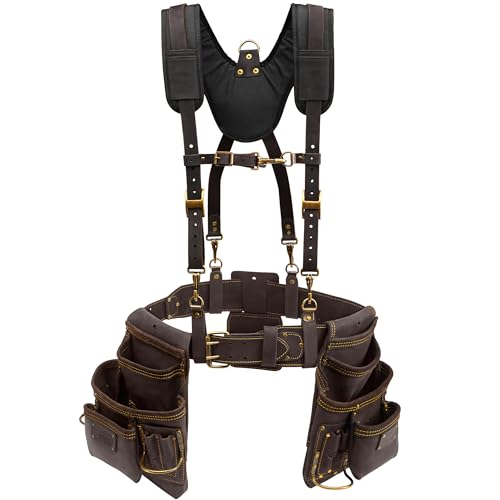
In the suspender itself, look for wide padded shoulder pads rather than bare webbing, because narrow straps concentrate the load on your traps until your arms go numb. An H-back or X-back stays put better than a Y-back when you are bent over. Elastic should have give without bounce, so a hammer swing doesn’t set the whole rig moving. Check the attachment: clips that hook over the belt edge are fast to remove and quick to pop off when you crouch, while loops threaded through the belt or clipped to dedicated D-rings stay connected. If you wear a fall-protection harness, route the straps so nothing shifts the harness off its load points.
Who should skip them: anyone strapping on a light pouch for an hour of punch-list work, and anyone spending the day in attics or crawl spaces where shoulder straps snag on framing. Carry a loaded belt for a full shift and you want them.
Leather Tool Belt with Suspenders
Balanced pouches, real leather that breaks in instead of falling apart, and suspenders that take the load off your hips. The kind of belt you’ll still be wearing in ten years.
- ✔ Suspenders save your back
- ✔ Durable leather
- ✔ Smart pouch layout
- ✔ Breaks in over time
- ✘ Heavier empty than nylon
- ✘ Leather needs occasional care
Nylon vs Leather
Nylon is lighter and cheaper; leather lasts longer and carries better once broken in. For daily pros, leather with suspenders wins. For weekend work, quality nylon is plenty. Round out your kit with proper work gloves.
The criterion that separates good from bad: whether the pouch mouth still holds its shape when the pouch is full. A collapsed pouch turns every tool grab into a two-handed fumble.
Leather earns its reputation because thick, oil-tanned hide is stiff enough to hold a mouth open and soft enough to mold to your body. Getting there takes a couple of weeks of wear, so the break-in is real rather than folklore, and after that the pouches stay where you put them. Inspect hide thickness at the belt, since thin floppy leather is the tell of a cheap rig, then look for rivets at every corner that takes load and doubled stitching along the top edge of each pocket.
Good nylon does two things leather cannot: it comes off the hook light, and it shrugs off water without care. Heavy ballistic weave with molded or stiffened pouch mouths holds shape nearly as well as leather, and modular systems let you slide pouches on and off a padded belt so you carry only what the day needs. The failure modes are stitching that pulls out at the pouch corners, thin fabric that abrades where a driver bit rides, and plastic buckles that flex under a loaded rig.
The Details That Decide It
The criterion that separates good from bad: hardware and geometry before capacity. What to put your hands on before you pay:
- Belt width and stiffness. A wide, contoured belt with an internal stiffener spreads load; a flat strap folds and concentrates it. Very wide belts dig into your ribs if you kneel all day.
- Buckle. Roller buckles are simple and hold their setting. Cam or quick-release buckles let you drop the rig and put it back at the same tension.
- Sizing. Measure over your work clothes at the height the belt will actually sit, and land in the middle of the adjustment range, not the last hole.
- Pouch shape. A few deep, tapered pockets with firm mouths beat a wall of shallow ones you cannot see into.
- Stress points. Rivets, bar tacks and doubled stitching wherever hammer loops, D-rings and suspender points attach. Cheap belts fail here first.
- Repairability. Replaceable pouches and available hardware mean you rebuild one section instead of buying the whole rig again.
Weigh them in that order. Belt, buckle and suspenders are what your body feels, so they come first, layout second, material third, and capacity last, because capacity is the one spec that punishes you for buying too much of it.
Layout: Put the Weight Where Your Hands Already Go
The criterion that separates good from bad: every pouch you don’t empty in a normal day is dead weight you carry all day.
Set tools on your dominant side, fasteners on the other, and leave the front of your hips clear, because front pouches catch ladder rungs and press into your thighs the moment you kneel. Pull the bags back toward your hip pockets and let your hands come to them. Balance counts as much as position, so hang the heaviest bag opposite the hammer loop and the belt stops rotating. Standing at a bench all day? Take the rig off and hang it.
What Changes as You Move Up the Range
Entry level
Light nylon, stamped hardware, single-row stitching, no suspenders. Fine for occasional Saturday work or a light trim pouch. What you give up is pouch mouths that collapse, buckles that flex and stitching that opens at the corners once real weight goes in.
The middle
The sweet spot for most people: heavy nylon or a decent leather belt, riveted stress points, a padded belt, and suspenders either included or offered as an add-on. Plenty of mid-range rigs hold up to full-time use. Check that the suspender attachment points are built in rather than an afterthought.
Top of the range
Thick, well-tempered leather or pro-grade modular nylon, hand-set rivets, replaceable hardware, a rig you rebuild instead of replace. Worth it if you wear a belt daily for years. Skip it if your belt lives on a garage hook, where that money does more good in a better cordless kit.
Mistakes That Cost You Comfort
- Buying by pouch count. Pockets are cheap to add and expensive to carry. Load only what the day’s work needs.
- Cinching the belt tight to stop the sag. That is the suspender’s job, and a tight belt is how you end up with numb hips.
- Wearing it on your waist. A tool belt rides on the hips; up on the waist it fights your ribs and your breathing.
- Judging leather in week one. A stiff new belt is supposed to be stiff, and drowning it in oil to speed things up leaves it limp.
- Storing it loaded. Empty the pouches and dry the belt away from direct heat, or it takes a permanent set around whatever you left inside.
Frame or remodel full time and leather with suspenders is the answer. Run trim, cabinets or service work and a light two-pouch setup, or a rig you can strip to one bag, will treat you better than a full framer’s belt.
FAQ
Do I still need suspenders if my belt fits well?
If the belt is loaded and you wear it for hours, yes. Fit keeps a belt from sliding, but the whole load still hangs off your hip bones. Suspenders move part of that weight to your shoulders and let you wear the belt looser, which is where the comfort comes from.
How many pouches do I actually need?
Most carpenters work out of two bags plus a hammer loop and a tape clip: tools on the dominant side, fasteners on the other. Add a third only when you can name what lives in it every day.
Should I buy a tool belt in my pants size?
No. Measure around your hips over the clothes you actually work in, at the height the belt will sit, and choose a size that puts you near the middle of its adjustment range. Sizing varies between makers, so trust the measurement rather than the label.
Can I wash a nylon tool belt?
Empty it, brush out the sawdust, sponge it with mild soap and water, then air dry out of the sun. Heat and machine drying are what kill stiffeners and stitching. Leather gets a wipe-down and occasional light conditioning instead, never a soak.