Our Top Picks


What's inside
- Cordless Nailer Categories at a Glance
- Framing Nailers: Nail Diameter and Head Style Come First
- The Best Cordless Nailer for Finish Work: 15, 16 or 18 Gauge
- Firing Systems: Why Two Guns With the Same Gauge Feel Different
- Matching the Gun to the Job: Ratings and Capacities to Check
- Frequently Asked Questions
- Who Should Buy What
- Cordless Nailer Categories at a Glance
- Framing Nailers: Nail Diameter and Head Style Come First
- The Best Cordless Nailer for Finish Work: 15, 16 or 18 Gauge
- Firing Systems: Why Two Guns With the Same Gauge Feel Different
- Matching the Gun to the Job: Ratings and Capacities to Check
- Frequently Asked Questions
- Who Should Buy What
As an Amazon Associate I earn from qualifying purchases. This post may contain affiliate links at no extra cost to you.
Most people who go shopping for the best cordless nailer come back with the wrong tool, because “nailer” is not one product. A framing gun and a brad gun are as different as a circular saw and a jigsaw. Buy an 18-gauge brad nailer for a deck ledger and the fasteners will not hold. Buy a framing nailer for shoe molding and you will blow through the trim and split every miter.
The separating criterion in this category is fastener size, and it drives everything else: gauge, nail length range, magazine style, tool weight and price bracket. Pick the fastener first, then pick the gun. Everything below is organized that way.
As an Amazon Associate we earn from qualifying purchases at no extra cost to you.






Sections
- Cordless Nailer Categories at a Glance
- Framing Nailers: Nail Diameter and Head Style Come First
- The Best Cordless Nailer for Finish Work: 15, 16 or 18 Gauge
- Firing Systems: Why Two Guns With the Same Gauge Feel Different
- Matching the Gun to the Job: Ratings and Capacities to Check
- Frequently Asked Questions
- Who Should Buy What
Cordless Nailer Categories at a Glance
Lead with this table. If you can find your project in the right-hand column, you already know which section to read.
| Nailer type | Gauge / collation | Typical nail length | Best for |
|---|
| Nailer type | Gauge / collation | Typical nail length | Best for |
|---|---|---|---|
| Framing | .113-.131 in. full round or clipped head | 2 in. to 3-1/2 in. | Walls, decks, subfloor, sheathing, fences |
| Metal connector | .131-.148 in. short nails | 1-1/2 in. to 2-1/2 in. | Hurricane ties, joist hangers, straps |
| 15-ga finish (angled) | 15 gauge, angled strip | 1-1/4 in. to 2-1/2 in. | Door casing, stair parts, thick baseboard |
| 16-ga finish (straight) | 16 gauge, straight strip | 1-1/4 in. to 2-1/2 in. | General trim, jambs, chair rail |
| 18-ga brad | 18 gauge | 5/8 in. to 2-1/8 in. | Shoe molding, small trim, cabinet face frames |
| 23-ga pin | 23 gauge headless pins | 3/8 in. to 1-3/8 in. | Delicate molding, glue-up clamping, no visible hole |
| Crown stapler | 18-ga narrow crown | 1/2 in. to 1-1/2 in. | Cabinet backs, drawer bottoms, underlayment |
Framing Nailers: Nail Diameter and Head Style Come First
For framing, the criterion that separates a usable gun from a returned one is whether it drives the nail your inspector expects. Check local code and the plan sheet before you buy. Some jurisdictions require full round head nails; clipped head and offset round head are accepted in others. Cordless framing guns generally run paper-collated or plastic-collated strips at 30 to 34 degrees, and the collation type limits which nails you can buy locally.
The second criterion is depth of drive into engineered lumber. Cordless framers from the major platforms will sink 3-1/2 in. nails into dimensional softwood all day, but LVL, PSL and dense old-growth are where weaker tools stall and leave proud heads. If you are sheathing and building walls, a mid-tier gun is fine. If you are hanging beams and nailing into engineered lumber, buy up.
Weight matters more than spec sheets suggest. Cordless framers typically land in the 8 to 11 lb range with a battery, and you feel every pound overhead when nailing blocking or rafters. Look at balance, not just the number. Also check sequential versus bump fire: bump mode moves sheathing fast, sequential is what you want for safety and precision. Any framing gun worth buying has a switchable trigger.
Cordless Framing Nailer (30-34 degree, 3-1/2 in. capacity)
Buy on the battery platform you already own, and confirm the tool takes the nail collation your local lumberyard actually stocks. Look for 3-1/2 in. capacity, a switchable sequential/bump trigger, tool-free depth adjustment and a dry-fire lockout. Ignore “nails per charge” marketing claims and check the weight with a battery installed, because that is what your shoulder will notice by mid-afternoon.
The Best Cordless Nailer for Finish Work: 15, 16 or 18 Gauge
This is where most buyers get stuck. The gauge number is the nail’s thickness, and it runs backwards: lower gauge means a thicker nail with more holding power and a bigger hole to fill.
15 gauge, angled. The strongest of the finish guns. The angled magazine gets into inside corners and along stair skirts where a straight gun will not fit. Use it for exterior door casing, jamb installs, heavy 5/4 baseboard and stair treads. It leaves the largest hole of the three, so plan on filling.
16 gauge, straight. The best single-gun compromise for interior trim. Enough holding power for baseboard, casing and chair rail, with a smaller hole than 15 gauge. If you are buying exactly one finish nailer for remodeling work, this is usually it.
18 gauge brad. Minimal splitting, tiny hole, and not much holding power. Perfect for shoe molding, cabinet trim, small returns, thin stock and anything you are also gluing. Not adequate on its own for structural trim or anything that gets bumped.
A practical setup for a trim carpenter is a 16-gauge finish gun plus an 18-gauge brad gun. A cabinet installer often runs 18-gauge brad plus 23-gauge pin. Nobody needs all five on day one.
16-Gauge Straight Finish Nailer, Cordless
If you install baseboard, casing and door jambs, this is the gauge to own first. Prioritize a no-mar tip that stays attached, a clear depth dial you can turn with gloves on, and a nose profile slim enough to reach into a coped corner. Also check the nail length range: many 16-gauge guns top out at 2-1/2 in., which is what you want for hitting studs through 1/2 in. drywall and thick trim.
Firing Systems: Why Two Guns With the Same Gauge Feel Different
Cordless nailers use three broad approaches, and this is the criterion that decides whether the tool annoys you daily.
Fuel cell plus battery. The original cordless system. Light and compact, but you buy consumable gas cartridges, performance can drop in cold weather, and there is a warm-up cycle. Still popular for framing because of the weight advantage.
Battery-only, motor and flywheel. The mainstream choice now across DeWalt XR, Milwaukee FUEL and Makita LXT lines. No gas, no compressor. Some designs have a brief spin-up before the first shot; others hold the flywheel ready and fire instantly but drain a little standby power. Read reviews specifically about lag time if you are doing production trim.
Battery plus internal air spring or nitrogen chamber. Effectively a sealed pneumatic. These tend to fire with zero delay and a familiar recoil, which trim carpenters like. They are often heavier at the nose.
Ranked by what actually causes returns: firing lag, dry-fire lockout that engages too early and wastes nails, jam clearing that requires an Allen key, and a no-mar tip that falls off and disappears into the sawdust.
- ✔ No hose, no compressor, no extension cord
- ✔ One battery platform covers nailer, saw and drill
- ✔ Instant setup for punch-list and one-nail jobs
- ✔ Quieter on occupied job sites than a compressor
- ✘ Heavier and more nose-heavy than a pneumatic gun
- ✘ Costs two to three times a comparable pneumatic
- ✘ Some models have noticeable spin-up delay on the first shot
- ✘ Battery adds bulk in tight cabinet interiors
- ✘ Repairs are more involved than a seal kit
Matching the Gun to the Job: Ratings and Capacities to Check
Before you check out, confirm these numbers on the spec page rather than guessing.
Maximum nail length. A framing gun that stops at 3 in. cannot do 3-1/2 in. work. A brad nailer that stops at 1-1/4 in. is nearly useless for anything but the thinnest stock. Buy at the top of the range in each category, since it costs little extra.
Magazine capacity and load style. Two-strip magazines mean fewer reloads on sheathing. Rear-load versus side-load changes how fast you clear a jam.
Collation angle. A 21-degree gun and a 30-degree gun take different nails. Match the angle to what your supplier stocks, or you will be ordering fasteners online forever.
Metal connector capability. Standard framing nailers cannot fire the short, thick nails that joist hangers require and cannot reach every hole in a hanger plate. That is a separate tool. Do not substitute.
Battery size. Compact 2.0 Ah packs keep a trim gun nimble; framing guns pull hard and generally want 4.0 Ah or larger. Nailers are usually sold both bare and as kits, and buying bare is the cheaper path if you already own packs.
18-Gauge Cordless Brad Nailer
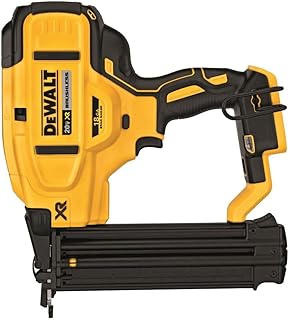
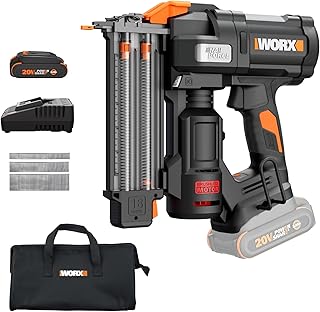
For homeowners, this is the one to start with. An 18-gauge brad gun handles shoe molding, small casing, picture frames, cabinet trim and light assembly work without splitting narrow stock. Look for a 2 in. or 2-1/8 in. maximum length, a jam release you can open without tools, and an LED that lights the workpiece rather than blinding you. Pair it with wood glue for any joint that needs real strength.
Frequently Asked Questions
Is a cordless nailer strong enough to replace a pneumatic gun? For nearly all trim and general framing in dimensional lumber, yes. The gap shows up in high-volume production work, where pneumatic guns are lighter, cheaper per tool and fire endlessly without battery swaps. Roofing and high-cycle sheathing crews still lean on hoses. For remodeling, punch lists, and anyone tired of dragging a compressor into a finished house, cordless wins on convenience.
Can one nailer do both framing and trim? No, and it is not worth trying. Framing nails are roughly .113 to .131 in. thick with heads that are designed to be visible; finish nails are thin with heads meant to disappear under filler. No magazine accepts both. If budget forces one purchase, buy the gun matching the work you do most, and rent or borrow for the other.
How do I choose between 16-gauge and 18-gauge for baseboard? Thickness of the trim decides it. For standard 1/2 in. to 5/8 in. MDF or pine baseboard going into studs, 16 gauge with 2 in. to 2-1/2 in. nails is the reliable choice. For 3/4 in. or thicker hardwood base, consider 15 gauge. Reserve 18-gauge brads for shoe molding, quarter round and returns where splitting is the bigger risk than pull-out.
Who Should Buy What
If you build structure, start with a framing nailer and add a metal connector nailer when you first meet a joist hanger. If you install trim for a living, start with a 16-gauge finish gun, add an 18-gauge brad, and add 15-gauge angled when you are hanging doors regularly. If you are a homeowner improving your own house, the 18-gauge brad nailer earns its keep first and a narrow crown stapler second. Buy on the battery platform already in your shop, buy the gun that takes locally stocked nails, and buy at the top of each length range.
Check prices on Amazon →