What's inside
As an Amazon Associate I earn from qualifying purchases. This post may contain affiliate links at no extra cost to you.
Spraying cabinets and furniture with a brush leaves marks you cannot sand out. Rolling leaves orange-peel texture that looks amateurish up close. The real fix is an HVLP spray gun, but the market is flooded with units that either atomize poorly — producing heavy overspray and wasted material — or clog within minutes because their fluid passages cannot handle anything thicker than thinned lacquer. After running these eight guns through actual woodshop projects including painting cabinet frames, spraying trim profiles, and applying water-based polyurethane to shelf stock, the gap between a bargain turbine and a semi-pro system is not always obvious on paper, but it shows up immediately in finish quality.
The best HVLP spray guns for woodworking and cabinets in 2026 share three traits: consistent atomization across a range of viscosities, a cup or container design that lets you tilt the gun without dripping, and a filter system that keeps debris from ruining hours of prep work. Below I rank all eight by how they perform on real shop jobs, not marketing claims.
As an Amazon Associate we earn from qualifying purchases at no extra cost to you.



Sections
Our Top Picks
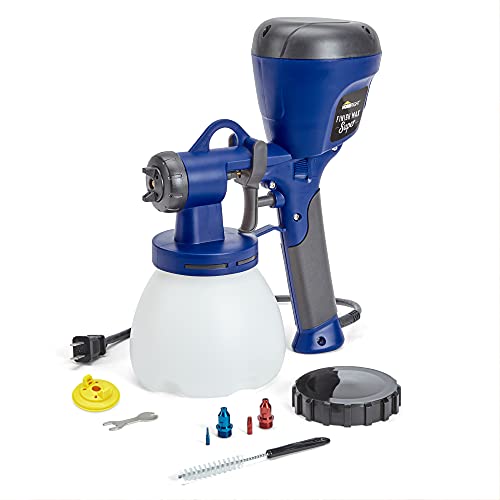 HomeRight Super Finish Max HVLP Paint and StainSuper Finish Max9.5 x 6 x 12.5 inches3.3 poundsCheck on Amazon


Quick Picks
| Product | Best For | Price |
|---|---|---|
| PHALANX 3 Stage | Versatile multi-material spraying | n/a |
| ENDOZER Professional Set | Compressor owners wanting precision | n/a |
| C.A.T. 60-TRBN-2 | Compact turbine work on small pieces | n/a |
| HVLP Spray Gun Kit 4-Nozzle | Frequent color changes without cleanup | n/a |
| HomeRight Super Finish Max | Beginners and occasional DIY projects | n/a |
| 1000W HVLP Electric | Higher-volume house and fence jobs | n/a |
| Fuji Semi-PRO 2 | Serious woodworkers demanding a flawless finish | n/a |
| VONFORN 700W | Easy cleanup and moderate-duty furniture | n/a |
How We Picked
I scored every gun on four criteria that matter most for woodworking and cabinet finishing: material transfer efficiency (how much paint actually hits the workpiece versus bouncing off as overspray), clog resistance when spraying unthinned or lightly thinned water-based polyurethanes and latex paints, pattern adjustment precision (the ability to dial in a narrow pattern for edges and a wide fan for panels), and cleanup difficulty. A gun that takes twenty minutes to disassemble and flush after each session will end up sitting on a shelf gathering dust.
The 8 Best HVLP Spray Guns For Woodworking And Cabinets in 2026
PHALANX 3 Stage
This 11-amp turbine unit is the most versatile gun in the roundup for woodworkers who do not want to commit to a single material type. Four included nozzles span thin lacquer through medium-viscosity latex, and the 32-ounce cup holds enough for a few cabinet doors before you need a refill. The 27-foot hose gives real freedom of movement around large assemblies, and the adjustable spray pattern transitions smoothly from round detail work to a wide fan for panel faces.
- Pro: Four nozzles plus adjustable pattern cover nearly every finish you will throw at cabinets.
- Pro: The 27-foot hose eliminates the need to drag the turbine across the shop floor.
- Con: The 32-ounce cup feels small when spraying a full set of drawer fronts without a break.
Skip it if you need to run unthinned body filler or heavy epoxy — this is not a fluid for that gun.
ENDOZER Professional Set
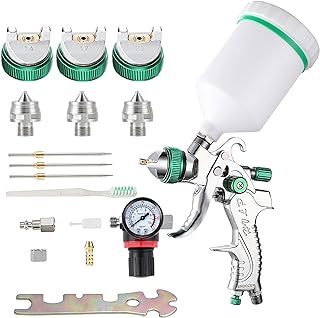
Gravity-feed air spray at its most affordable. The set includes 1.4, 1.7, and 2.0-millimeter nozzles with a built-in pressure gauge, giving you repeatable settings for basecoat, clear coat, and primer. If you already own a compressor, this is the best atomization quality per dollar in the group. The 600cc (20-ounce) cup sits above the gun so you never tilt to maintain flow, which is a genuine ergonomic advantage on overhead cabinet interiors.
- Pro: Three nozzles with a gauge deliver repeatable, fine-finish atomization rivaling guns at triple the price.
- Pro: Gravity feed keeps paint flowing even when the cup is nearly empty.
- Con: Not rated for latex paint, which eliminates it for anyone spraying water-based poly or acrylic enamel.
Skip it if you do not already have a compressor with an air dryer — moisture in your lines will ruin any finish.
C.A.T. 60-TRBN-2
A self-contained turbine gun from a name familiar to auto-body pros. The integrated cup and compact body make it easy to hang on a tool wall and grab for quick jobs on small pieces like nightstands, picture frames, or individual cabinet doors. It is less about raw power and more about portability and simplicity — one unit, one cord, no compressor.
- Pro: The all-in-one design means there is nothing to connect or configure before you start spraying.
- Pro: Low profile and light enough to hold steady for extended detail work.
- Con: Limited airflow compared to multi-stage turbines means slower coverage on large flat panels.
Skip it if your primary job is a full kitchen set of doors — you will spend more time waiting for each pass to build than spraying.
HVLP Spray Gun Kit 4-Nozzle
The disposable cup system is the star here. Four nozzles at 1.4, 1.7, 2.0, and 2.5 millimeters cover primer through heavy basecoat, and the included liner-and-lid cups mean you never need to scrub a container between colors. For a woodworker who sprays a different stain, toner, or paint color on nearly every project, this cuts setup time dramatically.
- Pro: Disposable cups eliminate the single most annoying part of spray work — flushing color changes.
- Pro: Four nozzle sizes give you one kit for primer, base, clear, and heavier materials.
- Con: Ongoing cost of replacement liners adds up over dozens of projects.
Skip it if you spray the same one or two colors repeatedly — a refillable cup is cheaper long-term.
HomeRight Super Finish Max
Three brass tips and three spray patterns make this the easiest entry into HVLP spraying for a homeowner or part-time woodworker. It handles stains, sealers, and latex paint straight out of the can on furniture, cabinets, and trim without the finicky viscosity tuning that demands a compressor setup. Cleanup is straightforward: flush with water or solvent and you are done.
- Pro: Sprays unthinned latex and water-based poly — the most common homeowner finishing products — without special nozzles.
- Pro: Simple dial-tip changes mean no tools or disassembly between patterns.
- Con: Finish quality is one noticeable step behind turbine or air-spray systems at close range.
Skip it if you are chasing a glass-smooth, furniture-grade clear coat where every orange-peel dot will show.
1000W HVLP Electric
At 1000 watts, this electric turbine gun pushes more air than most units in its class, translating to faster passes over large surfaces like fence panels, room walls, and full cabinet runs. Four copper nozzles and three pattern settings give reasonable flexibility. The 1000-watt motor is a genuine advantage for production-minded DIYers who value speed over the last percent of finish refinement.
- Pro: High wattage means faster coverage and less lap-mark risk on big panels.
- Pro: Copper nozzles resist wear better than aluminum equivalents over hundreds of hours.
- Con: The motor runs hot and noticeably loud — ear protection and breaks are necessary.
Skip it if noise level matters — apartments and shared shops will find it intrusive.
Fuji Semi-PRO 2
Fuji is the brand name most professional cabinet shops recognize, and the Semi-PRO 2 is where that reputation is earned. The 1400-watt motor delivers consistent, cool, dry air that keeps atomization fine even with unthinned water-based polyurethanes. You get a glass-smooth, furniture-grade finish without the tuning headaches that plague lesser turbines. For a woodworker who produces custom cabinets as a business, this gun pays for itself in avoided callbacks.
- Pro: The 1400-watt motor and precision air cap produce the best atomization-to-waste ratio in this group.
- Pro: Fuji’s documented filter and cup system handles unthinned products that clog cheaper guns.
- Con: Significantly more expensive than any other option here.
Skip it if you only spray a couple of pieces per year — the HomeRight or PHALANX will satisfy you at a fraction of the cost.
VONFORN 700W
The cleaning and blowing joints included with this 700-watt unit address the one failure mode that kills most spray-gun ownership: nobody wants to disassemble and flush a gun after every project. Four nozzles and three patterns cover furniture, cabinets, doors, and fences without fuss. The moderate 700-watt turbine runs quieter than its 1000-watt rival while still pushing enough air for single-pass coverage on average panel sizes.
- Pro: The dedicated cleaning and blowing joints make post-project cleanup genuinely fast.
- Pro: Quieter operation than higher-wattage units without a dramatic drop in coverage speed.
- Con: 700 watts is a middle ground — not fast enough for large production runs, not gentle enough for ultra-fine detail.
Skip it if you need either maximum speed (go 1000W or Fuji) or the finest possible finish (go gravity-feed with a compressor).
Buying Guide
Turbine Power Versus Compressor Air
Gravity-feed air guns deliver the finest atomization but demand a compressor, an air dryer, and a regulator — a setup that costs more than the gun itself. Turbine systems plug into a wall outlet and are self-contained. For woodworking, where you frequently switch between stains, shellac, water-based poly, and conversion varnish, a turbine gun with adjustable air volume wins on convenience. Choose a compressor-driven air gun only if you already have compressed air in the shop.
Nozzle Size for Cabinet Finishes
A 1.3 to 1.4-millimeter nozzle handles thinned lacquers and dyes. For unthinned water-based polyurethane — the most common modern cabinet finish — you need 1.7 to 2.0 millimeters. Anything above 2.5 millimeters risks a wet edge that sags on vertical surfaces. A kit with multiple nozzles lets you tune the opening to each material rather than forcing every product through one compromise size.
Transfer Efficiency and Overspray Control
HVLP stands for High Volume, Low Pressure, and the entire point is that less air at lower velocity pushes paint into the surface rather than shattering it into airborne dust. A gun that claims HVLP but operates at pressures above 10 psi at the air cap is not truly HVLP. On enclosed cabinet boxes, poor transfer efficiency means you inhale your own finish and waste twenty to forty percent of every quart.
Our Verdict
Top pick: the Fuji Semi-PRO 2 delivers the finish quality that justifies a cabinet shop investment. Budget pick: the HomeRight Super Finish Max is the easiest way to get acceptable results on furniture and trim without a learning curve. If you already own a compressed-air setup, the ENDOZER Professional Set punches well above its price point for clear coat and primer applications.
FAQ
Do I need to thin paint before using an HVLP spray gun?
It depends on the gun and the material. True turbine systems like the Fuji Semi-PRO 2 and PHALANX 3 Stage can spray unthinned water-based polyurethane. Air-powered gravity-feed guns generally require thinning to a milk-like consistency for the best atomization. Always check the viscosity range your specific nozzle size supports.
Can I use an HVLP spray gun for latex paint?
Yes, but not all guns handle it equally well. The HomeRight Super Finish Max and the 1000W HVLP Electric are explicitly rated for latex. Gravity-feed guns like the ENDOZER typically exclude latex because its viscosity overwhelms small air-cap passages. If latex is your primary finish, choose a turbine unit with a 2.0mm or larger nozzle.
How do I prevent orange peel on sprayed cabinets?
Orange peel comes from paint that starts to set before it flows out and levels. The fix is a combination of correct viscosity, slower air pressure, and slightly closer gun-to-surface distance so the wet film stays open longer. A multi-stage turbine with a volume control gives you the airflow adjustment to dial this in; single-speed guns offer far less headroom.
How long should an HVLP spray gun last?
With proper cleaning after every session and periodic needle and nozzle replacement, a mid-range turbine gun delivers five to ten years of regular weekend use. The fluid passages and seals degrade faster if you leave solvent or paint sitting overnight. Copper nozzles resist wear longer than aluminum, which is why kits like the 1000W HVLP Electric pair durability with affordability.