Our Top Picks
 DEWALT 20V MAX XR Brushless Cordless 7-1/4 in.STANDARD15.35 x 9.4 x 9.6 inches9.88 PoundsCheck on Amazon


What's inside
As an Amazon Associate I earn from qualifying purchases. This post may contain affiliate links at no extra cost to you.
A cordless circular saw lives or dies on three things: does it have the power to rip framing lumber without stalling, does the battery last a real work session, and does the base stay square to the blade. We found one that nails all three.
The frustrating part of shopping this category is that none of those three things appear on the box. Voltage badges, no-load RPM figures and “up to” runtime claims all describe a saw cutting nothing at all. Finding the best cordless circular saw for everyday carpentry is less about the biggest number on the sticker than about a few physical details: what the motor does when the cut gets hard, what the battery does when it is half empty, and whether the shoe is still flat after the saw slides off a stack of sheathing.
As an Amazon Associate we earn from qualifying purchases at no extra cost to you.


This guide walks the criteria in the order they actually bite, then covers what each price band buys you, the mistakes that cost carpenters the most cuts, and who is better off staying corded.
Sections
Power That Keeps Up
Brushless motors changed the game — this saw pushes through doubled-up 2x material without the bog you used to expect from cordless. On a fresh battery it kept pace with a corded saw for framing.
The criterion that separates good from bad: what the saw does in the last inch of a bind, not the first inch of a clean cut. Every modern saw slices a dry 2×4 on a sawhorse. The honest test is a long rip in wet pressure-treated stock, a doubled top plate, or a cut where the offcut starts to close on the blade. A weak saw drops speed, the motor note sags, the teeth burnish instead of cutting, and you get scorch marks and a line that wanders.
Brushless is the dividing line, and it is worth paying for past occasional use. A brushless motor puts more of the pack’s energy into the blade instead of into heat and brush friction, and the better ones sense load electronically and feed more current as the cut gets harder. That protects the battery as much as the schedule, because a saw that stalls repeatedly dumps enormous current through the cells.
Two things matter more than the voltage on the badge. Blade diameter sets depth of cut, and depth at 45 degrees is the number that limits you on real framing: a saw that clears 2x stock flat may not clear it on a bevel. Compact 6-1/2 inch class saws handle the large majority of dimensional lumber, while 7-1/4 inch saws buy you 4x posts, wet doubled material and bevels in a single pass. The second thing is the blade, which does as much work as the motor. A sharp thin-kerf framing blade with a low tooth count removes less material per revolution and asks less of the pack; a fine-tooth finish blade in framing lumber turns a strong saw into a weak one. Cordless saws are far more sensitive to blade choice than corded saws, because there is no wall outlet to hide the difference.
Runtime Is a Battery Question, Not a Saw Question
The criterion that separates good from bad: pack capacity and cell quality, not the number of volts on the tool. Voltage sets how hard the saw can push, amp-hours set how long it can push, and cutting is one of the few jobs that leans hard on both at the same time.
Compact batteries are pleasant to hold and the wrong choice for a saw. Ripping draws sustained high current, and small packs sag under it, run hot, and trip their own protection mid-cut. Mid-size and high-capacity packs give you more usable cuts per charge and stay cooler doing it, which matters because heat is what quietly kills cells. The high-output pack designs on most pro platforms exist for exactly this class of tool.
The working answer is two packs in rotation and a charger on the truck or the bench. Cut on one, charge the other, and give a hot pack a few minutes to cool before it goes on the charger. Anything marketed as an all-day battery is describing drilling, not cutting.
The Shoe Decides Whether Your Cuts Are Square
The criterion that separates good from bad: a thick, flat shoe with bevel and depth adjustments that lock and stay locked. This is the part of the saw you cannot upgrade later.
Thin stamped bases flex when you lean into a cut and take a permanent set when the saw lands on a slab. Cast or extruded magnesium and heavier machined bases stay flat, resist the twist that comes from riding a rough edge, and keep the front edge stiff enough to trust against a guide. Sight along the shoe on a flat surface before you commit; light under the front edge tells you what you need to know.
Check the 90 the day the saw arrives rather than assuming it. Pull the battery, set the bevel to zero, retract the lower guard, and hold a known-good square against the shoe and the flat of the blade body, not the teeth, which are set wider than the plate. Adjust the stop until the two agree, then repeat at 45 degrees. Do it again after any hard drop, and again if your cuts start closing up on one face.
The remaining shoe details read as comfort but turn into accuracy: bevel detents at the angles you actually use, a depth lever you can move with gloves on, a kerf indicator that lines up with the blade, and a clear sightline to the cut. Blade-left saws show a right-handed user the line directly, which is why most framers prefer them; blade-right keeps the saw body over the supported side. Neither is wrong, but choose deliberately instead of by accident.
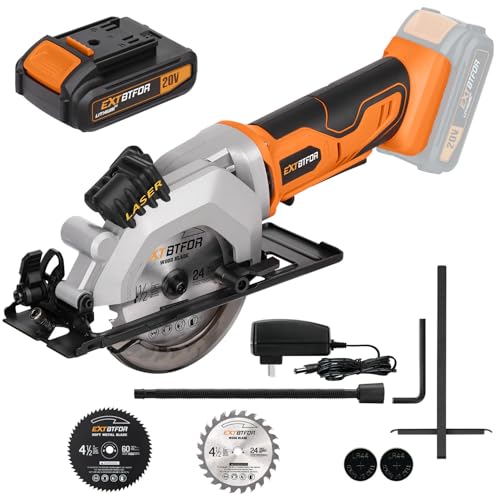
Brushless Cordless Circular Saw
Enough grunt for framing, a base that stays true, and runtime that survives a real session. Light enough for overhead cuts without wrecking your shoulder by lunch.
- ✔ Brushless power for framing
- ✔ Base stays square
- ✔ Good battery runtime
- ✔ Light for overhead work
- ✘ Bare tool if you own batteries
- ✘ Blade brake could be faster
What You Get at Each Price Band
Entry: Brushed Motors and Compact Packs
This tier suits the homeowner who breaks down a few sheets of plywood a year and already owns the battery platform. The tells are a stamped shoe that flexes under thumb pressure, a single compact battery in the kit, a printed bevel scale, and no electric brake. Skip it if you frame, cut wet lumber, or need more than a handful of cuts before lunch. It is not that these saws cannot cut, it is that they slow down precisely when you need them not to.
The Middle: A Brushless Bare Tool on a Platform You Own
This is the band most working carpenters should shop, and the value question is rarely the saw itself. If you already have packs, buy the bare tool and put the savings into a second high-capacity battery. Look for a magnesium shoe, an electric brake, a lower guard that retracts smoothly, and a hook you would trust on a rafter. Skip the bare tool only if you own no compatible batteries, where a kit usually works out better than a saw plus packs bought separately.
Top: High-Output Platforms and Rear-Handle Saws
Rear-handle saws fed by high-output packs come closest to corded rip performance, and the pushing geometry feels familiar if you grew up on a worm drive. You pay in weight and in the cost of the batteries that keep them fed. They suit framers and sheathing crews ripping long stock all day. Skip them if most of your cutting is blocking, trim and the odd bevel, because the extra mass is punishing overhead and on a ladder.
Common Mistakes and How to Avoid Them
- Judging power on one clean crosscut. Test in the hardest material you actually cut, or weigh the reviews that mention wet and doubled lumber above the rest.
- Running the wrong blade. A dull or fine-tooth blade costs more speed and runtime than any spec on the box. Keep a sharp thin-kerf framing blade on the saw and change it before it starts to burn.
- Supporting the cut so the kerf closes. A board bridged between two sawhorses invites a pinch and a kickback. Let the offcut fall free, or lay sheets on rigid foam and cut through.
- Forcing the feed. Pushing harder on a bogging saw only heats the blade. Back off, let it regain speed, and work out whether the problem is the material, the blade or the pack.
- Never touching the bevel stop. Most out-of-square cuts trace back to a factory 90 that nobody ever verified.
- Buying into a second battery platform. Split ownership means twice the chargers and a dead pack every time you grab the wrong one.
FAQ
Is a 6-1/2 inch saw enough, or do I need 7-1/4?
For studs, plates, blocking, joists and sheathing, the compact class is enough, and it is noticeably lighter overhead. Step up to 7-1/4 if you regularly cut 4x posts, doubled wet material or a lot of bevels, since depth of cut shrinks faster than people expect once the shoe is tilted.
Do I need a rear-handle saw?
Only if long rips are a daily part of the work, or you already prefer worm-drive geometry. A brushless sidewinder is lighter, cheaper, easier to manage on a ladder and plenty for general carpentry.
Blade-left or blade-right?
Right-handed users usually see the line better with a blade-left saw. Blade-right hides the line behind the motor but keeps the saw body over the supported side of the cut, which some people find steadier on sheet goods. Handle both if you get the chance; it is a preference, not a spec.
How many batteries should I plan on?
Two at minimum, sized up rather than down. One pack means standing around waiting; two mid or high-capacity packs in rotation cover a normal day of mixed cutting. Add a third if the saw shares a platform with another hungry tool.
Bottom Line
Weigh the three opening criteria knowing that two of them can be fixed after the purchase. Runtime is a battery decision, and half of any power complaint is a sharp blade away from going quiet. A shoe that will not stay square is the one you pay for on every cut you make.
For daily carpentry it’s the sweet spot of power, weight and runtime. Pair it with a spare battery and a good framing nailer and you’ve got a mobile framing setup that doesn’t tie you to an outlet.