Our Top Picks



What's inside
As an Amazon Associate I earn from qualifying purchases. This post may contain affiliate links at no extra cost to you.
Nothing speeds up framing like the right nailer — and nothing slows you down like the wrong one. The big decision is pneumatic versus cordless, and it comes down to how and where you work.
That sounds simple, and at the level of a counter conversation it is. The complication is that both categories are now genuinely good, so the wrong pick almost never feels wrong on day one. It feels wrong three weeks later, when you are hauling fifty feet of hose up a ladder to drive six nails, or when the second battery quits mid-afternoon with a wall of sheathing still standing open. Choosing between a pneumatic and a cordless framing nailer is really a decision about the shape of your typical day: how many nails you drive in a row, how far you are from an outlet, and how often you set the tool down to go do something else.
As an Amazon Associate we earn from qualifying purchases at no extra cost to you.


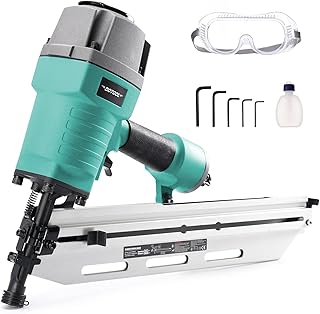

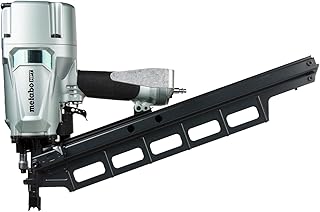
This guide walks the criteria in the order that actually matters — nails first, then air or battery, then the small features that separate a gun you keep for a decade from one you resent by the second job. A framing nailer is a long-horizon purchase. It will outlive several of the saws sitting next to it in the truck.
Sections
Start With the Nails, Not the Tool
The criterion that separates good from bad: buy the magazine angle and collation your local supplier actually keeps in stock. Everything else is secondary, because a framing nailer you cannot feed on a Saturday morning is a paperweight.
Framing nailers are sorted by magazine angle, and the angle dictates the fastener. Broadly, 21-degree guns run plastic-collated strips with full round heads, 28-degree guns run wire-weld strips, and 30- to 34-degree guns run paper-tape strips with clipped or offset round heads. Coil nailers feed wire coils and hold far more fasteners per load, which is why they show up on sheathing and fencing work. None of these is the “best” system in the abstract. The steeper paper-tape guns carry a more compact magazine that gets into stud bays and toe-nailing angles more easily, and the collation leaves nothing behind but paper dust. Plastic collation is tough and weather-resistant, but it throws plastic fragments as it fires, which is one more reason for eye protection.
Most framing nailers cover roughly 2 inches up to 3-1/2 inches, and you want the full range if you are doing structural work — the 3-1/2 inch nail is the one that matters for through-nailing plates and headers. Head style deserves a phone call before you buy: some jurisdictions and inspectors require full round head nails on structural framing, so check what is expected where you build rather than discovering it at inspection. For anything exterior or in contact with pressure-treated lumber, plan on hot-dipped galvanized or stainless fasteners, since treated wood chemistry is hard on bright and thinly plated nails.
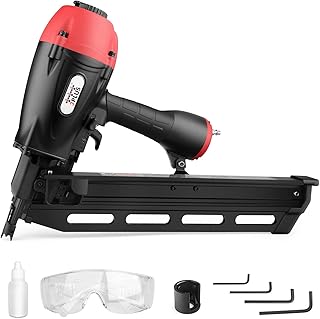
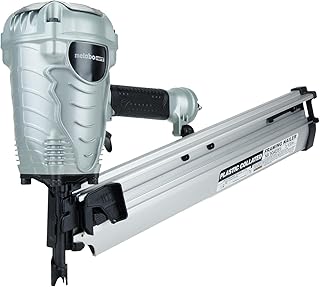
Pneumatic: power and value
If you already run a compressor, a pneumatic framing nailer is lighter, cheaper, and never runs out of charge. The tradeoff is dragging a hose everywhere.
The criterion that separates good from bad: you are not buying a nailer, you are buying a system. The gun is the cheap part. The compressor, the hose, and the fittings decide whether the setup feels fast or feels like waiting.
When you compare compressors, look at the airflow rating at 90 psi rather than the size of the tank. Tank volume only buys you a short buffer; the flow rating tells you whether the motor can keep up. A framing nailer consumes far more air per shot than a brad or finish gun, so a small portable unit that happily runs trim work all day will fall behind one framing gun bump-firing sheathing, and it has no chance of feeding two. Hose matters just as much: use a larger-diameter air hose for framing runs, because a long, skinny hose drops pressure on the way to the tool and shows up as underdriven nails you then have to finish by hand. Most framing guns are happy somewhere in the 70 to 120 psi window, and the manual will name the number.
What you get in return is a tool with nothing in your hand but the tool. That difference is invisible for ten nails and enormous when you are toe-nailing joists or nailing sheathing overhead for an afternoon. Pneumatics are also endlessly rebuildable — o-rings and driver blades are inexpensive, a few drops of oil in the air inlet each day keeps a standard model alive for years, and the resale market for good ones is real.
Who should buy pneumatic: crews and DIYers who already own air, anyone framing walls, decks, or sheathing in long sessions, and anyone who wants two working guns for what one cordless kit costs. Who should skip it: people with nowhere to store or transport a compressor, anyone working in occupied homes where compressor noise is a problem, and anyone whose day is mostly climbing, moving, and driving a handful of nails at a time.
Cordless: freedom to move
Cordless framing nailers have gotten genuinely good. No hose, no compressor — just grab and go. Perfect for repairs, fences, and jobs where a compressor is a hassle.
The criterion that separates good from bad: the battery platform you already own is worth more than any spec on the box. If you have batteries and a charger in the truck, a bare-tool cordless nailer is a modest add-on. If you are starting from zero, the batteries and charger can cost as much as the nailer, and that math is what actually decides the purchase.
The mechanisms differ and it is worth knowing which you are getting. Some designs pair a battery with a replaceable fuel cartridge, which keeps the tool light but adds a running consumable and gets fussier in cold weather. Others are fully battery-driven, using a sealed gas spring or a motor-driven flywheel, so nails are the only thing you buy. Flywheel designs may need a brief moment to spin up before the first shot; sealed-spring designs generally fire the instant you pull. Either way, cordless guns are built for bursts rather than continuous full-speed bump-firing, and none of them recover quite as fast as air.
Feature-wise, look for tool-free depth of drive, a switch between sequential and contact firing, a tool-free jam release at the nose, a solid rafter hook, and a dry-fire lockout so you stop before you start marking lumber with an empty driver. Confirm the tool is rated for full-length 3-1/2 inch nails if you are doing structural work, and expect any nailer to work harder in LVL and LSL than in softwood framing.
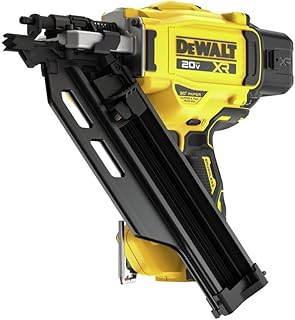
Cordless Framing Nailer
No compressor, no hose — walk up and drive nails. For repair work, fencing and anywhere dragging a hose is a pain, the freedom is worth it. Consistent depth in framing lumber.
- ✔ No hose or compressor
- ✔ Great for repair & fencing
- ✔ Consistent nail depth
- ✘ Heavier than pneumatic
- ✘ Batteries add cost
Who should buy cordless: remodelers and repair carpenters, fence and small-deck builders, anyone working off ladders and roofs where a hose is a trip hazard, and anyone who values being able to walk up and drive four nails without setting anything up. Who should skip it: production framers, anyone hanging sheathing overhead all day, and anyone on a tight budget with no existing battery platform.
What Actually Changes as the Price Goes Up
Pneumatic framing nailers are mature technology, so the budget end of that market is more honest than most tool categories. What you give up at the bottom is refinement, not function.
- Entry-band pneumatic: drives nails fine. Watch for thin magazines that dent and then jam, a fixed firing mode, depth adjustment that needs a wrench, a nose that mars finished surfaces, and no availability of rebuild parts.
- Mid-band pneumatic: the sweet spot for most buyers. Magnesium housing, tool-free depth of drive, a selectable sequential/contact trigger, tool-free jam clearing, an adjustable exhaust deflector so you are not blowing oil mist into your own face, and a hook that holds on a rafter.
- Top-band pneumatic: you are paying for balance in the hand, driver blade and o-ring longevity, published service parts, and a dealer network. Worth it if the gun earns money every week.
- Entry-band cordless: proceed carefully. Unknown-brand cordless nailers are where people get burned, because the mechanism is the whole tool. Expect more weight, slower recovery between shots, and sometimes a shorter maximum nail.
- Mid and pro-band cordless: consistent depth in engineered lumber, faster cycling, better sealing against sawdust and weather, and parts and service you can find in five years.
One piece of purchasing arithmetic that saves real money: compare bare tool plus your existing batteries against a full kit, and compare a cordless kit against a compressor-plus-two-guns setup. Those totals often reverse the answer you assumed.
Mistakes That Cost People Money
- Buying the gun before checking nail supply. Call the lumberyard you actually use and ask which angle and collation they stock year-round. Match the tool to that.
- Sizing a compressor by tank instead of airflow. A big tank on a weak pump just means a longer wait between recoveries.
- Leaving contact fire engaged all day. Bump-firing is for repetitive nailing on flat, supported work. For layout nailing, toe-nailing, and anything near your other hand, switch to sequential. Double-fires and recoil bounce are how people get hurt.
- Ignoring depth of drive. Overdriven nails in engineered lumber and sheathing lose holding power, underdriven nails become hammer work. Set depth on scrap of the same material before you start.
- Using a framing nailer for joist hangers and hurricane ties. Those connectors need a positive placement nailer and the correct hanger nails, not a framing gun aimed at a small hole.
- Neglecting maintenance. Drain the compressor tank, keep water out of the line with a filter, oil the tool if it is not labeled oil-free, and clear jams properly instead of firing through them.
- Forgetting the weight of a cordless tool overhead. A gun that feels fine on the bench feels different at arm’s length above your head for two hours.
Which to buy
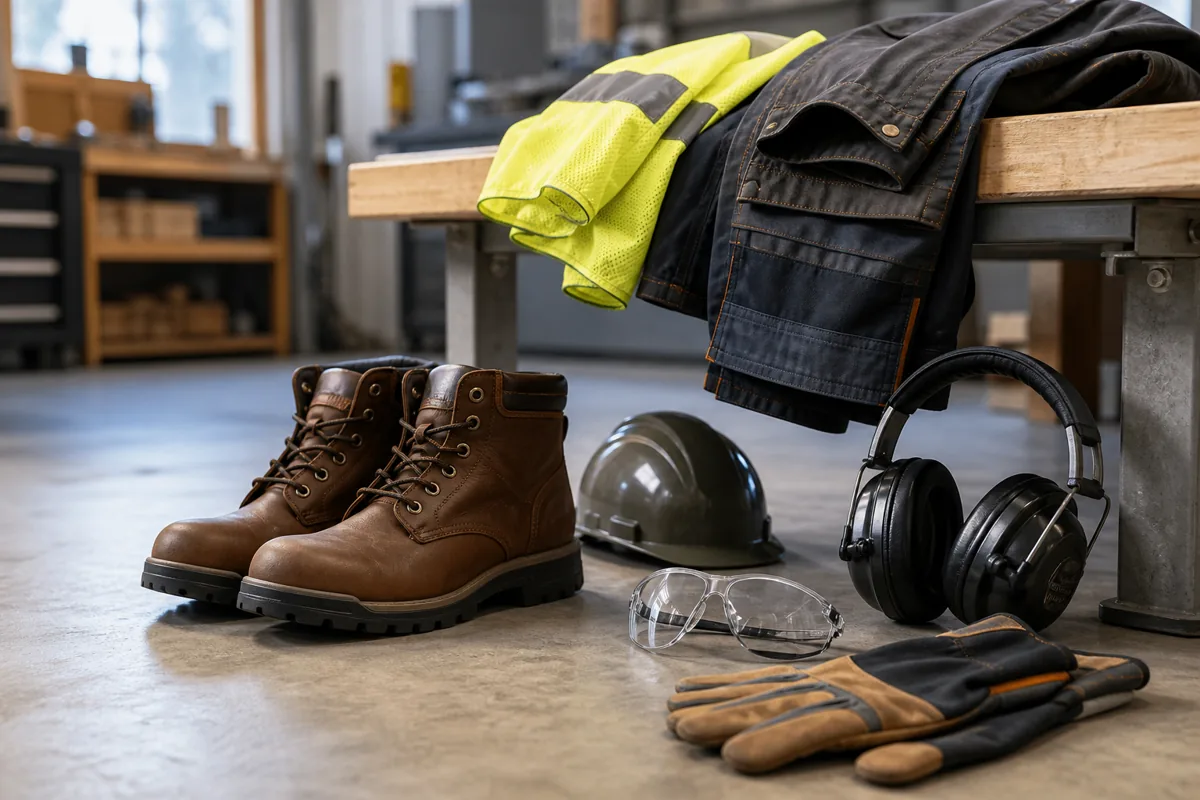
Framing a whole house near power? Pneumatic. Bouncing between small jobs and repairs? Cordless. Many carpenters end up owning both. Whichever you pick, wear your safety gear — nailers demand respect.
If you need a single decision rule: count the nails in your longest continuous run. If that number is in the hundreds and there is an outlet nearby, air wins on weight, cost, and pace. If it is in the dozens and you are moving constantly, cordless wins on the fifteen minutes of setup you never spend. And if you own one and hit a job that clearly wants the other, renting for a weekend is cheaper than buying the wrong tool twice.
FAQ
Can a cordless framing nailer really drive 3-1/2 inch nails?
Yes, current cordless framing nailers are built for the full nail range, including 3-1/2 inch. Verify it on the spec sheet for the exact model, because a few are limited to shorter nails. Engineered lumber like LVL and LSL is the real test — the tool will slow down there, and you should set depth on the actual material rather than assuming the softwood setting carries over.
What size compressor do I need for a pneumatic framing nailer?
Compare the airflow rating at 90 psi against the demand of the number of guns you intend to run. A small portable compressor can keep up with one framing nailer doing intermittent work. Sustained bump-firing, or two guns on the same compressor, calls for a substantially higher flow rating. Pair it with a larger-diameter hose so you are not losing pressure on a long run.
Are clipped head nails a problem?
It depends entirely on where you are building. Some jurisdictions and individual inspectors require full round head nails for structural framing, and that requirement drives your choice of magazine angle since head style and collation are linked. Ask locally before buying, and if you work across several areas, a full round head gun is the safer default.
Does a cordless nailer still need maintenance?
Less, but not none. There is no daily oiling and no water in the line, which is the main appeal. In exchange you blow out sawdust, keep the nose and magazine clean, replace batteries eventually, and accept that the internal mechanism is sealed and not a driveway repair. A pneumatic gun you can rebuild yourself for the cost of a few o-rings; that is the honest tradeoff behind the convenience.