
What's inside
- DeWalt Jobsite Table Saws Compared: Compact vs. 10-Inch Models
- Spec Comparison at a Glance
- The Rack-and-Pinion Fence: Why It’s the Selling Point
- Stand Compatibility and Portability
- Corded vs. FlexVolt: The Power Trade-Off
- Which Saw for Which Situation
- Ownership Realities the Listings Don’t Mention
- Bottom Line
- First-Setup Calibration Checklist
- Blade and Dado Compatibility Checklist
- More Picks Worth Considering
- Who Should Skip These Saws Entirely
- Common Mistakes Beyond the Fence Lock
- Buyer Questions
- Related Guides
As an Amazon Associate I earn from qualifying purchases. This post may contain affiliate links at no extra cost to you.
Sections
- DeWalt Jobsite Table Saws Compared: Compact vs. 10-Inch Models
- Spec Comparison at a Glance
- The Rack-and-Pinion Fence: Why It’s the Selling Point
- Stand Compatibility and Portability
- Corded vs. FlexVolt: The Power Trade-Off
- Which Saw for Which Situation
- Ownership Realities the Listings Don’t Mention
- Bottom Line
- First-Setup Calibration Checklist
- Blade and Dado Compatibility Checklist
- More Picks Worth Considering
- Who Should Skip These Saws Entirely
- Common Mistakes Beyond the Fence Lock
- Buyer Questions
- Related Guides
Our Top Picks
 DEWALT 15 Amp 8-1/4 in. Compact Portable JobsiteOne Size22.75 x 22.75 x 13 Inches54 poundsCheck on Amazon
 BOSCH GTS15-10 10 Inch Portable Jobsite Table Saw10 in28.1 x 27.8 x 13.53 inches102.95 poundsCheck on Amazon


DeWalt Jobsite Table Saws Compared: Compact vs. 10-Inch Models
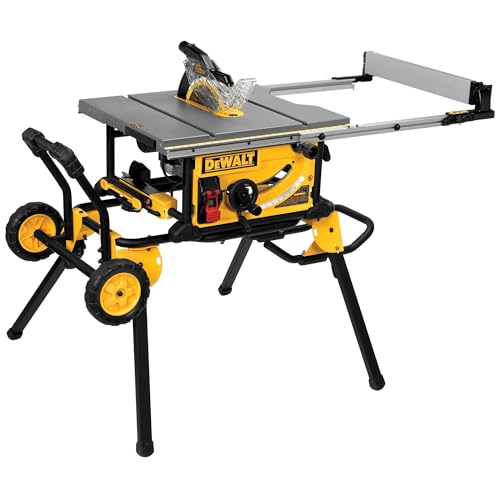
The short version: if you regularly rip full sheets of plywood or 2x material for framing and deck work, the 10-inch DWE7491RS is the right dewalt jobsite table saw — its 32-1/2-inch rip capacity and rolling stand are still the benchmark in 2026. If you’re a remodeler, trim carpenter, or work out of a small van, the 8-1/4-inch DWE7485 compact saw (corded) or DCS7485 (FlexVolt cordless) delivers the same fence system in a package roughly 20 pounds lighter — you just give up the ability to rip a 4×8 sheet in half down the middle.
All three saws share DeWalt’s rack-and-pinion fence, which is the real reason to buy into this lineup. Below is how they actually differ and which situation each one fits.
As an Amazon Associate we earn from qualifying purchases at no extra cost to you.


Spec Comparison at a Glance
| Spec | DWE7491RS (10″ w/ rolling stand) | DWE7485 (8-1/4″ compact, corded) | DCS7485B (8-1/4″ compact, FlexVolt) |
|---|---|---|---|
| Blade diameter | 10 in | 8-1/4 in | 8-1/4 in |
| Rip capacity (right of blade) | 32-1/2 in | 24-1/2 in | 24-1/2 in |
| Rip capacity (left of blade) | 22 in | 12 in | 12 in |
| Max depth of cut at 90° | 3-1/8 in | 2-9/16 in | 2-9/16 in |
| Max depth at 45° | 2-1/4 in | 1-3/4 in | 1-3/4 in |
| Motor / power | 15A corded, 4,800 RPM | 15A corded, 5,800 RPM | 60V FlexVolt, 5,800 RPM |
| Weight (saw only) | ~90 lb with stand | ~46 lb | ~46 lb (battery adds ~4 lb) |
| Dado capable | Yes (up to 13/16 in stack) | No | No |
| Typical street price | $550–$650 (stand included) | $300–$380 | $350–$450 bare tool |
Two numbers in that table do most of the deciding. First, rip capacity: 24-1/2 inches on the compact saws rips a 4×8 sheet to the long dimension but can’t split one down the middle — that takes the DWE7491’s 32-1/2 inches. Second, depth of cut: the 8-1/4-inch blade tops out around 2-9/16 inches, which clears a 2×4 (1-1/2 inches actual) easily but won’t cut a 4×4 (3-1/2 inches) in one pass like the 10-inch saw can.
The Rack-and-Pinion Fence: Why It’s the Selling Point
Every dewalt jobsite table saw in this lineup uses a fence that rides on geared rails front and back, driven by a pinion under the front rail. Turning the adjustment knob moves the fence parallel to the blade by design — there’s no manual squaring step like on clamp-style fences.
In practical terms this means:
- The fence locks parallel to the miter slot within roughly 1/32 inch out of the box, and stays there because both rails are captive.
- Micro-adjustments are repeatable — dial half a turn, get a predictable fraction of an inch of movement.
- The rails telescope, so the fence can sit close to the blade for narrow rips or extend out to full capacity without wobble.
Accuracy is effectively identical across all three saws since they share the mechanism. The 10-inch model’s advantage is purely the longer rail set. One ownership note: sawdust packs into the pinion teeth over time and makes the knob feel gritty. A quick brush-out every few uses keeps it smooth — five minutes with a stiff brush and compressed air is the entire maintenance job.
Stand Compatibility and Portability
This is where the two size classes genuinely split.
10-inch DWE7491RS
The “RS” suffix means it ships with the DW7440RS rolling stand — a folding leg-and-wheel setup that lets you push the saw around like a hand truck and drop it into position in about ten seconds. The saw also accepts the same stand if bought separately. At roughly 90 pounds combined, one person can move it, but you’ll feel it on stairs. The stand is a real workflow advantage if you’re the type who sets up in a driveway or moves between floors; it’s a hindrance if your saw never leaves a shop corner.
Compact saws (DWE7485 and DCS7485)
The compact models mount to DeWalt’s scissor-style and rolling compact stands. They’re light enough (~46 lb) that many users skip a stand entirely and run them on a pair of sawhorses or a workmate-style bench — which is legitimate for occasional use. If you want a stand, budget an extra $100–$200 on top of the saw price. Important: the compact saws do not fit the DW7440RS stand designed for the 7491 — the mounting holes differ, so check stand-to-saw compatibility before buying.
Corded vs. FlexVolt: The Power Trade-Off
The DCS7485 is mechanically the same saw as the corded DWE7485 — same blade, same capacity, same fence. The only question is power delivery.
| Factor | Corded DWE7485 | FlexVolt DCS7485 |
|---|---|---|
| Sustained ripping (wet PT, hardwood) | Unlimited; 15A holds speed | Strong but sags sooner; high drain |
| Runtime (9.0Ah FlexVolt battery) | n/a | Roughly 30–50 linear feet of 3/4″ hardwood ripping per charge; much more in softwood |
| Setup | Needs outlet or generator | True grab-and-go; great for punch-list work |
| Total cost of entry | Lower | Higher — bare tool plus battery/charger unless you own FlexVolt already |
The cordless version makes sense in two situations: you already own FlexVolt batteries from other tools (the battery cost disappears), or your work is genuinely remote — a deck in a backyard, a barn build, punch work where running a cord costs more time than the battery swap. If you’re the second type and don’t own batteries, a realistic worked example: bare tool (~$400) plus a 9.0Ah battery and fast charger (~$300–$350) puts you near $700+ — at which point the corded DWE7491RS with its bigger capacity is the better buy unless cordless is non-negotiable.
Which Saw for Which Situation
| Your situation | Pick | Why |
|---|---|---|
| Framing, decks, plywood sheet work, shop-adjacent use | DWE7491RS | 32-1/2″ rip, cuts 4×4, dado-capable, rolling stand included |
| Remodeling, trim, flooring, van-based work | DWE7485 | 46 lb, stores flat, cheaper, still rips sheet goods to length |
| Remote sites, no power, existing FlexVolt batteries | DCS7485 | Same compact platform without the cord dependency |
| First saw, tight budget, occasional DIY | DWE7485 | Lowest entry cost with the same accurate fence |
| Built-in cabinetry aspirations, dadoes, joinery | DWE7491RS | Only one of the three that accepts a dado stack |
Ownership Realities the Listings Don’t Mention
- What wears first: the blade it ships with. Stock 24-tooth blades are for rough ripping; budget $25–$50 for a 40-tooth combination blade if you want clean plywood edges. Brushes and belts are multi-year items on these direct-drive motors.
- Guard assembly: the modular guard/riving knife is genuinely quick to remove and reinstall — that’s good for safety compliance, but the anti-kickback pawls scuff soft materials. Many users leave pawls off for finished work; keep the riving knife on regardless.
- Dust collection: all three have a 2-1/2-inch port, but a lot of dust exits below the blade on the compact saws since the cabinet is open-bottomed. A shop vac on the port helps; don’t expect cabinet-saw containment.
- Common mistake: ripping stock between the fence and blade with the fence unlocked “just for a second.” The fence can shift mid-cut and cause kickback. Lock it every pass — the rack-and-pinion design makes this a one-hand, half-second habit.
- FlexVolt-specific: cold weather cuts runtime noticeably, and the saw will thermal-protect and pause on long, aggressive rips. Carry a second battery rather than waiting on a charge.
Bottom Line
Buy the DWE7491RS if capacity and the included rolling stand match your work — it covers the widest range of tasks. Buy the DWE7485 if weight and footprint matter more than the last eight inches of rip capacity. Buy the DCS7485 only when cordless freedom justifies the battery investment, ideally because you already own FlexVolt packs. The fence accuracy is a wash across all three, so you’re really buying capacity, portability, and power source — in that order of importance for most buyers.
First-Setup Calibration Checklist
The guide above covers fence care in passing, but none of the three DeWalt saws should make its first cut straight out of the box without a short calibration pass. Budget about twenty minutes and work through these checks in order, because each one assumes the previous one is already true.
- Blade to miter slot. Raise the blade fully, mark one tooth, and measure from that tooth to the miter slot at the front of the table, then rotate the same tooth to the back and measure again. The two readings should match. If they drift, the table or trunnion needs a small shift before anything else can be trusted.
- Fence to blade. Lock the fence a few inches from the blade and measure at the front and back edges of the blade. A fence that toes in toward the rear of the blade is a kickback risk, not just an accuracy issue.
- Riving knife alignment. Sight down the blade and confirm the knife sits centered in the kerf line and slightly below the top of the blade. A knife offset to one side will steer stock into the fence or away from it.
- Bevel stops. Check the blade against a reliable square at zero degrees and at forty-five degrees rather than trusting the pointer scale, then set the pointer only after the stops are confirmed.
- Throat plate and guard fit. The plate should sit flush or a hair below the table surface, and the guard assembly should mount and release smoothly, since a guard that fights you is a guard that gets left in the box.
Blade and Dado Compatibility Checklist
Blade choice changes these saws more than any other single purchase, and compatibility differs sharply between the two size classes.
- Arbor and diameter. The 10-inch DWE7491 models use a 5/8-inch arbor and the full catalog of 10-inch blades. The 8-1/4-inch compacts use the same arbor size but a smaller blade diameter, and the selection of quality 8-1/4-inch blades is noticeably thinner, so check availability of your preferred tooth count before committing to the compact platform.
- Tooth count by task. The stock 24-tooth blade is a rough ripping blade. A 40-tooth combination blade is the sensible default for mixed work, and a 60-tooth or finer blade earns its place for plywood and melamine where edge chip-out shows.
- Dado stacks. Only the 10-inch saws accept a dado stack, up to 13/16 inch wide, and they need the matching dado throat plate sold for the model. The compact saws cannot run a stack at all; grooves there mean multiple passes with a standard blade or a move to a router.
- Kerf and the riving knife. Match blade kerf to the knife thickness. A thin-kerf blade paired with a standard knife can let the workpiece close behind the cut and pinch, which shows up as burning and resistance mid-rip.
More Picks Worth Considering
The comparison above stays inside the DeWalt lineup. These three saws from other makers answer the same jobsite brief in different ways, and each one gives a specific type of buyer a reason to look outside the yellow lineup.
Bosch GTS15-10 10-Inch Jobsite Table Saw with Gravity-Rise Stand
The Bosch is the closest direct rival to the DWE7491RS. Its published figures run slightly ahead of the DeWalt in two places that matter: depth of cut at ninety degrees is 3-9/16 inches, the deepest in this class, and rip capacity to the right of the blade is 32-1/8 inches, enough to split sheet goods with room to spare. The 15-amp motor turns at 3,800 RPM, and Bosch fits an electronic blade brake that stops the blade in roughly three seconds. The GTA50W gravity-rise stand is the headline feature, folding and unfolding in a single assisted motion. It fits framing and remodeling crews who set up and tear down daily. It does not fit buyers counting on a long warranty, since Bosch covers it for one year against the longer DeWalt term, and at about ninety-one pounds with the stand it is no easier to carry up stairs.
SKIL TS6307-00 10-Inch Jobsite Table Saw with Folding Stand

The SKIL is the value route into a full 10-inch blade. It pairs a 15-amp, 4,600 RPM motor with a genuine rack-and-pinion fence, the feature budget saws usually skip, and the fence is why its cuts track square instead of wandering. Published capacity is 25-1/2 inches of rip and 3-1/2 inches of depth at ninety degrees, so it cuts a nominal 4×4 in one pass, something neither DeWalt compact can do. The folding stand is integrated rather than an add-on, and the saw weighs a little over fifty pounds, so it loads into a vehicle without help. It fits first-time buyers, home shops, and part-time remodelers who want 10-inch capacity and an honest fence on a mid-range spend. It does not fit production framing crews: rip capacity gives up ground on wide sheet work, and the warranty runs one year, extending to three only if registered shortly after purchase.
SKILSAW SPT99-11 10-Inch Heavy Duty Worm Drive Table Saw
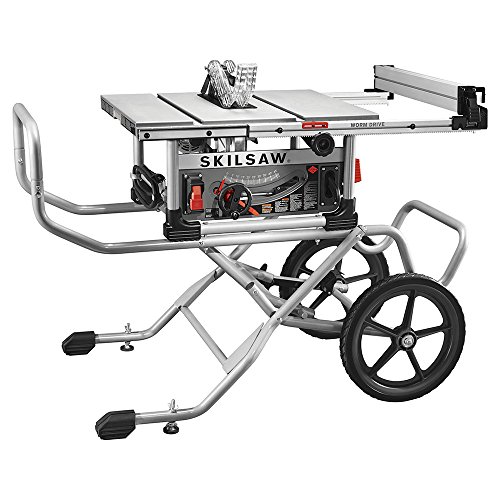
The SPT99-11 takes a different mechanical path from every direct-drive saw in this guide. Its worm drive gearing, built around brass gears, trades blade speed for torque, so the saw keeps pulling through wet pressure-treated lumber and dense hardwood rips that make lighter saws slow down. Published capacity is 30-1/2 inches of rip and 3-5/8 inches of depth at ninety degrees, and it uses a rack-and-pinion fence, so the accuracy story matches the DeWalt approach. The rolling stand rides on large sixteen-inch wheels that roll over cords, offcuts, and uneven ground instead of catching on them. It fits framing crews and deck builders whose work is mostly heavy ripping in tough material. It does not fit the portability-first buyer: at roughly ninety-four pounds it is the heaviest saw here, and trim carpenters doing light, precise work gain nothing from the extra torque.
Who Should Skip These Saws Entirely
- Cabinet shops and high-volume work. Any jobsite saw is a compromise on table size, trunnion mass, and vibration control. If the saw never moves, a cabinet or hybrid saw holds alignment longer and handles wide panels with less effort.
- Buyers who need a flesh-sensing brake. None of the saws in this guide or the additions above stops the blade on skin contact. If that technology is a requirement, it lives in a different product line and price tier.
- Dado-first joinery on a compact budget. The compact DeWalt saws cannot run a dado stack at all, so a buyer whose joinery depends on dadoes should either step up to the 10-inch class or plan on a router-based workflow from the beginning.
Common Mistakes Beyond the Fence Lock
The main guide flags the unlocked-fence rip, which deserves its place. Three more mistakes show up repeatedly with this class of saw. First, running sheet goods alone without outfeed support: the back half of a full sheet tips down as it clears the blade, which lifts the front edge and ruins both the cut and the operator’s control, so a roller stand or a helper is part of the setup, not an extra. Second, leaving the stock blade on for finish work and blaming the saw for torn plywood edges that a finer blade would have prevented. Third, storing the FlexVolt saw with the battery left in and fully drained through a cold season, which shortens pack life; packs store best partly charged and indoors.
Buyer Questions
Can the compact saws really handle a full sheet of plywood?
They can rip a sheet to length and can split one with careful fence placement at the limit of their capacity, but there is no margin for error or for a wider offcut. Anyone breaking down sheets every week belongs on the 10-inch saws.
Does the 10-inch saw need a dedicated circuit?
A 15-amp saw shares a typical household circuit poorly with other heavy loads. Running it on a circuit that also feeds a dust collector or a large compressor invites nuisance trips mid-cut, so a lightly loaded circuit is the practical setup.
Is a zero-clearance insert worth adding?
For plywood and narrow rips, yes. It supports the fibers right at the blade, which reduces chip-out on the underside of the cut and keeps thin offcuts from dropping into the throat and kicking back up.
How often should the fence rails be cleaned?
Whenever the adjustment knob begins to feel gritty rather than smooth. Packed dust in the pinion teeth is the main cause of fence movement feeling uneven, and a brush-out takes only a few minutes.
Related guides
More from Amazon
Programs that pair well with the guide above. Offers and eligibility are set by Amazon and may change.
A free business account with business pricing and bulk-buying tools for work, shop or home office.
Create a business accountFree shipping on eligible items, Prime Video and more. Eligible new members can start with a free trial.
Start a Prime free trialAudiobooks and podcasts to listen to on the go. Eligible new members can start with a free trial.
Try Audible freeAd-free music streaming. Eligible new subscribers can start with a free trial.
Try Music Unlimited freeAs an Amazon Associate we earn from qualifying purchases.







Write Your Review
No reviews yet. Be the first to share your experience!