What's inside
- Which Battery Should You Run on a DeWalt Battery Framing Nailer?
- Battery Compatibility: What Actually Fits
- Shots Per Charge, Weight, and Cost: The Comparison Table
- Power Delivery: Why Capacity Isn’t the Whole Story
- Cold-Weather Performance
- Decision Matrix: Match the Battery to Your Situation
- Ownership Realities That Listings Don’t Mention
- FAQ
- Related Guides
- Which Battery Should You Run on a DeWalt Battery Framing Nailer?
- Battery Compatibility: What Actually Fits
- Shots Per Charge, Weight, and Cost: The Comparison Table
- Power Delivery: Why Capacity Isn’t the Whole Story
- Cold-Weather Performance
- Decision Matrix: Match the Battery to Your Situation
- Ownership Realities That Listings Don’t Mention
- FAQ
- Related Guides
As an Amazon Associate I earn from qualifying purchases. This post may contain affiliate links at no extra cost to you.
Sections
- Which Battery Should You Run on a DeWalt Battery Framing Nailer?
- Battery Compatibility: What Actually Fits
- Shots Per Charge, Weight, and Cost: The Comparison Table
- Power Delivery: Why Capacity Isn’t the Whole Story
- Cold-Weather Performance
- Decision Matrix: Match the Battery to Your Situation
- Ownership Realities That Listings Don’t Mention
- FAQ
- Related Guides
Which Battery Should You Run on a DeWalt Battery Framing Nailer?
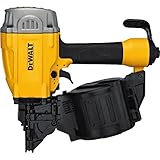
The short answer: a DeWalt battery framing nailer — the DCN692 (30° paper-tape) or DCN21PL (21° plastic-collated) — runs on any 20V MAX or FlexVolt pack, but the 5Ah DCB205 is the right default for most users, the FlexVolt 9Ah DCB609 is the best choice for all-day framing crews, and compact 1.7–2Ah packs only make sense for punch-list work. The nailer itself draws high current in bursts, so smaller packs deliver fewer shots per charge than their capacity suggests, while big packs add real weight to a tool that already weighs around 7.8 lbs bare.
Battery Compatibility: What Actually Fits
Both DeWalt cordless framing nailers are 20V MAX tools, which means:
As an Amazon Associate we earn from qualifying purchases at no extra cost to you.

- All 20V MAX packs work: from the compact DCB203 (2Ah) up through the DCB208 (8Ah), including PowerStack pouches like the DCBP520 (5Ah).
- All FlexVolt packs work: DCB606 (6Ah), DCB609 (9Ah), and DCB612 (12Ah) automatically step down to 20V mode on this tool, delivering their full amp-hour rating at 20V.
- No 60V-only limitation: unlike FlexVolt-only tools (saws, grinders), the framing nailer never forces you into the heavier FlexVolt line — you choose based on runtime and weight preference.
Note that FlexVolt packs used on 20V tools deliver their rated amp-hours at the lower voltage — a DCB609 rated 3Ah at 60V gives you 9Ah at 20V. That’s why FlexVolt batteries punch above their size on the nailer.
Shots Per Charge, Weight, and Cost: The Comparison Table
Manufacturer figures claim roughly 500–700 nails per charge on mid-size packs in sequential mode; real-world sink rates for 3″–3.5″ framing nails into SPF lumber run lower in bump mode. The numbers below reflect realistic full-depth firing into dimensional lumber:
| Battery | Capacity (20V) | Est. Shots/Charge* | Weight | Total Tool Weight | Best For |
|---|---|---|---|---|---|
| DCBP034 PowerStack 1.7Ah | 1.7Ah | 250–320 | ~0.8 lb | ~8.6 lb | Remodels, toe-nailing, overhead |
| DCB203 2Ah | 2Ah | 280–350 | ~0.9 lb | ~8.7 lb | Occasional use, punch lists |
| DCB205 5Ah | 5Ah | 600–750 | ~1.4 lb | ~9.2 lb | Most users — best balance |
| DCBP520 PowerStack 5Ah | 5Ah | 650–800 | ~1.3 lb | ~9.1 lb | Bump firing, cold weather |
| DCB208 8Ah | 8Ah | 950–1,200 | ~2.1 lb | ~9.9 lb | Full-day framing, few swaps |
| DCB609 FlexVolt 9Ah | 9Ah | 1,050–1,300 | ~2.1 lb | ~9.9 lb | Crews sharing FlexVolt fleet |
| DCB612 FlexVolt 12Ah | 12Ah | 1,400–1,700 | ~3.1 lb | ~10.9 lb | Max runtime; heavy for overhead |
*Estimates based on 3¼” framing nails into SPF in sequential mode. Bump mode and dense engineered lumber (LVL, LSL) can cut these figures by 20–30%.
Power Delivery: Why Capacity Isn’t the Whole Story
The DCN692 uses a flywheel-and-solenoid design that spins up before each shot. Two things matter beyond amp-hours:
- Discharge rate: PowerStack pouch cells (DCBP520) sustain higher current under repeated bump firing, meaning the flywheel recovers faster between shots and you get fewer stalled sinks on rapid fire. If you’re sheathing or bump-nailing all day, the 5Ah PowerStack outperforms the standard 5Ah despite identical capacity.
- Depth consistency: on nearly-depleted small packs (under ~15%), you may notice nails sitting proud before the low-battery warning kicks in. Larger packs hold voltage steadier through the discharge curve.
Cold-Weather Performance
Cordless framing often happens in freezing conditions, and lithium-ion chemistry loses usable capacity as cell temperature drops:
- At 32°F (0°C), expect roughly 10–20% fewer shots per charge across all pack sizes.
- At 0–10°F, small packs suffer disproportionately — a 2Ah pack can lose a third of its effective output because its higher internal resistance compounds the cold penalty.
- Larger packs (8Ah, 9Ah, 12Ah) self-warm faster under load and recover better; the DCB612 is the strongest cold-weather performer per charge.
- Practical fix: keep spare packs in a heated cab or inside jacket pockets, and swap at first sign of slow flywheel spin-up rather than waiting for the pack to quit.
Decision Matrix: Match the Battery to Your Situation
| Your Situation | Recommended Pack | Why |
|---|---|---|
| DIYer framing a basement or shed, occasional weekends | DCB205 5Ah | One charge covers a typical session; likely already in your kit |
| Overhead joists, tall walls, working off ladders | DCBP034 or DCB203 | Saves ~0.5–1 lb; you swap more but fatigue less |
| Pro framer, bump mode, sheathing all day | DCBP520 PowerStack 5Ah | Best burst power and fastest recovery between shots |
| Crew already running FlexVolt saws | DCB609 9Ah | Shared fleet, one charger, ~1,200 shots per pack |
| Cold-climate work, long days between charges | DCB612 12Ah | Highest capacity, best cold-weather voltage stability |
| Budget-limited, buying batteries just for this tool | Two DCB205s | Two mid packs beat one big pack — charge one while running the other |
Ownership Realities That Listings Don’t Mention
- Two mid-size packs beat one giant pack. A 12Ah pack is heavy, takes ~2 hours to charge on a standard DCB115, and leaves you dead in the water when it empties. Two 5Ah packs on a fast charger (DCB1104 or DCB1106) create an effectively endless rotation.
- What wears first: the driver blade and the nosepiece o-rings, not the battery contacts. Keep the magazine clean of paper-tape dust and collation glue — buildup causes more misfires than weak batteries do.
- Common mistake: buying the biggest pack for a nailer used mostly overhead. Framers consistently report fatigue, not runtime, as the limiting factor — the extra pound of a FlexVolt 12Ah is felt by hour six.
- Firmware quirks aside: if the tool stalls, check nail collation angle and depth setting before blaming the battery — a mis-set depth adjustment burns charge on partial drives.
FAQ
Can I use a FlexVolt battery on the DeWalt 20V framing nailer?
Yes — FlexVolt packs automatically run at 20V on 20V MAX tools and deliver their higher amp-hour rating. The trade-off is weight: FlexVolt packs are roughly 1.5–3 lbs versus under a pound for compact 20V packs.
How many nails per charge will I realistically get?
Plan on roughly 110–130 shots per amp-hour in sequential mode with framing nails — about 600–750 on a 5Ah pack. Bump mode into dense engineered lumber can cut that by a third.
Is the framing nailer worth it over a pneumatic setup?
For remodels, punch work, and sites without power, yes — you skip the compressor, hose, and setup time. For high-volume production framing where a crew fires thousands of nails daily, pneumatics still win on tool weight and per-shot cost.