What's inside
- Which FlexVolt DeWalt table saw configuration should you buy?
- Battery compatibility: what “FlexVolt” actually means
- Cutting capacity versus a corded jobsite saw
- Stand, outfeed, and workspace decisions
- Buying advice by situation
- DeWalt versus SKIL: which type of saw makes more sense?
- Ownership realities and maintenance
- Related Guides
- Which FlexVolt DeWalt table saw configuration should you buy?
- Battery compatibility: what “FlexVolt” actually means
- Cutting capacity versus a corded jobsite saw
- Stand, outfeed, and workspace decisions
- Buying advice by situation
- DeWalt versus SKIL: which type of saw makes more sense?
- Ownership realities and maintenance
- Related Guides
As an Amazon Associate I earn from qualifying purchases. This post may contain affiliate links at no extra cost to you.
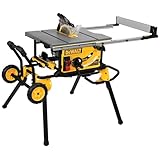
The best DeWalt FlexVolt table saw for most mobile woodworkers is the 8-1/4-inch DCS7485: it uses DeWalt 20V MAX or 60V MAX batteries, has a 24-inch rip capacity, and delivers useful jobsite portability, but it gives up the depth capacity, unlimited runtime, and lower operating cost of a corded 10-inch saw.
As an Amazon Associate we earn from qualifying purchases at no extra cost to you.


Sections
- Which FlexVolt DeWalt table saw configuration should you buy?
- Battery compatibility: what “FlexVolt” actually means
- Cutting capacity versus a corded jobsite saw
- Stand, outfeed, and workspace decisions
- Buying advice by situation
- DeWalt versus SKIL: which type of saw makes more sense?
- Ownership realities and maintenance
- Related Guides
Which FlexVolt DeWalt table saw configuration should you buy?
DeWalt’s cordless table-saw offering is centered on the DCS7485 platform, commonly sold as the bare DCS7485B or as a kit such as the DCS7485T. The exact kit contents can vary by country and sales period, so check whether the package includes a battery, charger, stand, or only the saw.
| Configuration | Battery compatibility | Typical specification | Best fit | Main compromise |
|---|---|---|---|---|
| DCS7485B bare tool | 20V MAX batteries; 60V MAX FlexVolt batteries in 20V mode | 8-1/4-inch blade; 24-inch rip; about 45 lb without battery | Owners who already have DeWalt batteries | Battery and charger cost extra |
| DCS7485 kit | Usually supplied with a 60V MAX FlexVolt battery and charger | Same saw and cutting capacity as the bare tool | New buyers needing a complete cordless system | Higher initial price and charging time |
| DCS7485 on a separate rolling stand | Same as above | About 45 lb for the saw, plus the stand | Frequent setup, teardown, and transport | More bulk in a vehicle and more parts to maintain |
| DCS7485 on a fixed workbench | Same as above | Compact footprint, with custom outfeed support possible | Small shops that still need cordless operation | Less convenient to move and fold away |
The DCS7485 is not a 10-inch saw scaled down to run on a battery. Its 8-1/4-inch blade is a deliberate jobsite design. It reaches approximately 2-1/2 inches of depth at 90 degrees and approximately 1-3/4 inches at 45 degrees, depending on blade and regional specification. That is enough for standard 2-by stock, plywood, trim, flooring, and many cabinet components, but it is less comfortable for thick hardwood slabs or repeated deep rips.
Battery compatibility: what “FlexVolt” actually means
A useful feature of this DeWalt table saw is that it can run from ordinary 20V MAX batteries as well as FlexVolt packs. A 20V MAX battery operates the saw in its 20V configuration. A FlexVolt pack automatically switches to the voltage required by a compatible tool, while a 60V MAX pack typically offers greater energy and sustained output for demanding cuts.
Do not confuse voltage with runtime. A 60V MAX 6Ah FlexVolt battery is commonly described as 60V and 6Ah, which represents roughly 360 watt-hours before losses. The same pack is also marketed as 20V MAX 18Ah when used with a 20V tool. The energy is essentially the same; the labeling changes with the operating voltage.
In practice, runtime depends heavily on material, blade sharpness, feed speed, and whether the saw is idling between cuts. A 60V FlexVolt pack is the sensible choice for sheet-goods work or repeated ripping. A smaller 20V battery is more practical for short installation work where low weight matters. For a full day of intermittent cutting, plan on at least one spare charged pack rather than assuming a single battery will last an entire shift.
A simple runtime calculation
Suppose a 60V 6Ah battery provides about 360 watt-hours, and the saw averages 600 watts while actually cutting. The theoretical cutting time is:
360 watt-hours ÷ 600 watts = 0.6 hours, or 36 minutes of continuous motor load.
That does not mean 36 minutes of nonstop ripping in normal work. Cutting is intermittent, and the motor draws less or more power depending on the load. If a job takes 100 cuts averaging 10 seconds each, the motor runs for only about 17 minutes. This illustrates why one battery may complete a moderate installation job even though it cannot support continuous production sawing all day.
Cutting capacity versus a corded jobsite saw
The cordless DCS7485 is strongest when carrying power is more difficult than carrying lumber. Its 24-inch rip capacity handles a 4-by-8-foot sheet with a useful margin, and the rack-and-pinion fence adjustment is faster to repeat than a basic sliding fence. The saw also includes the normal safety equipment expected on a modern jobsite saw, including a riving knife and blade guard.
A corded 10-inch jobsite saw such as the DeWalt DWE7491RS remains the better choice for a workshop or production remodeling crew. It offers a larger blade, greater cutting depth, and generally more comfortable capacity for thick stock. It also avoids battery cost and charging logistics. Its disadvantages are the power cord, dependence on an outlet or generator, and less freedom when cutting outside or in unfinished buildings.
| Decision factor | DCS7485 cordless | Typical 10-inch corded jobsite saw |
|---|---|---|
| Blade size | 8-1/4 inches | 10 inches |
| Rip capacity | About 24 inches | Often 30 to 32 inches |
| Depth at 90 degrees | About 2-1/2 inches | Often about 3-1/8 inches |
| Saw weight | About 45 lb before battery and stand | Often 50 to 90 lb depending on stand |
| Operating cost | Battery wear and replacement cost | Electricity and extension-cord cost |
| Best advantage | Fast setup where power is unavailable | Continuous cutting and deeper capacity |
Stand, outfeed, and workspace decisions
The saw can be used on a stable bench, sawhorses with a properly supported platform, or a compatible rolling jobsite stand. A folding or wheeled stand is worthwhile if you set up at different locations, but verify the mounting pattern and maximum supported weight before buying. Kit letters do not always indicate the same stand configuration across markets.
For safe sheet-goods work, the DeWalt table saw outfeed arrangement matters as much as the saw itself. The factory table is too small to support a full sheet after it passes the blade. Use an outfeed table, roller support, or a second person positioned to support the material without pulling it. Keep the support surface level with, or slightly below, the saw table so the workpiece cannot catch on an edge.
A compact outfeed solution can be a folding panel attached behind a bench, provided it does not interfere with the blade guard, riving knife, fence travel, or saw-folding mechanism. Side support is also important when ripping wide panels; unsupported material can twist into the blade even when the fence is correctly set.
Buying advice by situation
| Your situation | Recommended choice | Why |
|---|---|---|
| You already own several DeWalt 20V tools | Bare DCS7485B, if your work is light to moderate | You avoid duplicating a charger and can use existing batteries |
| You are starting a cordless DeWalt system | DCS7485 kit with a FlexVolt battery | The larger pack is more suitable for sustained ripping |
| You cut plywood occasionally in multiple locations | DCS7485 with a folding or rolling stand | Portability outweighs the smaller blade |
| You cut hardwood or thick stock every day | A corded 10-inch jobsite or contractor saw | Deeper capacity and unlimited runtime matter more |
| Your shop has very limited storage | DCS7485 on a removable bench or compact stand | The lighter saw is easier to store than a full-size setup |
DeWalt versus SKIL: which type of saw makes more sense?
The “SKIL vs DeWalt table saw” choice is usually less about brand loyalty than system priorities. SKIL’s common jobsite table saws are often attractive as corded, 10-inch options with good capacity for the money. They can be a strong value for a fixed workshop or a user who does not already own cordless batteries.
DeWalt’s advantage is the mature 20V MAX and FlexVolt battery ecosystem, compact transport, widely available replacement components, and a fence system that is convenient for repeated adjustments. Choose the DeWalt if you regularly work where outlets are inconvenient or already own compatible batteries. Choose a corded SKIL or another 10-inch saw if maximum capacity per dollar and continuous cutting are more important than cordless mobility.
Ownership realities and maintenance
- Blade condition comes first: a dull or resin-coated blade increases load, reduces battery runtime, and encourages unsafe feeding. Clean or replace it before blaming the battery.
- Keep the fence aligned: check that the fence is parallel to the blade and locks evenly. A fence that shifts during a cut can cause burning, binding, or inaccurate work.
- Clear dust regularly: brush or vacuum the table, motor vents, blade-height mechanism, and battery contacts. Do not direct high-pressure air into bearings or electronics.
- Protect the battery: store packs dry and moderate in temperature, and avoid leaving a depleted battery on the charger or in a hot vehicle for extended periods.
- Use the riving knife and guard: removing them for convenience increases risk and is rarely necessary for ordinary ripping.
- Budget for consumables: a general-purpose blade, a fine-finish blade, dust collection accessories, and eventual battery replacement can cost more over several years than the initial saw price.
Choose the DeWalt FlexVolt table saw when the job demands a compact saw that can go wherever the material is. Choose a corded 10-inch machine when cutting volume, thick stock, or shop-based accuracy makes battery logistics a disadvantage. The DCS7485 is most compelling as a portable system tool—not as a replacement for every full-size table saw.