What's inside
As an Amazon Associate I earn from qualifying purchases. This post may contain affiliate links at no extra cost to you.
Sections
Best DeWalt Portable Table Saw by Job: A Quick Answer
The DeWalt DWE7491RS is the most versatile choice for frequent jobsite use, the lighter DWE7485 suits crews that move a saw often, and the compact DWE7480 is worth considering when available at a lower price. For a fixed workshop, the larger DWE7491RS offers the best balance of rip capacity and portability—but none of these compact saws replaces a heavy cast-iron cabinet saw for demanding, stationary work.
DeWalt model availability, bundled stands, and street prices can vary by region and year. Treat the ranges below as general U.S. market guidance, not quotes; check the exact model number and included accessories before buying.
As an Amazon Associate we earn from qualifying purchases at no extra cost to you.
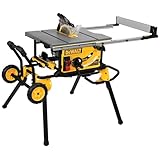


DeWalt Portable Table Saw Comparison
| Model | Rip capacity | Approx. bare-saw weight | Blade and cut depth | Stand setup | General U.S. price range |
|---|---|---|---|---|---|
| DWE7485 | 24.5 in. right; 12 in. left | About 46 lb | 8-1/4 in. blade; up to 2-9/16 in. at 90° | Saw only; compatible stand sold separately | About $300–$450, saw only |
| DWE7491RS | 32-1/2 in. right; 22 in. left | About 55 lb, plus stand | 10 in. blade; up to 3-1/8 in. at 90° | Rolling stand included in the RS package | About $550–$750, stand included |
| DWE7480 | 24-1/2 in. right; 12 in. left | About 48 lb | 10 in. blade; up to 3-1/8 in. at 90° | Usually saw only; stand availability depends on package | About $250–$400 where available |
Specifications and package contents can differ across revisions and markets. Confirm them on the product label or current DeWalt documentation, especially when comparing a bare saw with a stand bundle. The DWE7480 is an older compact model and may be harder to find new than the DWE7485.
Which Saw Fits Your Work?
- Choose the DWE7491RS for full-sheet breakdown and repeated wide rips. Its 32-1/2-inch right-side capacity handles a 48-inch-wide plywood sheet in two passes, but it cannot rip a full 48-inch half-sheet in one pass. Its rolling stand is convenient for moving between level work areas, though the saw and stand take more room in a vehicle and storage area.
- Choose the DWE7485 when carry weight and storage matter more than wide cuts. Its 24.5-inch right-side capacity is sufficient for ripping a standard 48-inch sheet lengthwise into two roughly 24-inch sections. The 8-1/4-inch blade is compact, but its maximum depth is lower than the 10-inch models—a relevant limitation when cutting thick stock.
- Consider the DWE7480 as a value option if you find a suitable package. It combines a 10-inch blade with a compact format and similar capacity to the DWE7485. Its age and availability make it important to compare warranty, condition, and included parts rather than choosing by discount alone.
- For occasional indoor shop use, pick based on storage and material size. The DWE7485 is easier to put away; the DWE7491RS gives more capacity when working with sheet goods. If you rarely move the saw, a stable, properly sized shop support surface may matter more than a rolling stand.
What the Numbers Mean in Practice
Rip capacity is measured from the blade to the fence at its farthest usable position. It is not the maximum width of every cut: a board must also be supported safely as it enters and leaves the blade. A 24.5-inch capacity can split a 48-inch sheet down the middle, while 32.5 inches gives more room for wider panels but still falls short of a full 48-inch rip.
Weight figures generally refer to the saw rather than the complete transport setup. Add the stand, blade, push sticks, and accessories when planning a vehicle load. The DWE7491RS rolling stand saves setup time and reduces the need to carry a separate folding support, but it is not weight-free; stairs, rough ground, and tight doorways can make a lighter saw easier to handle.
Blade, Fence, and Setup Considerations
The DWE7485’s 8-1/4-inch blade keeps the saw compact, while the 10-inch blades on the DWE7491RS and DWE7480 offer greater cutting depth. Blade diameter alone does not determine cut quality: tooth geometry, sharpness, and suitability for the material matter too. A general-purpose blade is a reasonable starting point; use a sharp blade intended for the cut and material, and follow the manual’s blade and arbor requirements.
DeWalt’s rack-and-pinion fence adjustment on these portable models is designed to make fence positioning easier than a basic sliding fence. Still, check that the fence locks securely and remains parallel to the blade before cutting. A fence that is out of alignment can cause poor cuts and increase binding risk. Do not use the fence and miter gauge together to trap a workpiece during a crosscut.
Before the first cut, assemble the stand on firm, level ground, confirm that its locks are engaged, and check the blade guard, riving knife, and anti-kickback components. Connect dust collection if available: portable saws can scatter a substantial amount of fine dust indoors. Keep hands clear of the blade, use a push stick for narrow rips, and support long or wide stock without restricting its movement.
Price Versus Ownership Cost
Compare complete setups, not just saw prices. A saw-only DWE7485 may need a compatible stand and extra outfeed support; those additions can narrow the price gap with a stand-included DWE7491RS. If you already own a sturdy stand, the smaller package may be the better value. If you regularly work alone with sheet goods, the included rolling stand may save setup effort, but it does not remove the need for safe material support.
Blades are the main recurring consumable. Dull or pitch-covered teeth can make cuts rougher and force the motor to work harder; clean blades according to their manufacturer’s instructions and replace damaged ones. Keep the tabletop, fence tracks, and adjustment mechanisms free of sawdust, resin, and debris. Avoid using oily products on surfaces where they could transfer to wood or interfere with a cut. Also inspect power cords, guards, stand fasteners, and locking mechanisms periodically.
For value, consider how often the saw will be used. If a stand upgrade costs $150 and saves five minutes of setup on 60 workdays, that is five hours recovered over the year. That calculation does not assign a dollar value to the time, but it helps explain why a stand bundle can make sense for a frequently moved jobsite saw and be unnecessary for a mostly stationary shop.
Bottom Line
For a versatile DeWalt portable table saw with a rolling stand and wider ripping capacity, the DWE7491RS is the strongest all-around choice. The DWE7485 is the better fit when carrying and storage are priorities and 24.5 inches of right-side capacity is enough. The DWE7480 can be a sensible lower-cost 10-inch option if it is available new with clear warranty coverage. Before purchase, match the saw’s capacity to your widest routine cuts, add up stand and support costs, and verify the exact package specifications.