What's inside
- Circular Saw Buying Guide for Beginners
- Start with the material you need to cut
- Blade size and cutting depth
- Corded or cordless: choose by your work pattern
- Bevel range and adjustment quality
- Blade type matters more than many beginners expect
- Guide-rail compatibility and straight cuts
- Safety features worth paying for
- A practical decision matrix
- Ownership costs and maintenance
- Bottom line
- Related Guides
- Circular Saw Buying Guide for Beginners
- Start with the material you need to cut
- Blade size and cutting depth
- Corded or cordless: choose by your work pattern
- Bevel range and adjustment quality
- Blade type matters more than many beginners expect
- Guide-rail compatibility and straight cuts
- Safety features worth paying for
- A practical decision matrix
- Ownership costs and maintenance
- Bottom line
- Related Guides
As an Amazon Associate I earn from qualifying purchases. This post may contain affiliate links at no extra cost to you.
Sections
- Circular Saw Buying Guide for Beginners
- Start with the material you need to cut
- Blade size and cutting depth
- Corded or cordless: choose by your work pattern
- Bevel range and adjustment quality
- Blade type matters more than many beginners expect
- Guide-rail compatibility and straight cuts
- Safety features worth paying for
- A practical decision matrix
- Ownership costs and maintenance
- Bottom line
- Related Guides
Circular Saw Buying Guide for Beginners
For most beginners, the best first circular saw is a 7-1/4-inch model with a 15-amp corded motor, a 0–45-degree bevel, a durable carbide-tipped blade, and a compatible straightedge or guide rail; choose a cordless version instead if portability matters more than unlimited runtime.
Start with the material you need to cut
A circular saw is primarily a rough- and general-purpose cutting tool for sheet goods, framing lumber, decking, fence boards, and similar materials. Your material determines the useful blade diameter, tooth count, motor power, and cutting depth.
As an Amazon Associate we earn from qualifying purchases at no extra cost to you.

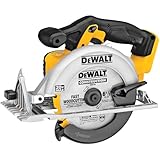


| Saw type | Typical maximum depth at 90 degrees | Best suited to | Main limitation |
|---|---|---|---|
| Compact 5-3/8-inch | About 1-11/16 inches | Trim boards, shelving, thin plywood, light repairs | Limited capacity in 2x lumber |
| 6-1/2-inch cordless | About 2-1/8 inches | Sheet goods, framing, mobile work, DIY projects | Battery and charger add cost and runtime limits |
| 7-1/4-inch corded | About 2-1/2 inches | 2x lumber, plywood, decking, frequent workshop use | Requires an outlet and managing a power cord |
| 7-1/4-inch cordless | About 2-9/16 inches | Framing, remodeling, outdoor work, job-site mobility | Heavier investment in batteries and chargers |
| 8-1/4-inch or larger | Roughly 2-7/8 to 3-1/8 inches | Deep cuts, heavy framing, demanding production work | Usually heavier and less convenient for beginners |
A 7-1/4-inch blade is the most versatile starting point because it can cut a standard 2×4 in one pass at 90 degrees and leaves room for common replacement blades. A compact saw makes sense when weight, storage, and occasional use are more important than maximum capacity.
Blade size and cutting depth
Do not choose by blade diameter alone. Check the manufacturer’s published cutting capacity at both 90 and 45 degrees. Angled cuts are shallower, and some saws lose more capacity than others when the shoe is tilted.
For example, a saw might cut approximately 2-1/2 inches at 90 degrees but only about 1-5/8 inches at 45 degrees. That is enough for many 2x boards at a bevel, but not necessarily for thicker posts or stacked material. Avoid stacking boards to make one cut with a handheld saw; secure each workpiece properly and make separate cuts when practical.
Look for a clearly marked depth adjustment with a secure locking lever. A loose depth mechanism can change during a cut, while an adjustment that is difficult to read encourages beginners to set the blade too deeply. Set the blade so its lowest tooth extends only slightly below the material—usually about 1/8 to 1/4 inch for sheet goods. This reduces unnecessary tooth exposure and can improve control.
Corded or cordless: choose by your work pattern
Choose corded power when
- You work mainly in a garage or workshop with a nearby outlet.
- You make long cuts or many repeated cuts.
- You want the lowest purchase cost for high available power.
- You do not already own batteries from a tool platform.
A corded 7-1/4-inch saw commonly uses a 13- to 15-amp motor. It can run continuously, but the cord can snag on the workpiece or enter the cutting path. Use a properly rated extension cord only when necessary, keep it behind the saw, and inspect it for damage.
Choose cordless power when
- You work outdoors, on ladders, during remodeling, or in unfinished spaces.
- You already own compatible batteries and a charger.
- You value quick setup more than unlimited runtime.
- You need to carry the saw between rooms or job sites.
Battery voltage is not a complete performance measurement. A higher-voltage system may provide more cutting power, but weight, battery capacity, blade sharpness, and the material being cut also affect results. A typical 18V or 20V-class cordless saw with a 5.0Ah battery may deliver roughly 100–200 feet of plywood cutting under practical conditions, but dense lumber, a dull blade, repeated bevel cuts, and cold batteries can reduce that substantially. Treat runtime figures as planning estimates, not guarantees.
A simple ownership calculation helps. If a cordless saw kit costs about $250–$450 and you expect 20 uses during the first two years, the tool-and-battery cost is approximately $12.50–$22.50 per use before replacement blades. A $100–$180 corded saw used near an outlet may cost about $5–$9 per use over the same period. Cordless becomes easier to justify when saved setup time and mobility matter.
Bevel range and adjustment quality
For basic crosscuts and rips, a 0-degree setting is sufficient. A bevel adjustment expands the saw’s usefulness for roof framing, trim, furniture components, and angled joints. A range of 0–45 degrees is a sensible beginner minimum; some models extend to 50 or 56 degrees for specialized work.
Prioritize a rigid shoe, an easy-to-read angle scale, and a positive stop at 45 degrees. The stop should return consistently, but verify the actual angle with a square before precision work. A tool-free bevel lever is convenient, while a firm locking mechanism matters more than a fancy scale. Some saws offer a 22.5-degree detent, which can help with common compound angles.
Blade type matters more than many beginners expect
The supplied blade is often a general-purpose carbide-tipped blade, but it may not be ideal for every task. Match the blade to the material and finish required.
- Framing blade: commonly 18–24 teeth on a 7-1/4-inch blade; fast and suitable for construction lumber, but leaves a rougher edge.
- General-purpose blade: commonly 24–40 teeth; a useful compromise for plywood, boards, and occasional remodeling.
- Fine-finish blade: commonly 40–60 teeth; produces cleaner plywood and crosscuts, but cuts more slowly and can heat up if forced.
- Specialty blades: available for laminate, aluminum, fiber-cement, and other materials; use only a blade specifically rated for the saw and material.
Confirm the blade diameter and arbor size before buying replacements. A blade must also match the saw’s maximum rated speed. Never install a blade with missing, cracked, or heavily damaged carbide teeth. A dull blade increases feed pressure, heat, wandering, and kickback risk.
Guide-rail compatibility and straight cuts
If you expect to cut cabinet panels, doors, countertops, or long plywood strips, investigate guidance before buying the saw. A side fence helps with narrow, repeated cuts, but it is not the same as a guide rail.
Guide rails usually use an anti-slip underside and a straight edge that the saw’s shoe follows. Some saws accept a manufacturer-specific rail directly; others require an adapter, and some are not designed for rail use. Check the manufacturer’s compatibility list rather than assuming every 7-1/4-inch saw will fit every rail.
For a beginner cutting a 48-inch-wide plywood sheet, a guide rail can be more valuable than a larger motor. If the saw requires an adapter, include the adapter and rail in the total budget. A clamp-on straightedge is a lower-cost alternative, but measure the offset from the saw shoe to the blade and position the guide accordingly.
Safety features worth paying for
- Lower blade guard: should retract smoothly and return fully without sticking.
- Spindle lock: makes blade changes easier, though you still need the correct wrench and proper tightening.
- Electric brake: stops the blade quickly after the trigger is released; useful when setting the tool down.
- Trigger lockout: helps prevent accidental starting, but it is not a substitute for removing the battery or unplugging the tool during blade changes.
- Dust port: useful indoors, especially with plywood and MDF, when connected to a suitable extractor.
- Bright cut-line indicator: helps follow a marked line, although the indicator may need checking against the actual kerf.
- LED light: improves visibility in dim areas but does not replace adequate workspace lighting.
For left-handed users, check blade position and handle layout. A blade on the left or right side can change visibility, balance, and where sawdust is discharged. Choose the layout that gives you the clearest view while keeping both hands in safe positions.
A practical decision matrix
| Your situation | Recommended choice | Features to prioritize |
|---|---|---|
| Lowest cost, workshop use, frequent long cuts | 7-1/4-inch corded saw | 13–15 amps, rigid shoe, 0–45-degree bevel, replaceable brushes or durable motor design |
| Occasional repairs and limited storage | 6-1/2-inch cordless or compact 5-3/8-inch saw | Light weight, battery availability, clear depth scale, compact case |
| Remodeling, outdoor work, and repeated cuts | 7-1/4-inch cordless saw | Brushless motor, 5.0Ah or larger battery option, rafter hook, electric brake |
| Cabinet panels and cleaner long cuts | Saw compatible with a guide rail | Rail adapter or direct fit, low-clearance shoe, dust extraction, fine-finish blade |
| Heavy framing or unusually thick stock | 7-1/4-inch high-power or 8-1/4-inch saw | Deep capacity, robust shoe, strong bevel lock, appropriate heavy-duty blade |
Ownership costs and maintenance
Blades are the first consumable most owners replace. Keep a framing blade for construction cuts and a finer blade for visible edges instead of forcing one blade to do everything. Remove resin and pitch according to the blade manufacturer’s guidance; do not use a damaged blade simply because it still spins.
After each project, unplug the corded saw or remove the cordless battery before clearing dust. Brush debris from the lower guard, shoe, vents, and depth mechanism. Check that the guard returns without hesitation and that the arbor bolt, fence, and bevel lever are secure. Store the saw with the blade protected and the cord loosely coiled.
Common beginner mistakes include cutting without supporting the offcut, twisting the saw to correct a wandering line, setting the blade too deep, using a fine blade for fast framing, and allowing the cord or battery to interfere with the cut. Support large panels on sacrificial foam or properly spaced supports, mark the waste side of the line, and let the saw’s motor maintain speed rather than pushing aggressively.
Bottom line
Choose a 7-1/4-inch corded saw for the best value and continuous workshop power, a 7-1/4-inch cordless model for mobility and heavier work, or a 6-1/2-inch compact saw for lighter projects and easier handling. Whichever format you select, give equal attention to cutting depth, bevel locking, blade availability, guard movement, and guide-rail compatibility. Those details determine whether the saw remains useful after the first project—not just how impressive its motor specification looks.