What's inside
- Best Budget Circular Saws at a Glance
- Our Picks by Situation
- SKIL 5280-01: Best Budget Circular Saw for Most DIY Users
- DEWALT DWE575SB: Best Upgrade for Regular Use
- Makita 5007F: Best Traditional Workhorse
- Ryobi CSB125: Best for Infrequent Light-Duty Work
- What to Compare Before Buying
- Ownership Costs and Maintenance
- Final Recommendation
- Related Guides
- Best Budget Circular Saws at a Glance
- Our Picks by Situation
- SKIL 5280-01: Best Budget Circular Saw for Most DIY Users
- DEWALT DWE575SB: Best Upgrade for Regular Use
- Makita 5007F: Best Traditional Workhorse
- Ryobi CSB125: Best for Infrequent Light-Duty Work
- What to Compare Before Buying
- Ownership Costs and Maintenance
- Final Recommendation
- Related Guides
As an Amazon Associate I earn from qualifying purchases. This post may contain affiliate links at no extra cost to you.
The best budget circular saw for most DIY woodworkers is the SKIL 5280-01: it combines a 15-amp motor, a 7-1/4-inch blade, 2-7/16-inch maximum cut depth, and a 51-degree bevel at a typically low market price. For heavier or more frequent work, the DEWALT DWE575SB is the better upgrade; for occasional repairs, a basic 13-amp saw is often sufficient.
As an Amazon Associate we earn from qualifying purchases at no extra cost to you.

Sections
- Best Budget Circular Saws at a Glance
- Our Picks by Situation
- SKIL 5280-01: Best Budget Circular Saw for Most DIY Users
- DEWALT DWE575SB: Best Upgrade for Regular Use
- Makita 5007F: Best Traditional Workhorse
- Ryobi CSB125: Best for Infrequent Light-Duty Work
- What to Compare Before Buying
- Ownership Costs and Maintenance
- Final Recommendation
- Related Guides
Best Budget Circular Saws at a Glance
| Model | Motor | Maximum depth at 90° | Approx. depth at 45° | Bevel range | Approx. bare-tool or saw weight | Typical market range |
|---|---|---|---|---|---|---|
| SKIL 5280-01 | 15 amps, corded | 2-7/16 inches | About 1-7/8 inches | 0–51° | About 8.7 lb | $45–$75 |
| DEWALT DWE575SB | 15 amps, corded | 2-9/16 inches | About 1-5/8 inches | 0–57° | About 8.8 lb | $120–$170 |
| Makita 5007F | 15 amps, corded | 2-1/2 inches | About 1-3/4 inches | 0–45° | About 10.6 lb | $100–$150 |
| Ryobi CSB125 | 13 amps, corded | 2-7/16 inches | About 1-7/8 inches | 0–51° | About 7.5 lb | $40–$70 |
Published dimensions can vary slightly by revision, blade type, and measuring method. The useful comparison is not the last fraction of an inch, but whether the saw can cut your thickest material without forcing the blade to its limit.
Our Picks by Situation
| Your situation | Best fit | Why |
|---|---|---|
| Lowest sensible price for home projects | SKIL 5280-01 | 15-amp power, useful bevel range, and strong capacity for sheet goods and dimensional lumber. |
| Frequent remodeling or framing | DEWALT DWE575SB | More refined adjustments, electric brake, durable magnesium shoe, and a deeper maximum cut. |
| General woodworking with a proven conventional design | Makita 5007F | Powerful motor and a rigid base plate suited to repeated straight cuts. |
| Light-duty repairs and occasional cuts | Ryobi CSB125 | Lighter and inexpensive while still handling standard 2-by lumber and 3/4-inch sheet material. |
SKIL 5280-01: Best Budget Circular Saw for Most DIY Users
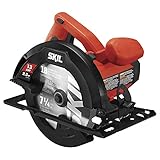
The SKIL 5280-01 is the strongest value choice when the saw will be used for shelving, garden projects, furniture components, flooring underlayment, and occasional framing. Its 15-amp motor matches the power class of substantially more expensive corded saws, and its 2-7/16-inch cut at 90 degrees is enough for a standard 2-by board, whose actual thickness is 1-1/2 inches.
The 51-degree bevel range is particularly useful at this price. The bevel lever is not as refined as the hardware on professional saws, so check the angle with a square before repeated compound cuts. The stamped steel base plate keeps the cost down, but it can bend if the tool is dropped or used as a pry bar. That matters more than a small difference in motor output: a distorted shoe can make otherwise accurate cuts wander.
DEWALT DWE575SB: Best Upgrade for Regular Use
The DWE575SB costs more than a basic budget saw, but it earns consideration when the tool will be used every week. Its 15-amp motor and 2-9/16-inch 90-degree capacity provide a little more clearance, while the magnesium base plate is lighter and generally more resistant to deformation than a thin stamped steel shoe.
Its bevel range extends to 57 degrees, and the adjustment hardware is easier to read and lock consistently. The electric brake stops the blade faster after the trigger is released, which is useful when making many cuts. This model is still a corded saw, so it avoids the battery and charger cost associated with cordless systems. Choose it when accuracy, repeated setup, and long-term ownership matter more than the lowest purchase price.
Makita 5007F: Best Traditional Workhorse
The Makita 5007F is a practical middle-ground choice. It uses a 15-amp motor, cuts up to about 2-1/2 inches at 90 degrees, and has a rigid base plate that supports controlled straight cuts. Its maximum bevel is 45 degrees rather than 50 degrees or more, but that covers the bevel work most DIY projects require.
At roughly 10.6 pounds, it is heavier than the SKIL and DEWALT models in this comparison. That extra weight can help the saw feel planted on long cuts, but it becomes tiring during overhead work or when breaking down a large number of panels. It is a good option for a workshop where durability and predictable handling are more important than minimum weight.
Ryobi CSB125: Best for Infrequent Light-Duty Work
The 13-amp Ryobi CSB125 is adequate for common household projects and is lighter than many 15-amp alternatives. It can cut standard dimensional lumber and sheet goods, and its 51-degree bevel capacity gives it more versatility than its low price suggests.
The trade-off is reduced reserve power when cutting wet lumber, dense hardwood, or several boards in succession. Feed the saw steadily rather than pushing hard. If the motor bogs repeatedly, use a sharper blade, reduce the cutting depth to just below the workpiece, and allow the motor to recover. For occasional use, these limitations may be acceptable; for framing or production-like work, choose a 15-amp model.
What to Compare Before Buying
Cut depth at 90 and 45 degrees
At 90 degrees, a 7-1/4-inch saw should cut ordinary 2-by material with room to spare. At 45 degrees, available depth drops significantly. If you routinely make bevel cuts through 2-by lumber, look for at least about 1-3/4 inches of 45-degree capacity and confirm the figure in the manufacturer’s specifications.
Set the blade only slightly deeper than the material. For a 3/4-inch plywood panel, about 7/8 inch of blade exposure is usually enough. Excess exposure increases the amount of tooth below the workpiece and can make kickback more severe without improving the cut.
Motor power
Amperage is a useful comparison among corded saws, but it is not a complete performance measurement. A 15-amp motor offers more reserve than a 13-amp motor when cutting thick lumber, hardwood, or damp material. Blade sharpness, tooth count, feed rate, and alignment also have major effects.
For a homeowner making a few cuts each month, 13 amps is usually adequate. For remodeling, decking, framing, or repeated sheet breakdown, 15 amps is the safer budget target.
Bevel adjustment
Look for a clearly marked scale, a lever or knob that locks firmly, and minimal play between the shoe and the motor housing. A large bevel range is useful only if the setting remains accurate. Before cutting a project part, make a test cut in scrap and verify the angle with a combination square.
Guide compatibility
A circular saw is only as straight as the reference it follows. All of these saws can be used with a clamped straightedge or a shop-made guide, but they are not automatically compatible with every proprietary track system. Check the shoe width, front and rear clearances, and whether the guide requires a special adapter.
For a low-cost setup, make a guide from a straight plywood strip fastened to a wider base. Trim the base with the saw once, then align its edge with the cut line on future workpieces. This is inexpensive and often more reliable than trying to adapt a rail the saw was not designed to accept.
Base-plate durability
The base plate, or shoe, is one of the first parts to reveal how a budget saw has been treated. Stamped steel is economical and sufficiently rigid for careful DIY use, but it may bend after a drop. Aluminum or magnesium shoes usually resist distortion better and glide more smoothly, though they do not make the saw immune to damage.
Ownership Costs and Maintenance
A realistic budget includes blades. A general-purpose 24-tooth carbide blade is useful for fast framing cuts, while a 40-tooth or 60-tooth blade produces cleaner plywood and furniture cuts. If a $15 blade is replaced after 30 substantial projects, its blade cost is about $0.50 per project. That small calculation explains why buying the cheapest possible saw while using dull blades often produces disappointing results.
- Unplug the saw before changing blades or clearing debris.
- Blow or brush dust from the blade guard pivot, motor vents, and shoe after use.
- Check that the lower guard snaps closed without sticking.
- Inspect the cord for cuts and keep it behind the saw during operation.
- Use the correct blade bore and diameter; never defeat the guard to fit an incompatible blade.
- Store the saw flat so the base plate is not bent by other tools.
The most common budget-saw mistakes are setting the blade too deep, forcing a dull blade, relying on an unverified bevel scale, and allowing the cord to pull the tool away from the cut line. Correcting those habits can improve results more than moving from a 13-amp to a 15-amp motor.
Final Recommendation
Choose the SKIL 5280-01 if you want the best budget circular saw for occasional DIY and woodworking at the lowest sensible cost. Choose the DEWALT DWE575SB when the saw will see regular remodeling or framing use and you value its lighter, tougher shoe and refined adjustments. The Makita 5007F is a dependable conventional workhorse, while the Ryobi CSB125 makes sense for light, infrequent cuts where low weight and low purchase cost come first.