What's inside
As an Amazon Associate I earn from qualifying purchases. This post may contain affiliate links at no extra cost to you.
Sections
Best flat-tooth table saw blades: choose by the cut you need
The best flat tooth table saw blade for clean crosscuts and dados is usually a 40-tooth, 10-inch blade with a flat-top grind (FTG), provided its kerf, arbor, and intended use match your saw and work. For frequent plywood crosscuts, prioritize a fine-finish blade with an ATB or combination grind; for square-bottom grooves, choose an FTG blade or a compatible dado set instead. Tooth shape matters as much as tooth count.
FTG teeth have flat cutting edges that leave a flat-bottomed kerf, making them useful for grooves, rabbets, and other cuts where a squared-off bottom matters. Their trade-off is that they tend to leave rougher crosscuts across wood fibers than alternating-top-bevel (ATB) teeth. A blade marketed for ripping or dados may therefore be a poor choice for visible plywood crosscuts.
As an Amazon Associate we earn from qualifying purchases at no extra cost to you.


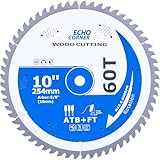

Compare the main choices
| Blade type | Typical tooth count | Typical kerf on 10-inch blades | Best fit | Crosscut finish |
|---|---|---|---|---|
| FTG rip blade | 24 | About 1/8 in. (0.125 in.) | Fast ripping in solid hardwood; joinery cuts when the blade width suits the setup | Rough to moderate |
| FTG general-purpose blade | 40 | About 1/8 in. (0.125 in.) | Mixed shop work and occasional flat-bottom grooves | Moderate; varies by tooth geometry and material |
| Fine-finish ATB blade | 60–80 | About 3/32–1/8 in. (0.094–0.125 in.) | Crosscutting hardwood and cutting plywood or veneered panels | Fine, with less tear-out when properly set up |
| Stacked dado set | Varies by set | Adjustable; often roughly 1/4–13/16 in. | Wide, square-bottom grooves and dados | Clean groove walls and bottom when correctly configured |
These are common configurations, not guarantees: actual dimensions vary by manufacturer. Check the blade label and manual before buying. A blade’s kerf is its cutting width; a thin-kerf blade removes less material and can suit lower-powered saws, but must be compatible with the saw’s riving knife and setup.
Which blade suits your situation?
- Mostly rip solid hardwood: A 24 tooth table saw blade with FTG teeth can clear chips quickly and make efficient lengthwise cuts. Expect a less polished crosscut edge, and use a dedicated crosscut blade when appearance matters.
- One blade for varied shop work: A 40-tooth combination blade is a practical compromise. Confirm whether it actually uses FTG teeth: many general-purpose blades use alternating bevels or a combination of tooth shapes rather than a flat-top grind throughout.
- Crosscut plywood or veneered panels: Choose a fine tooth blade for table saw use—commonly 60–80 teeth with ATB geometry—rather than choosing FTG solely for its name. A zero-clearance insert, scoring pass, or sacrificial backing can further reduce visible tear-out.
- Cut repeatable, wide dados: Use a dado set only if the saw manufacturer permits it and the arbor, flange, guard, and throat insert accommodate the setup. Do not assume a standard FTG blade can be stacked or that every saw accepts dado cutters.
- Occasional grooves with a standard blade: An FTG blade can make a narrow groove whose width matches its kerf. Multiple passes can widen it, but alignment and a flat bottom become harder to control; a router or dado set may be the better tool.
Tooth count is not a finish rating
More teeth generally mean smaller gullets and more cutting edges engaged in the work, which can produce a smoother cut at a suitable feed rate. But tooth count alone does not determine finish. Tooth grind, hook angle, blade sharpness, material, feed pressure, and saw alignment all matter. A 24-tooth FTG blade is built for fast ripping, not delicate crosscuts; a high-tooth-count ATB blade is usually better for plywood, but does not leave the same flat-bottom profile as FTG.
For hardwood crosscuts, a sharp 40–60 tooth crosscut or combination blade is often a better choice than a low-tooth-count FTG blade. For plywood, support the panel and keep the show face positioned according to the blade’s cutting direction and the saw’s setup; make a test cut on scrap before committing to a visible edge.
Check fit before you buy
Start with the saw manual, then verify the blade diameter, arbor-hole diameter, maximum speed rating, and kerf. Most contractor and cabinet table saws use 10-inch blades with a 5/8-inch arbor, but this is not universal. Never force a blade onto an arbor or use a blade whose speed rating is below the saw’s no-load speed.
Also check the riving knife. It should be appropriate for the blade’s kerf: a knife thicker than the kerf can bind, while an unsuitable thinner knife may not prevent the workpiece from closing behind the blade. Keep the guard and anti-kickback components installed when the operation allows. If a dado cut requires removing safety equipment, follow the saw maker’s instructions and use the correct dado insert; don’t improvise a setup.
Setup and care that protect cut quality
- Inspect the blade: Look for missing, cracked, or chipped teeth and any visible warping. Stop using a damaged blade.
- Clean off pitch: Resin buildup can increase friction and make cuts seem dull. Use a cleaner intended for saw blades, following its directions, and dry the blade before reinstalling.
- Align the saw: Check blade-to-miter-slot alignment and fence parallelism using the saw manual’s procedure. Misalignment can burn stock, worsen finish, and increase binding risk.
- Feed steadily: Avoid forcing the cut or pausing in the work. Use a push stick or other appropriate aid to keep hands away from the blade.
- Sharpen or replace as needed: Carbide teeth can often be professionally sharpened, but the cost may not make sense for an inexpensive blade. Dullness, burning, and increasing feed resistance are signs to inspect the blade and setup—not reasons to push harder.
For many small shops, owning two blades is more useful than asking one FTG blade to do everything: a 24-tooth rip blade for solid stock and a 60-tooth ATB blade for clean crosscuts and plywood. Add a compatible dado set only when wide grooves are regular work. That division of labor usually produces better edges and fewer compromises than relying on tooth count alone.