Our Top Picks
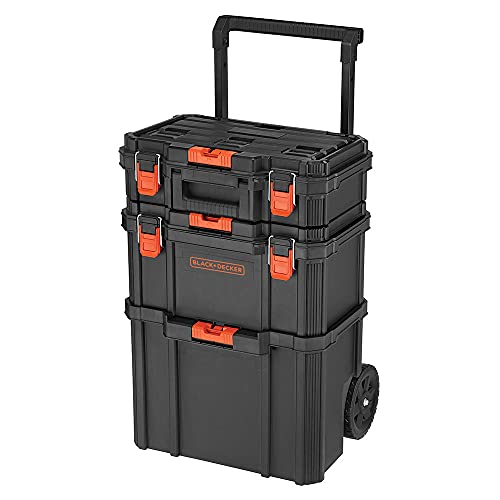 beyond by BLACK+DECKER BLACK+DECKER BDST60500APB Stackable Storage SystemSmall20 x 15.75 x 29 InchesCheck on Amazon
 CRAFTSMAN VERSASTACK XL Rolling Tower Tool Storage System22.1 inches22.1 x 17.98 x 33.3 inches33.9 PoundsCheck on Amazon
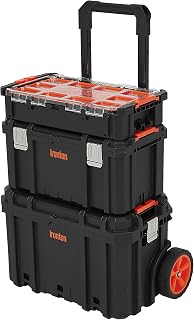
 Ironton Light-Duty Modular Rolling Toolbox System24.75 x 14.5 x 38.63 inches24.75 x 14.5 x 38.63 inches29.6 poundsCheck on Amazon


What's inside
As an Amazon Associate I earn from qualifying purchases. This post may contain affiliate links at no extra cost to you.
A rolling tool box almost never fails at the box. It fails at the caster that cracks on a gravel driveway, the latch that pops open in a truck bed, or the day you learn the base you bought two years ago no longer fits anything on the shelf. Choosing the best rolling tool box system is therefore less about one cart and more about committing to an ecosystem that still sells parts in five years.
Each section below leads with the criterion that separates a job site system from a garage novelty, then names who it suits. Everything here refers to the modular stacking families sold in the US at Home Depot, Lowe’s, Acme Tools, and Amazon, plus the standalone wheeled chests that still make sense if you are not building a fleet.
As an Amazon Associate we earn from qualifying purchases at no extra cost to you.




| System family | Stack method | Best fit | Watch for |
|---|---|---|---|
| Milwaukee PACKOUT | Cleat and side latches | Trades hauling many small parts | Full stacks get heavy on stairs |
| DeWalt ToughSystem 2.0 | Auto-latch onto the base | Truck bed and job site abuse | Older 1.0 parts may not cross over |
| Makita interlocking cases | Case-on-case interlock | Shops already deep in LXT | Fewer tote and bag options |
| Ridgid Pro Gear 2.0 | Rotating latch tabs | Value buyers at Home Depot | Narrower accessory catalog |
| Craftsman VersaStack | Lid latch pockets | DIY and light pro use | Lighter wheels and handles |
Sections
How to Choose the Best Rolling Tool Box System
Four things decide the outcome, in this order: wheel diameter and axle construction, latch and gasket quality, the published load rating for the exact base you buy, and the breadth of the accessory catalog you will be shopping from for the next decade. Cost per box is the fifth consideration, not the first. A cheap stack you cannot extend ends up more expensive than a mid-priced one you keep adding to.
Wheels and Axles: The Fastest Way to Sort Job Site From Garage
Under roughly five inches of wheel diameter, you are buying a smooth-floor product. That wheel drops into every expansion joint and stalls on cords and door thresholds. Seven inches and up with a wide tread clears curbs and gravel while the load leans back on two wheels, which is how a loaded stack actually travels. Prefer thermoplastic rubber or solid rubber over hard polypropylene, because the softer compound absorbs the shock that splits caster housings and will not scuff a finished floor. A steel axle in a sealed bearing outlasts a molded plastic pin by a wide margin. If the store allows it, load the base, tip it back, and roll it over a scrap 2×4. Handle flex and wheel chatter there predict failure on site.
Rolling base plus modular box kits
Buy the base and two boxes first, then add organizers once you know what you really carry. Filter by wheel diameter and confirm the base is the current generation for your brand, since older bases and newer boxes do not always latch together.
Latches and Seals: Ask What the IP Rating Certifies
Good systems auto-engage the latch when a box seats onto the base, so nothing rides loose between stops. For weather, the only claim with a test behind it is an IP code from IEC 60529: IP65 means dust tight plus protection from low-pressure water jets, while IP54 means limited dust ingress and splash resistance only. Phrases like weather resistant and job site tough certify nothing. Check the gasket as well, since a continuous molded gasket seated in a channel holds up far better than a foam strip glued to the lid, and metal-reinforced over-center latches keep that gasket compressed long after plastic hooks have relaxed. If batteries, a rotary laser, or a meter live in the stack, sealing is not optional.
Load Ratings and Stack Height
Every major manufacturer publishes a capacity figure and almost nobody reads it. Rolling bases in the big US systems commonly advertise totals in the low hundreds of pounds, with lower per-box limits; confirm the number on the spec sheet for the exact base and generation rather than the family as a whole. Then be honest about ergonomics. A three-box stack of hand tools and fasteners passes 100 pounds quickly, and that height puts the center of gravity above your grip on stairs. Two deep boxes with a shallow organizer on top is the layout most people settle into: heavy on the bottom, most-used box at waist height.
All-terrain rolling boxes with oversized wheels
If your day starts at the curb and ends in a basement, wheel size matters more than drawer count. Look for a steel axle, a locking telescoping handle, and a published load rating instead of a vague heavy-duty claim.
Matching the System to Your Trade
Remodelers and general contractors should buy for accessory breadth, because the value shows up in the tenth purchase rather than the first. Finish carpenters and cabinet installers want a narrow footprint, non-marking wheels, and shallow drawers for hardware and blades. Electricians, plumbers, and service techs gain most from small-bin organizers and sealed lids, since the stack doubles as rolling parts inventory. Fleet buyers should measure the bed between wheel wells and check whether the brand sells mounting plates before committing. Homeowners are the group most often oversold: one wheeled box with a lift-out tray usually beats a partial ecosystem.
- ✔ One base moves three or four boxes in a single trip
- ✔ Gasketed cases protect batteries, lasers, and meters
- ✔ Organizers detach and carry to the work
- ✔ Bases and boxes sell individually, so you can scale slowly
- ✘ Proprietary latches lock you into one brand
- ✘ A full stack gets heavy fast on stairs
- ✘ Wheels and handles are the usual failure points
- ✘ Cost per cubic foot is higher than a plain steel chest
Compact rolling tool boxes for home and garage
Most homeowners need one wheeled box with a lift-out tray, not a fleet. Skip the ecosystem, put the money toward a sealed lid and smooth casters, and keep the footprint narrow enough to park beside a car.
Rolling Tool Box System FAQ
Do modular systems from different brands work together? Not by design. Latch geometry and cleat spacing are proprietary, so a box from one brand will sit on another brand’s base but will not lock to it. Third-party adapter plates exist for some combinations, though they add height and rarely restore the auto-latch. Pick one ecosystem and stay in it.
How much weight can a rolling tool box carry? Base ratings in the major US systems generally land in the low-to-mid hundreds of pounds, with per-box limits well below that. Treat the figure as a structural limit rather than a target, because you still have to steer that mass over curbs and thresholds.
Is a steel rolling chest better than a plastic modular system? For static garage storage with heavy hand tools, a steel chest gives more capacity per dollar and better drawer slides. For anything that leaves the building daily, gasketed resin cases win on weight, sealing, and the ability to carry a single box to the work.
Judge these systems by the base and the wheels, not the drawer count in the product photo. Confirm the generation is current, get the load rating in writing, then buy the smallest configuration that solves this year’s work and grow it from there.
Check prices on Amazon →