Our Top Picks

What's inside
As an Amazon Associate I earn from qualifying purchases. This post may contain affiliate links at no extra cost to you.
Plywood does not fail at the cut line the way solid lumber does. It splinters. The face veneer on the exit side of the blade lifts, chips and feathers, and no amount of sanding brings that edge back once the veneer is torn. If you are hunting for the best circular saw blade for plywood, the problem you are actually solving is very specific: keeping thin, cross-grain face veneer supported while dozens of teeth pass through it per second.
The good news is that this is a solved problem, and it is solved cheaply. A plywood blade is not exotic. It is a high tooth count, alternate top bevel carbide blade with a thin kerf and a shallow hook angle. Once you understand why each of those four traits matters, you can walk any aisle at Home Depot, Lowe’s or an online listing page and sort the good from the bad in about ten seconds.
As an Amazon Associate we earn from qualifying purchases at no extra cost to you.




Sections
Quick comparison: blade types for sheet goods
The criterion that separates a good plywood blade from a bad one is tooth count relative to material thickness. You want at least three teeth engaged in the cut at all times, and in thin veneer you want many more than that. Here is how common blade categories stack up on a 7-1/4 inch circular saw.
| Blade type | Typical teeth (7-1/4 in) | Best use | Plywood edge quality |
|---|---|---|---|
| Framing / general purpose | 18 to 24 | Studs, joists, demolition | Poor, heavy tearout |
| Combination | 40 | Mixed rip and crosscut | Fair with tape and scoring |
| Fine finish crosscut | 56 to 60 | Trim, hardwood crosscut | Good |
| Plywood / paneling specialty | 60 to 80 | Sheet goods, veneer, melamine | Excellent |
| Melamine / laminate (TCG) | 80+ | Double-sided laminate, MDF core | Excellent, longest life |
Note the pattern. Nothing under 40 teeth belongs anywhere near a finished plywood edge, and the jump from 40 to 60 teeth is the single biggest visible improvement most people will make.
The four specs that decide the best circular saw blade for plywood
Tooth count. For 3/4 inch plywood on a 7-1/4 inch saw, 60 teeth is the practical sweet spot. It leaves a clean edge without generating so much heat that the blade burnishes the cut. For 1/4 inch underlayment, thin door skins and prefinished panels, 80 teeth is better because the veneer is thinner and needs more support per inch of travel. On a compact 6-1/2 inch cordless saw, expect the equivalent range to sit around 48 to 60 teeth, since the smaller circumference means fewer teeth cover the same tooth spacing.
Grind geometry. ATB, or alternate top bevel, is what you want. The teeth are beveled in alternating directions so each one acts like a knife point that severs veneer fibers at the surface instead of pushing them out. Higher bevel angles cut cleaner and dull faster. A triple chip grind, sometimes labeled TCG, has a flat raker tooth alternating with a chamfered tooth and is the standard choice for melamine, laminate and MDF core panels because those abrasive surfaces destroy sharp ATB points quickly. For raw birch, maple or oak plywood, ATB wins on edge quality.
Kerf. Thin kerf blades, roughly 0.059 to 0.071 inch, remove less material, load the motor less and matter enormously on cordless saws where runtime is finite. The tradeoff is stiffness. A thin kerf blade that has been abused or heated will deflect and wander in a long rip. Full kerf around 0.098 inch tracks straighter but demands more power.
Hook angle. This is the forward lean of the tooth face. Framing blades run aggressive positive hook angles of 15 to 20 degrees to self-feed through soft lumber. Plywood blades run low positive or slightly negative hook, generally under 10 degrees, so the tooth scrapes and slices rather than grabbing and lifting the veneer. Low hook angle is also the reason a good plywood blade feels slower to push. That resistance is the blade doing its job.
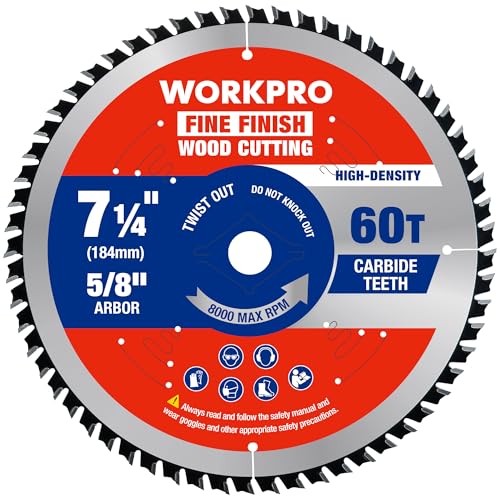
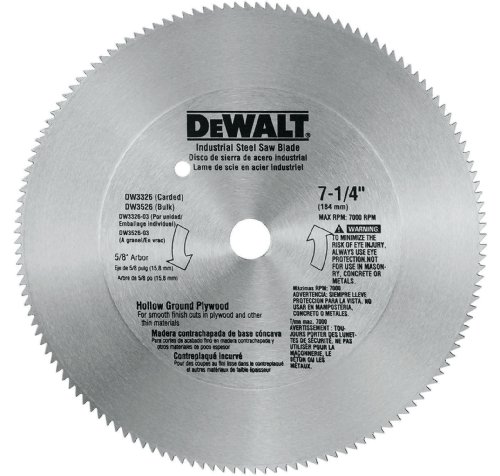
60-tooth thin kerf plywood and finish blade, 7-1/4 in
This is the default answer for most shops. A 60-tooth ATB thin kerf blade in the standard 7-1/4 inch, 5/8 inch arbor size handles 3/4 inch cabinet plywood, hardwood trim and the occasional crosscut in solid stock without complaint. Buy from a carbide-tipped line you recognize rather than the cheapest listing, because tip quality and braze consistency are where budget blades cut corners. Confirm the arbor size and that the diamond knockout matches your saw before ordering.
Matching the blade to the panel you are actually cutting
Panel construction changes the correct answer more than most buying guides admit.
Cabinet grade hardwood plywood with a thin birch or maple face veneer is the most tearout prone material in the shop. Use 60 to 80 teeth, ATB, and always cut with the good face oriented away from the blade’s exit direction. With a handheld circular saw the blade exits through the top surface, so the good face goes down.
Melamine and prefinished panels chip on both faces because the coating is brittle and there is no fiber to tear, only a surface to fracture. Move to a TCG grind, slow your feed rate, and consider a scoring pass at about 1/16 inch depth before the full cut.
Baltic birch is dense with many thin plies and glue lines. It dulls carbide faster than you expect. A high quality 60-tooth blade is fine, but plan on resharpening or replacement sooner.
Construction sheathing, OSB and subfloor do not need a fine blade at all. Cutting OSB with an 80-tooth blade wastes an expensive blade on adhesive-heavy material. A 24 or 40-tooth blade is the right tool there.
80-tooth blade for melamine, laminate and thin veneer
If your work is cabinet carcasses in prefinished melamine or you cut a lot of 1/4 inch panel stock, this is the category to buy. Look for a triple chip grind and a negative or near-zero hook angle. Expect it to feel slow in solid wood and expect faster dulling if you use it as a general purpose blade, so keep it dedicated to sheet goods.
Technique, blade guards and what to check before you cut
The criterion here is support. A blade cannot cut cleanly through material that is flexing.
Set blade depth so the teeth protrude only about 1/8 to 1/4 inch below the panel. Shallower depth means the teeth are traveling more downward than forward as they exit, which reduces lifting. Support the sheet on foam board or sacrificial lumber so the offcut cannot sag and pinch the blade. Clamp a straightedge or use a track saw guide instead of freehanding, because a wandering cut burnishes one side and tears the other. On difficult veneer, score the cut line with a utility knife or make a shallow first pass, then complete the cut at full depth. Painter’s tape along the cut line helps hold veneer down and is essentially free.
On the tool side, verify the blade’s maximum rated RPM meets or exceeds your saw’s no-load speed. Blades sold in the US should carry a marked maximum RPM and most quality carbide blades are manufactured to ANSI O1.1 safety requirements for circular saw blades. Never remove or wire back a blade guard, and check that the lower guard springs closed freely before every session. If your saw pulls to one side, the arbor washer, blade flange or the blade itself may be out of flat.
- ✔ High tooth count ATB blades cut veneer cleanly enough to skip edge banding rework
- ✔ Thin kerf reduces load and extends cordless runtime
- ✔ Inexpensive relative to the cost of ruined sheet goods
- ✔ A dedicated plywood blade keeps your general purpose blade from being worn out on abrasive panels
- ✘ Slower feed rate and more heat if you push hard
- ✘ Clogs and burns in thick solid wood and wet lumber
- ✘ Dulls quickly on OSB, particleboard and anything with adhesive or fasteners
- ✘ Thin kerf versions can deflect in long rips if the blade is warped or overheated
Frequently asked questions
How many teeth do I need for 3/4 inch plywood? Sixty teeth on a 7-1/4 inch blade is the practical answer for cabinet grade material. Forty teeth will work if you tape the cut line, score first and keep the good face down, but 60 gives a cleaner edge with less fuss. Step up to 80 teeth only for thin panels, melamine or prefinished veneer.
Can I use a plywood blade for framing or general lumber? You can, but you should not make a habit of it. High tooth count blades have small gullets that cannot clear the volume of chips solid lumber produces, so the blade heats, burns the wood and can bind. Keep a 24-tooth framing blade for lumber and a fine blade for sheet goods. Swapping takes under a minute.
Is a track saw better than a circular saw and straightedge for plywood? A track saw is more repeatable and its anti-splinter strip supports the veneer right at the cut, which reduces tearout on the top face. But a good circular saw with a 60-tooth blade, a clamped straightedge and proper panel support gets very close for a fraction of the cost. Blade selection matters more than which of the two saws you own.
What to buy and where to start
If you own one saw and want one upgrade, buy a 60-tooth thin kerf ATB blade in your saw’s diameter and arbor size, keep your existing framing blade for rough work, and add an 80-tooth or TCG blade later only if coated panels become a regular part of your work. Check the arbor bore, the marked maximum RPM and the kerf width before checkout, since those three numbers determine whether the blade fits and is safe on your specific saw. Price in the specialty range is reasonable enough that the blade usually pays for itself on the first sheet of cabinet plywood you do not have to recut.
Check prices on Amazon →