Our Top Picks
 WEN BL1080 10-Inch 80-Tooth Carbide-Tipped Ultra-Fine Finish Professional10 inches10 x 10 x 0 Inches1.6 PoundsCheck on Amazon


What's inside
As an Amazon Associate I earn from qualifying purchases. This post may contain affiliate links at no extra cost to you.
Trim work exposes a blade faster than anything else on a job site. The 40-tooth combination blade that shipped with your saw will cut primed finger-joint casing to length, but it leaves fuzz on the face, chips the paint film where the teeth exit, and turns a 45-degree miter into a joint you have to caulk closed. If you are filling and caulking to hide cut quality instead of seasonal movement, the blade is the bottleneck. The best miter saw blade for trim is not the priciest one on the pegboard, it is the one whose tooth count, grind geometry, and hook angle match both the stock you cut and the saw you already own.
Below is the short version of the tool-counter conversation: the specs that separate clean cuts from ragged ones, how to size a blade to your saw, and which blade belongs on which material.
As an Amazon Associate we earn from qualifying purchases at no extra cost to you.





| Blade Type | Typical Teeth (10 in / 12 in) | Who It Is For |
|---|---|---|
| General purpose ATB | 40-60 / 60-72 | Mixed framing and punch list work on one blade |
| Fine finish Hi-ATB | 80 / 96-100 | Softwood, poplar, primed MDF and finger-joint trim |
| Ultra-fine crosscut | 90-100 / 110-120 | Prefinished trim, veneered stock, hardwood casing |
| Triple chip (TCG) | 80 / 96 | PVC, cellular composite trim, aluminum edging |
| Negative hook finish | 80-100 / 96-120 | Sliding saws and thin, tear-prone moldings |
Sections
What Separates a Clean Trim Blade From a General-Purpose One
The criterion is how much wood each tooth takes and how it exits the fibers. More teeth means a smaller bite and less lifted fiber at the exit face, which is why 80 teeth on a 10-inch plate cuts glassier than 40. Diameter counts too: a 12-inch blade travels farther per revolution, so it needs roughly 96 to 120 teeth to match the finish an 80-tooth 10-inch blade leaves.
Grind is the other half. Standard ATB (alternate top bevel) blades bevel around 10 to 15 degrees, while Hi-ATB blades push that to roughly 30 to 40 degrees for a knife-like point that slices veneer and paint film instead of pushing it. Triple chip grind pairs a chamfered tooth with a flat one, which is what plastics and aluminum want. Look for micrograin carbide in the C3 to C4 finishing grades, laser-cut expansion slots, and an anti-vibration plate.
How to Choose the Best Miter Saw Blade for Trim
Start with fit. Diameter must match the saw’s rating, never larger than the manual allows, and the arbor is 5/8 inch on virtually every 10-inch and 12-inch miter saw sold here. Then read the plate: blades built to EN 847-1 are marked with kerf width and maximum safe speed, and that speed must exceed your saw’s no-load rpm, generally near 4,800 to 5,000 for 10-inch saws and 3,800 to 4,000 for 12-inch models.
Hook angle comes next. A positive hook pulls the blade into the work, which suits a table saw and works against a chop saw. For trim, 0 to negative 5 degrees keeps a slider from self-feeding into thin stock. Match kerf to power last: thin kerf plates near 3/32 inch load the motor less and suit cordless saws, while full kerf plates near 1/8 inch resist deflection on wide crown and long slide cuts.
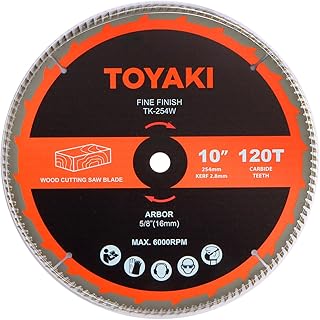
80-Tooth Fine Finish Blade, 10 in
For most interior trim, an 80-tooth Hi-ATB blade with a near-zero hook is the sweet spot, and the well-known fine finish lines all sit in this range. Confirm arbor size and stamped max rpm before you buy.
Match the Blade to the Trim Material
Painted softwood and poplar are forgiving, and an 80-tooth fine finish blade handles base, casing, and crown without complaint. MDF and primed finger-joint stock are harder on tooling, since resin binders and filler are abrasive and round over carbide points faster than solid wood. Keep the finish blade away from glue lines, adhesive, and anything hiding a brad.
Hardwood casing rewards restraint. Too many teeth plus a slow feed traps heat, and burnished oak or maple end grain shows every second of it, so an 80-tooth blade fed steadily beats a 120-tooth blade babied through the cut. PVC and cellular composite want TCG teeth and a negative hook, because heat welds chips back into the kerf. Prefinished and veneered molding is the hardest test: highest practical tooth count, plus a zero-clearance backer.
Triple Chip Blade for PVC and Composite Trim
If you install PVC, cellular composite, or aluminum edging, a TCG blade with a negative hook earns a dedicated slot in the truck. Check that it is rated for nonferrous metal before cutting aluminum.
Thin Kerf, Full Kerf, and Keeping the Edge
Thin kerf plates pull less current, which matters on cordless saws and on 12-inch machines living at the edge of a 15-amp circuit. The tradeoff is stiffness. A thin plate can deflect in a wide cut, and deflection shows up as a miter that closes at the top and gaps at the bottom. Stabilizer collars help on some saws, but they eat into capacity and do not fit every arbor.
Pitch buildup imitates a dull blade almost perfectly: burning, resistance, tearout. Clean the plate and gullets with a pitch remover before writing the blade off. Quality fine finish blades are worth resharpening, and bargain-bin blades generally are not.
- ✔ Cleaner exit fibers, so less filler and caulk
- ✔ Tight miters on both painted and stained trim
- ✔ Micrograin carbide holds a fine point for many cuts
- ✘ Slower feed rates and burns easily in dense hardwood
- ✘ Dulls fast if used on framing, adhesive, or fasteners
- ✘ Needs a square saw and zero-clearance support to show its value
Setup Mistakes That Get Blamed on the Blade
The criterion here is support where the teeth exit. Fibers blow out wherever nothing backs them, so add an auxiliary fence and a sacrificial MDF or plywood backer, then cut through it once so the slot is zero clearance. Much of what gets called blade chipping ends right there.
The rest is technique. Let the blade reach full speed before contact, feed steadily instead of dropping the head, and let it stop before lifting so the teeth do not clip the finished face on the way out. Check the 90 and 45 degree detents against a machinist square, confirm the arbor bolt is tight, and run dust collection so chips are not recut.
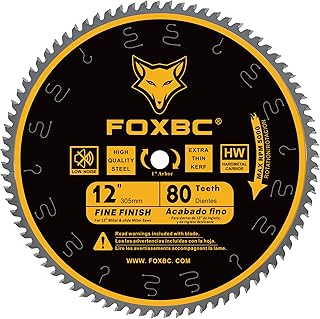
12 in Ultra-Fine Blade for Sliding Saws
On a 12-inch slider cutting prefinished or veneered molding, look for 96 to 120 teeth, a negative hook, and a stiff plate with expansion slots.
Trim Blade FAQ
How many teeth should a 12-inch trim blade have? Treat 96 as the working minimum and 110 to 120 for prefinished or veneered stock, since a 12-inch blade covers more distance per revolution and needs the extra count to leave the same finish.
Can I cut framing lumber with an 80-tooth blade? It will get through a 2×4, just slowly and with more heat, and you pay for it in edge life. Keep a 40 to 60 tooth blade for rough work and swap on trim day.
Will a premium blade fix a budget saw? It is the best dollar-for-dollar upgrade available, but bearing play, head flex, and a fence out of square set the ceiling. Tune the saw first, then buy the blade.
For most trim work the answer lands in one place: 80 teeth on a 10-inch saw or 96 to 120 on a 12-inch, near-zero hook, micrograin carbide, and a zero-clearance backer behind every cut. Add a TCG blade if you install synthetic trim.
Check prices on Amazon →