Our Top Picks


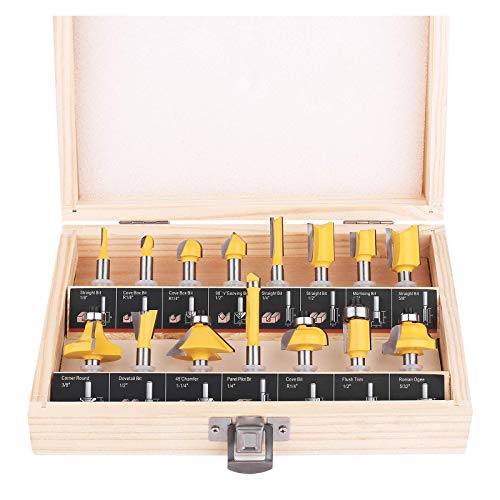


What's inside
As an Amazon Associate I earn from qualifying purchases. This post may contain affiliate links at no extra cost to you.
Most router bit starter sets are sold on piece count, and piece count is the least useful number on the box. A 35-piece kit built around soft carbide and thin bearings is worth less than six well-ground bits in a hard case. The job of the best router bits starter set is narrower than the packaging suggests: clean edges, square-shouldered grooves, and two or three decorative profiles, all running safely on the router you already own.
What follows is organized by the decisions you make standing at the shelf. Each section opens with the one criterion that separates a set worth buying from a set that will annoy you by the third project.
As an Amazon Associate we earn from qualifying purchases at no extra cost to you.


Sections
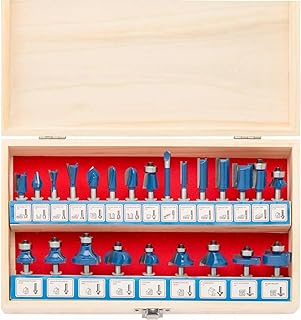
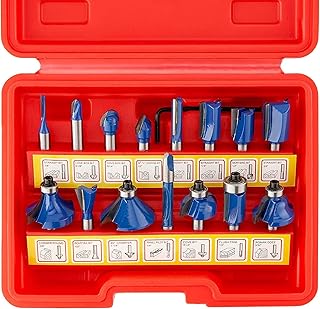
Starter Set Types Compared
The criterion here is usable bits, not total bits. Count the profiles you can name a project for. If that number is under six, the set is padded.
| Set type | Typical pieces | Shank | Who it suits |
|---|---|---|---|
| Compact starter kit | 12-16 | 1/4 in | First router, palm and trim router owners |
| Mixed general set | 24-35 | 1/4 in and 1/2 in | Handheld work plus occasional table use |
| Router table profile set | 5-8 | 1/2 in | Cabinet doors, panels, heavy edge profiles |
| Buy-as-you-go singles | varies | 1/2 in preferred | Woodworkers who know which cuts they repeat |
What Makes the Best Router Bits Starter Set Worth the Money
The separating criterion is carbide quality and the grind on the cutting edge, because that is what you feel in the second hour of use rather than on the first cut. Almost every set in the affordable tier is carbide tipped rather than solid carbide, and that is fine. What varies is grain size and grade.
Carbide grade and edge finish
Tooling carbide is classified by industry C-grades. Wood-cutting router bits commonly sit in the C2 to C4 range, with the finer micrograin grades holding a keener edge in hardwood and in abrasive sheet goods like MDF and melamine. A vendor who publishes a grade, specifies micrograin carbide, or states that edges are ground rather than left as-brazed is telling you something real. A vendor who only says industrial grade is telling you nothing.
Body, braze, and bearings
Look at the braze line where carbide meets steel. It should be thin, even, and free of voids; cheap sets show a wandering fillet. On bearing-guided bits such as flush trim and rabbeting bits, the bearing is the first component to fail, so favor sets that use standard replaceable bearings and include the retaining hardware. Tooling built to EN 847-1 and marked MAN is rated for hand feeding and uses chip-limiting bodies, which is a genuine safety feature once diameters get large.
Compact 1/4-Inch Carbide-Tipped Starter Kit
If you own a trim or palm router and nothing else, shop this category. Prioritize a kit that includes two straight bits, a bearing flush trim bit, a 1/4 in round-over, and a 45 degree chamfer, then ignore the piece count entirely. Check that the case indexes each bit separately instead of dropping them into foam that tears.
Shank Size: The Decision That Outlives the Set
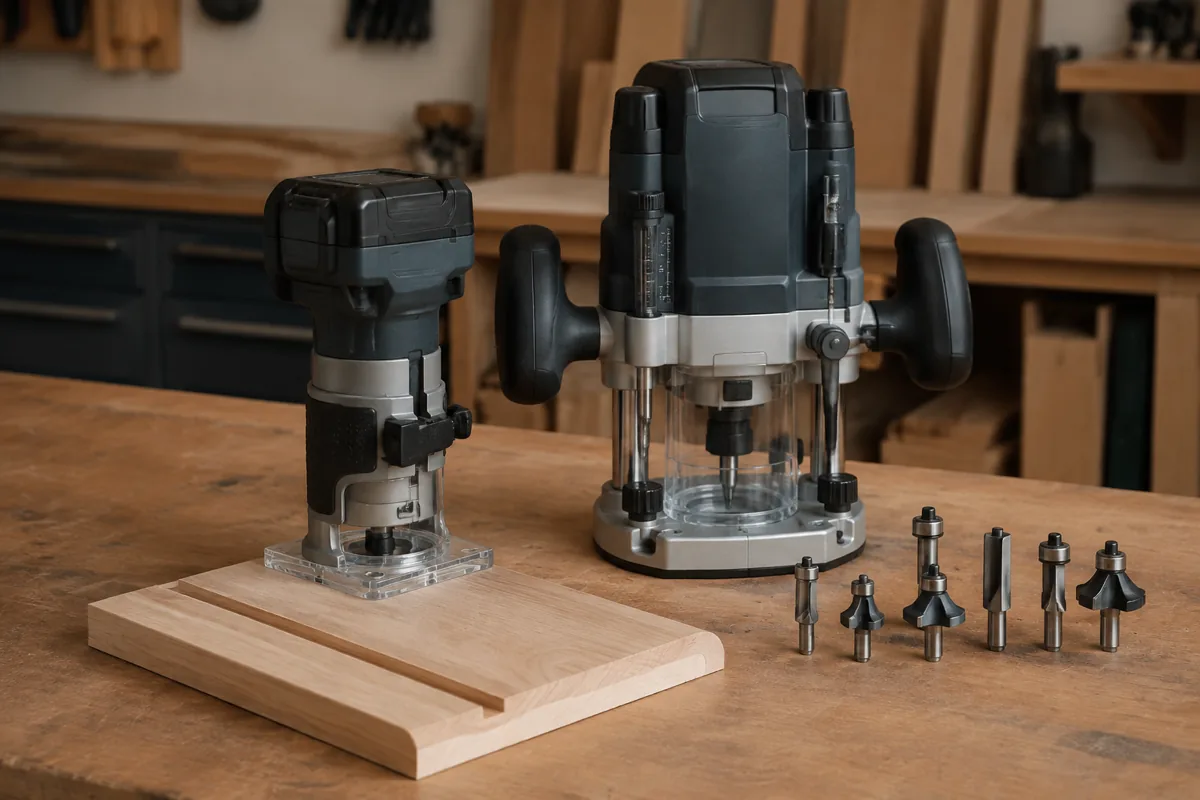
The criterion is simple: confirm which collets your router accepts before you look at a single set. Compact and trim routers typically take 1/4 in only, sometimes with an optional 3/8 in collet. Full-size routers in the 2 HP and up class usually ship with both 1/4 in and 1/2 in collets.
The rigidity difference is geometry, not marketing. A 1/2 in shank has four times the cross-sectional area of a 1/4 in shank, and resistance to bending rises with the fourth power of diameter, so the heavier shank deflects far less under load. In practice that means less chatter in hard maple, less burning, and a cleaner profile on large-diameter cutters. If a router table is anywhere in your future, buy 1/2 in shank wherever you have the choice.
Collet technique matters as much as the choice itself. Insert at least three quarters of an inch of shank, keep the bit from bottoming out in the collet, and never clamp on the relief undercut some makers grind near the shoulder. A bit that walks out mid-cut almost always walked out because it was clamped shallow.
The Profiles You Will Actually Use
The criterion is project frequency. About six profiles carry the large majority of beginner and intermediate work.
Straight bits in 1/4 in and 1/2 in cutting diameter handle dados, grooves, and template work. Bearing flush trim bits clean up plywood templates, edge banding, and glued-on solid edging. Round-overs in 1/8 in and 1/4 in radius soften shelf and tabletop edges and are the most-used decorative profile in furniture by a wide margin. A 45 degree chamfer covers edges plus miter work in a table. A rabbeting bit with an interchangeable bearing set cuts several rabbet depths from one cutter, which is real value in a starter kit. A cove or small Roman ogee gives you traditional trim.
Profiles that sit in the case for years: multi-form and stacked ogees, keyhole bits, panel pilots, and dovetails if you do not own a dovetail jig. Buying those later, individually, and in 1/2 in shank almost always costs less than buying them twice.
Mixed 1/4 and 1/2 Inch Set for Table Work
The right pick if you own a full-size router or a table. Look for a set where the large-diameter profile bits come in 1/2 in shank and only the small cutters are 1/4 in. Verify that every large bit lists a maximum RPM on the shank or the packaging, and confirm your router has variable speed before buying anything over two inches in diameter.
RPM Limits and Safe Setup
The criterion is bit diameter, and it is not negotiable by feel. Rim speed climbs with diameter, so a cutter that is comfortable at 24,000 rpm at half an inch across is hazardous at three inches. Commonly published guidance runs roughly like this: bits up to about 1 in can take full speed, 1 to 2 in come down toward 16,000 to 18,000, 2 to 2.5 in toward 12,000 to 16,000, and anything past 3 in belongs at 10,000 to 12,000 or lower. Follow the figure the manufacturer prints, not the range.
That is why a single-speed trim router paired with a set containing large panel-raising bits is a mismatch the day it arrives. It is also why depth of cut discipline matters: take shallow passes, on the order of an eighth of an inch per pass in hardwood, feed against bit rotation, and give the tool room to clear chips instead of packing them.
- ✔ One purchase covers nearly all beginner joinery and edge profiles
- ✔ Cost per bit is a fraction of buying the same profiles singly
- ✔ A fitted case keeps carbide edges from knocking together
- ✔ Lets you learn which profiles you reach for before spending on premium singles
- ✘ Large sets pad the count with profiles most people never use
- ✘ Budget carbide dulls faster in MDF, plywood, and hard maple
- ✘ Sets offered only in 1/4 in shank limit you if you later add a router table
- ✘ Bearings and retaining screws on the cheapest kits are the first failure point
Storage, Cleaning, and When to Upgrade
The criterion is whether the edge is dull or merely dirty, and most of the time it is dirty. Pitch and resin buildup imitates dullness by raising friction and heat. Clean bits with a dedicated pitch and resin remover or a citrus cleaner and a brass brush. Avoid caustic oven cleaners, which attack the cobalt binder holding the carbide together.
Store bits indexed and separated, keep bearings dry and lightly oiled, and if you touch up an edge at all, hone only the flat face with a fine diamond plate. Profiled edges belong at a sharpening service. When the two or three bits you use constantly are worn, replace those with premium singles rather than buying another full kit.
Premium Single Bits, Bought One at a Time
This is the upgrade path most woodworkers end up on. Established lines such as Whiteside, Freud, Amana, and CMT cost more per bit and hold an edge considerably longer in abrasive material. Buy singles for the profiles you use weekly and let the starter set cover occasional cuts.
Router Bit Starter Set FAQ
Is a 1/4 in or 1/2 in shank better in a starter set? Buy for the router you own. If your router takes 1/4 in only, a 1/4 in set is the correct purchase and will cut cleanly within its diameter limits. If your router accepts both, choose 1/2 in for anything above roughly an inch of cutting diameter, since the heavier shank resists deflection and chatter far better.
How many bits do I actually need to start? Six to eight will cover most projects: two straight bits, a bearing flush trim, two round-over radii, a chamfer, a rabbeting bit, and one decorative profile you like. Bigger kits are fine when the price per usable bit is still lower, but do not pay extra for the count itself.
Can I sharpen carbide router bits at home? Lightly, and only on the flat face, using a fine diamond hone and a few even strokes. Never work the profiled side, because you change the cutting geometry and the bit stops cutting true. Bearing-guided and profiled bits are best sent to a sharpening service, and inexpensive bits are usually cheaper to replace than to service.
Buy for the router in your hand and the joints you actually cut, treat piece count as noise, and expect to replace your two most-used bits with premium singles inside a year. That is a healthy sign the set did its job.
Check prices on Amazon →