What's inside
- How to Choose a Jobsite Table Saw
- Start with the cut you actually need
- The specifications that change jobsite performance
- Fence design often matters more than extra motor power
- Safety systems: useful only when kept in place
- Stand stability versus transport size
- Dust collection and cleanup realities
- Choose by situation
- Ownership costs and common mistakes
- Final buying checklist
- Related Guides
- How to Choose a Jobsite Table Saw
- Start with the cut you actually need
- The specifications that change jobsite performance
- Fence design often matters more than extra motor power
- Safety systems: useful only when kept in place
- Stand stability versus transport size
- Dust collection and cleanup realities
- Choose by situation
- Ownership costs and common mistakes
- Final buying checklist
- Related Guides
As an Amazon Associate I earn from qualifying purchases. This post may contain affiliate links at no extra cost to you.
Sections
- How to Choose a Jobsite Table Saw
- Start with the cut you actually need
- The specifications that change jobsite performance
- Fence design often matters more than extra motor power
- Safety systems: useful only when kept in place
- Stand stability versus transport size
- Dust collection and cleanup realities
- Choose by situation
- Ownership costs and common mistakes
- Final buying checklist
- Related Guides
How to Choose a Jobsite Table Saw
To choose a jobsite table saw, match its rip capacity, fence accuracy, motor performance, safety features, stand, dust control, and transport size to the material you cut and the places where you work—not simply to the highest headline specification.
Start with the cut you actually need
Most portable table saws are designed for sheet goods, framing lumber, trim, and general remodeling rather than large-scale cabinet production. Your first decision is whether the saw can support the widest repeated cut you expect to make.
As an Amazon Associate we earn from qualifying purchases at no extra cost to you.


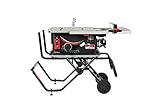
- Up to 24 inches: suitable for flooring, narrow shelves, trim, and ordinary framing work.
- 24 to 30 inches: a useful range for ripping half sheets, cabinet components, and wider boards.
- 30 inches or more: better for breaking down plywood and making repeated wide cabinet cuts, but the saw usually becomes heavier and needs more room around it.
Remember that published rip capacity is measured from the blade to the far side of the fence. It does not tell you how safely one person can support a full sheet. For 4-by-8-foot plywood, a separate outfeed table, roller support, or a second person may matter more than another few inches of capacity.
The specifications that change jobsite performance
| Feature | Practical target | What it changes on site |
|---|---|---|
| Rip capacity | 24–30 inches for general remodeling; 30+ inches for frequent sheet work | How wide a panel can be cut against the fence without improvised extensions |
| Motor | 15-amp corded motor or a high-output brushless cordless system | Whether the saw maintains speed in dense lumber and long rips |
| Blade size | 10-inch blade, commonly 24–60 teeth depending on the cut | Cut depth, availability of blades, and finish quality |
| Maximum cut depth | About 3-1/8 inches at 90 degrees for many 10-inch saws | Whether it can cut common 2-by material in one pass |
| Fence travel | At least 24 inches, with a rigid locking rail | How easily wide rips can be repeated accurately |
| Weight | Approximately 45–75 pounds for a portable saw and stand | Balance between carrying effort, rigidity, and setup time |
| Dust port | 2-1/2-inch port, ideally with enclosed blade housing | How much dust reaches the floor, tool, and operator |
Motor power is more than the amp rating
A 15-amp corded motor is a common choice because it can deliver sustained power without battery changes. Its real performance depends on the extension cord, circuit, blade sharpness, and electronic overload control. A long, undersized extension cord can cause voltage drop and make a capable saw feel weak. For a portable corded saw, use a heavy-duty cord appropriate for the distance and keep the blade clean and sharp.
Cordless models are useful when unfinished sites lack reliable power or when carrying a cord would create a trip hazard. Their output depends on battery voltage, amp-hour capacity, temperature, and the specific battery platform. A high-output battery may cut aggressively but add substantial weight and cost. Cordless is most compelling for punch-list work and short cutting sessions; corded power usually makes more sense for continuous production.
Blade height and bevel adjustment
Blade height should be easy to adjust precisely and should lock without excessive play. Set the blade only slightly higher than the workpiece—roughly the height of the gullets above the material for many cuts. This reduces unnecessary exposed blade while maintaining proper cutting action. A saw that reaches approximately 3-1/8 inches at 90 degrees can normally cut 2-by stock in one pass, while bevel cuts reduce effective depth.
Check whether the bevel scale is readable and whether the adjustment mechanism holds its setting when the saw is moved. For furniture and cabinetry, repeatable 45-degree bevels matter more than an advertised maximum angle that is difficult to set accurately.
Fence design often matters more than extra motor power
The fence is the reference surface for every rip cut. Choose one that is straight, stiff, and capable of locking at both the front and rear. A fence that clamps only at the front can deflect or skew, especially when the workpiece presses against it.
- Rack-and-pinion fences: quick to position and convenient for repeated adjustments, particularly when the handwheel moves both sides together.
- Telescoping fences: useful when the saw must remain compact for transport but still offer wider rip capacity at the jobsite.
- Traditional sliding fences: simple and fast, but they require the operator to verify parallel alignment after moving them.
Before buying, look for a fence face that is tall enough to guide sheet goods and low enough to permit narrow cuts and accessories. A fence that is difficult to square encourages workarounds, which are a common source of inaccurate cuts and kickback.
Safety systems: useful only when kept in place
A riving knife helps keep the kerf open behind the blade and reduces the chance that the material will pinch the blade. A blade guard helps contain contact with the spinning blade, while anti-kickback pawls can help resist material moving backward. Prefer a tool-free or quick-release system that can be fitted for ordinary through-cuts without removing half the assembly.
Some table saws use flesh-detection technology that can stop or drop the blade after detecting contact. Such systems can add significant cost and may require a replaceable brake cartridge or other consumable after activation. They do not replace the fence, riving knife, push sticks, or safe hand placement, but they can be a meaningful choice for people who prioritize an additional layer of protection.
For narrow rips, budget for push sticks or push blocks. Keep hands out of the blade’s path, and never use the fence as a guide for the offcut when the offcut is trapped between the blade and fence.
Stand stability versus transport size
A saw that folds quickly is not automatically a good portable saw. Look at the contact points, wheel size, leg locks, and how much the stand flexes when a heavy board is pushed through. Larger wheels roll over gravel and thresholds more easily; small wheels keep the folded package smaller but can be frustrating on uneven ground.
For frequent solo loading, a 45- to 55-pound saw with an integrated folding stand may be easier to use than a 70-pound high-capacity model. For a crew that unloads once each morning, the heavier saw may repay its weight with a more stable table and fence. Measure the folded dimensions against your vehicle, storage rack, and stairways. Also allow room for the fence, miter gauge, cord, and blade accessories; these often become separate loose pieces.
Dust collection and cleanup realities
A 2-1/2-inch dust port is compatible with many shop vacuums, but collection performance depends on how enclosed the blade chamber is. Open-sided portable saws may eject dust even when connected to a vacuum. A cyclone separator or pre-filter can protect the vacuum filter during large plywood jobs, while a fine dust extractor is preferable when cutting composite sheet goods indoors.
Inspect the throat plate and blade housing regularly. Packed sawdust can interfere with height adjustment, bevel movement, and the riving knife. Unplug a corded saw or remove the battery before cleaning. Do not rely on compressed air alone in an enclosed workspace; it can redistribute fine dust throughout the room.
Choose by situation
| Your situation | Best fit | Why |
|---|---|---|
| Occasional homeowner repairs, limited storage | Compact 10-inch saw, roughly 45–55 pounds, 24-inch rip capacity | Lower carrying burden and enough capacity for common trim and framing cuts |
| Remodeler cutting plywood weekly | 15-amp saw or high-output cordless model, 28–32-inch capacity, rolling stand | Better support for sheet goods and faster setup between rooms |
| Cabinet or finish carpenter on site | Rigid fence, low-play bevel mechanism, accurate miter slots, strong dust port | Repeatability and clean cuts matter more than minimum folded size |
| New user prioritizing protection | Saw with a complete guard and riving-knife system; consider active safety technology | Features are more likely to help when they are easy to install and use |
| Remote site without dependable power | Cordless saw on a battery platform you already own, with at least two high-capacity batteries | Eliminates generator and extension-cord dependence, but preserves a backup power source |
Ownership costs and common mistakes
Include blades, batteries, cartridges where applicable, push sticks, and a dust separator in the ownership budget. A simple cost-per-use calculation can clarify the choice: if a cordless saw and two batteries cost $900 and you expect 60 substantial jobs, the equipment cost is about $15 per job before blades and wear parts. A $500 corded setup used 20 times costs $25 per use, even though its purchase price is lower. The better value depends on how often you will actually carry and operate it.
The first parts to wear are usually the blade, throat plate, fence faces, stand hardware, and adjustment gears—not the motor. Replace a dull or damaged blade instead of forcing the saw through material. Keep the table waxed with a suitable dry lubricant, verify the fence is parallel to the blade, tighten loose stand fasteners, and store the saw dry. Never use a warped fence or a cracked throat plate.
Final buying checklist
- Confirm the rip capacity against your widest regular cut.
- Check that the fence locks squarely at both ends.
- Verify the blade reaches your common stock thickness at 90 degrees.
- Test whether the stand is stable on uneven surfaces and manageable for one person.
- Make sure the guard and riving knife can be installed without tools or complicated alignment.
- Measure the folded saw, not just the tabletop, against your vehicle and storage space.
- Price replacement blades, batteries, safety cartridges, and dust-collection accessories.
The best jobsite table saw is the one whose capacity matches your material, whose fence stays accurate after transport, and whose safety and setup systems you will use on every cut. Prioritize repeatability and stability before chasing the largest rip number or the smallest folded package.