What's inside
As an Amazon Associate I earn from qualifying purchases. This post may contain affiliate links at no extra cost to you.
For straightening a long board, a jointer plane and a fore plane can both remove twist, bow, and high spots. They do not do the job in quite the same way. The practical difference is length: a jointer plane bridges hollows more reliably, while a fore plane removes stock faster and feels less awkward on shorter work.
As an Amazon Associate we earn from qualifying purchases at no extra cost to you.


Sections
Our Top Picks


The basic difference
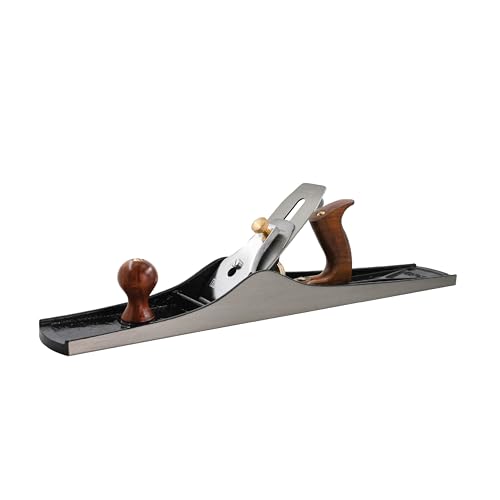
A jointer plane is typically 22 to 24 inches long, such as a traditional No. 7 or No. 8 pattern. Its long sole rides across the board and references the areas that are already high. That makes it the better tool for producing a genuinely straight face and edge on long boards.
A fore plane is usually around 17 to 20 inches long, commonly based on a No. 5 pattern. It has a wider, thicker shaving than a smoothing plane and is intended for fast stock removal. Its shorter sole follows changes in the surface more readily, so it is quicker at attacking humps but less effective at proving that a long board is flat.
| Feature | Fore plane | Jointer plane |
|---|---|---|
| Typical length | 17–20 inches | 22–24 inches |
| Main job | Fast flattening and rough preparation | Final straightening and jointing |
| Best board length | Short to medium boards, or heavy stock removal | Long boards and edges that must meet cleanly |
| Typical shaving | Moderate to thick | Thin to moderate |
| Main weakness | Can follow long hollows | Slower and more tiring for rough work |
When a fore plane makes sense
Choose a fore plane when the board is rough-sawn, badly cupped, or has obvious high areas that need removing. A cambered iron—the cutting edge slightly rounded—lets the plane take a wide, aggressive shaving without leaving deep square-edged tracks. On a 6-foot board, that speed matters.
Set the iron for a shaving roughly 0.004 to 0.010 inch thick, depending on the timber and how much stock must come off. Take diagonal strokes across the grain first, working from both directions where possible. Once the surface is close, reduce the cut and plane more along the length.
The fore plane is also the sensible one-plane choice for many owners. If your boards are generally under 5 feet long and you are making benches, shelves, boxes, or small furniture, its shorter sole is rarely a serious disadvantage. A well-tuned fore plane can flatten a board and leave a surface ready for a smoother or cabinet scraper.
For buying, look for a properly fitted iron, a stable sole, and a mouth that can support the cut without excessive chatter. A used plane can be good value, but budget for flattening, rust removal, and possibly a replacement iron. Here is a useful starting point for comparing fore plane hand planes.
When a jointer plane earns its length
Use a jointer plane when straightness matters over a long distance: door edges, wide table parts, long shelves, face frames, and boards longer than about 6 feet. Its long sole spans a hollow instead of dropping into it, so each stroke removes the high ends or ridges while leaving the hollow for later passes.
This does not mean a jointer plane automatically makes a board flat. If you rock the plane, press hard on the toe or heel, or change pressure at the wrong time, you can still create a wavy surface. Start each stroke with pressure on the front handle, move your body through the cut, then transfer pressure toward the rear as the plane leaves the board. Keep the plane moving before the iron enters the timber.
A jointer is particularly valuable for straightening an edge. Mark the edge with a pencil, take controlled shavings, and check it with a reliable straightedge. For a board 6 feet long, a straightedge at least 4 feet long is more useful than a short combination square. Check the edge at several positions and sight along it under a bright background.
A jointer plane with a mildly cambered iron is still versatile. A heavily rounded fore-plane iron is faster for excavation, but it is inconvenient for a jointed edge because the center cuts while the corners may not reach the work. For jointing, use a modest camber or nearly straight edge with the corners eased.
A practical planing sequence
First support the board firmly. A board that moves will defeat careful planing and can cause tear-out as the cut changes. Mark the face with a pencil grid, using lines spaced about 2 to 4 inches apart. The disappearing lines show where material remains.
Deal with twist before chasing a perfect finish. Check the board across its diagonals with winding sticks, or use a pair of straight, parallel sticks. Plane the high corners until the sticks sit in the same visual plane. Then remove the remaining cup and bow with diagonal fore-plane strokes.
Switch to the jointer plane once the pencil marks are mostly gone and the surface is broadly even. Plane with the grain in overlapping passes, checking with a straightedge after every few strokes. On a long board, concentrate on the high areas rather than trying to make every shaving full length. A full-length shaving is a finishing goal, not the starting requirement.
For the edge, mark a reference face and keep checking the edge against it. Plane from both ends toward the middle if you are correcting a hollow, then use full-length passes once the hollow is nearly closed. Do not assume the factory edge is straight enough to use as a reference.
Which one should you buy?
Buy a fore plane if you want one general-purpose plane, work mostly on shorter boards, or need to remove a lot of material by hand. It is the cheaper and more maneuverable option, and it is fine for many home-shop projects. A No. 5-style plane with a cambered iron is a sensible starting category.
Buy a jointer plane if you regularly work with long stock or need dependable straight edges for glue-ups. The extra length is not a luxury in that work; it is the feature that makes the plane bridge irregularities. A No. 7 jointer plane is generally easier to handle than a No. 8 while retaining the important long-sole advantage.
If the boards are badly rough and you can afford only one plane, start with the fore plane and spend time learning to check twist and straightness. If you can afford two, the most efficient pairing is a cambered fore plane for removal followed by a jointer plane for reference surfaces. Neither replaces accurate marking, a sharp iron, and frequent checks.