What's inside
As an Amazon Associate I earn from qualifying purchases. This post may contain affiliate links at no extra cost to you.
Wide softwood boards are easy to remove material from, but they are also easy to bruise, tear out, and dish with an undersized plane. The best choice depends on whether the board is rough-sawn, already fairly flat, or needs a final surface ready for finish. For most work, a well-tuned jack plane is the sensible starting point. A longer fore or jointer plane becomes more useful as board width and length increase.
As an Amazon Associate we earn from qualifying purchases at no extra cost to you.



Sections
Our Top Picks
 Stanley 1-12-004 Smooth Plane Bailey No. 4Smooth Plane 2 Inch9.88 x 5.67 x 2.68 inches4.2 poundsCheck on Amazon


What Makes a Plane Suitable for Wide Softwood?
Softwood rewards a sharp iron and a light cut. Its low-density earlywood can compress under the sole, while harder latewood can resist the blade. A plane that is too aggressive may leave ridges, torn fibers, or a surface that looks flat but is actually hollow between the board’s growth rings.
For boards around 8 to 12 inches wide, a plane with a sole between 14 and 22 inches long is a practical range. A short smoothing plane can produce an excellent finish, but it follows dips rather than removing them. A long jointer plane bridges those dips and gives you a better reference surface.
Look for an iron that can be sharpened to roughly 25 to 30 degrees, with a small camber for stock removal. On a jack plane, the cutting edge should usually be visibly curved but not circular—often about 1/16 inch of difference between the center and corners. The corners must not leave tracks when the plane is tilted slightly during a pass.
The Best Plane Types for the Job
| Plane type | Best use | Main advantage | Limitation |
|---|---|---|---|
| Jack plane, roughly 14–15 inches | General flattening and thickness reduction | Fast, versatile, and easier to control | May follow long hollows on wide boards |
| Fore plane, roughly 18–20 inches | Flattening long, rough boards | Bridges uneven areas better than a jack | Less nimble and needs more effort |
| Jointer plane, roughly 22–24 inches | Truing long edges and faces | Excellent reference surface and edge control | Heavy, expensive, and slow for small work |
| Smoothing plane, roughly 9–10 inches | Final passes after flattening | Leaves a refined surface with minimal tear-out | Not suitable for flattening a rough wide board |
Best Overall: A Jack Plane with a Cambered Iron
For a single plane, choose a No. 5-style jack plane or equivalent. It is long enough to flatten ordinary boards while remaining manageable on a workbench. A cambered iron lets you take a heavier cut in the middle of the board and feather the edges without leaving sharp tracks.
This is the category to consider when buying a No. 5 jack hand plane. A vintage plane can be excellent if the sole is reasonably flat, the mouth is sound, and the frog and blade adjust without excessive play. A cheaper new plane is fine for occasional projects, but expect to spend time flattening the sole, fitting the iron, and improving the cap iron.
Set the blade for a cut of about 1/32 inch when removing material, then reduce it to around 1/64 inch for smoothing. Work diagonally across the board first. Once the high spots are removed, take lengthwise passes with the grain. A straightedge and winding sticks are more useful than guessing from the appearance of the shavings.
When a Fore or Jointer Plane Is Worth Buying
If you regularly flatten boards longer than 6 feet, a fore plane or jointer plane saves effort because its longer sole bridges hollows. A fore plane is the better compromise for most carpenters. It removes stock quickly but is shorter, lighter, and less expensive than a full jointer plane.
Choose a No. 6 fore plane when you want a second plane for wide shelves, tabletops, doors, and long framing components. Its roughly 18-inch sole gives useful control without making every pass a workout.
A No. 7 or No. 8 jointer plane makes sense when straight edges matter—such as for joining boards into a panel—or when you flatten long workpieces frequently. It is not automatically better for every wide board. On a 3-foot shelf, the extra length and weight can make it harder to steer, especially across soft, flexible stock.
Use a Smoothing Plane Only After Flattening
A smoothing plane is a finishing tool, not a roughing tool. Once the board is flat and the diagonal plane marks are gone, a sharp smoothing plane with a fine mouth and nearly straight iron can leave a surface ready for oil or varnish.
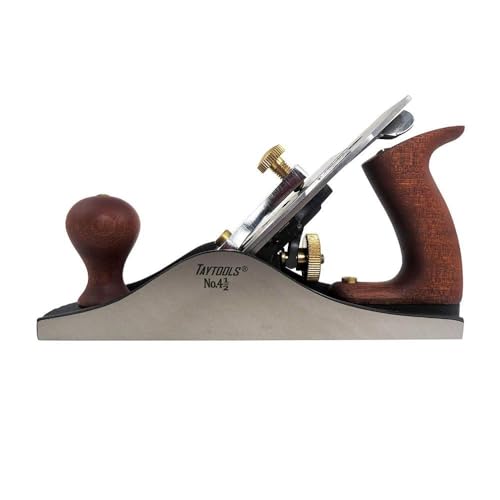
For someone adding a second plane, a No. 4 smoothing hand plane is usually more useful than a specialized scrub plane. Set the blade to take a shaving around 0.004 to 0.008 inch thick. Use short overlapping passes, check the surface under raking light, and stop as soon as the plane removes the remaining roughness.
On knotty pine, spruce, or Douglas fir, even a fine setting may tear out where grain reverses. Closing the mouth helps, but it does not defeat bad grain. A higher cutting angle can reduce tear-out, though it also increases pushing effort. If the board has severe knots, sanding may be quicker than trying to plane every patch cleanly.
Buying and Tuning Advice
Prioritize a rigid body, a blade that holds an edge, and reliable depth and lateral adjustments. Decorative features matter far less. The sole does not need to be mirror-flat; it needs to be flat enough that the toe, area ahead of the mouth, and heel support the work consistently. A hollow of a few thousandths of an inch is usually harmless.
Before judging any plane, flatten the back of the iron near the cutting edge, sharpen it, and make sure the cap iron is seated tightly. A dull blade causes more problems than an imperfect sole. Hone when the shaving becomes ragged or the plane starts requiring noticeably more force.
Secure wide boards firmly, but avoid crushing soft edges. Plane with the grain whenever possible; if the grain changes direction, reverse the board or take lighter cuts. Keep the board supported along its length so it does not flex under the plane. For occasional DIY work, one sound jack plane plus a straightedge is often enough. Spend the extra money on a jointer only when board length, edge joining, or repeated flattening justifies its weight.