What's inside
- How to Choose a Jobsite Generator
- 1. Size it for the tools you’ll run
- 2. Match the generator to your work pattern
- 3. Choose inverter or conventional output
- 4. Select fuel for availability and storage
- 5. Check noise, portability, and site requirements
- 6. Think beyond the purchase: maintenance and wear
- Which generator makes sense for your situation?
- Related Guides
- How to Choose a Jobsite Generator
- 1. Size it for the tools you’ll run
- 2. Match the generator to your work pattern
- 3. Choose inverter or conventional output
- 4. Select fuel for availability and storage
- 5. Check noise, portability, and site requirements
- 6. Think beyond the purchase: maintenance and wear
- Which generator makes sense for your situation?
- Related Guides
As an Amazon Associate I earn from qualifying purchases. This post may contain affiliate links at no extra cost to you.
Sections
- How to Choose a Jobsite Generator
- 1. Size it for the tools you’ll run
- 2. Match the generator to your work pattern
- 3. Choose inverter or conventional output
- 4. Select fuel for availability and storage
- 5. Check noise, portability, and site requirements
- 6. Think beyond the purchase: maintenance and wear
- Which generator makes sense for your situation?
- Related Guides
How to Choose a Jobsite Generator
To choose a jobsite generator, add up the running watts of the tools you may use at the same time, then make sure the generator’s rated output can also handle the largest startup surge; after that, choose fuel, inverter type, runtime, noise level, and portability to fit the way you work.
1. Size it for the tools you’ll run
Generators list two power figures: rated (running) watts for sustained use and starting (surge) watts for short bursts when a motor starts. A circular saw, compressor, shop vacuum, or dust extractor can demand considerably more power at startup than while running. The surge is brief, but an undersized generator may stall, trip its breaker, or fail to start the tool.
As an Amazon Associate we earn from qualifying purchases at no extra cost to you.
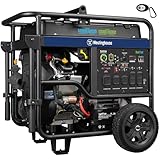


Find each tool’s wattage on its nameplate or in its manual. If only volts and amps are listed, use watts = volts × amps as a useful estimate for a simple load. Motor loads may draw more than that estimate during startup, so use the manufacturer’s starting-watt figure when available. For a more accurate estimate with equipment rated in amps, account for power factor if the manufacturer provides it.
Add the running watts of everything that could operate simultaneously. Then add the extra starting demand of the largest motor that could start while those other loads are already running. Don’t add every tool’s full startup figure unless you expect them all to start at once. For practical headroom, aim for a calculated demand around 80% of the generator’s rated output; that leaves room for changing loads and helps avoid running at the limit continuously.
Worked sizing example
Suppose you expect a 1,500-watt table saw, a 900-watt dust extractor, and 200 watts of lights to run together. Their combined running load is 2,600 watts. If the saw needs an additional 1,000 watts to start, the momentary demand is about 3,600 watts. At an 80% planning target, 3,600 ÷ 0.8 = 4,500 watts. A generator with roughly 4,500 watts of rated output and enough surge capacity for the startup demand is a more suitable starting point than one advertised as “4,000 watts” if that figure is its peak rather than rated output.
Check the manual for actual tool startup needs and the generator’s rated output at the outlets you plan to use. A generator’s total headline wattage may not be available from one receptacle, and long, undersized extension cords can cause voltage drop and tool problems.
2. Match the generator to your work pattern
| Typical jobsite use | Useful starting range | What to prioritize |
|---|---|---|
| One handheld tool, charger, and lights | 2,000–3,000 rated watts | Low weight, easy storage, adequate outlets |
| One large saw or vacuum, used in turns | 3,000–4,500 rated watts | Motor-starting capacity and a clear load plan |
| Saw, dust collection, and lights together | 4,500–6,500 rated watts | Rated output, outlet layout, and runtime |
| Several motor loads or a larger crew | 6,500+ rated watts | Load management, transport, and suitable circuits |
These are planning ranges, not guarantees: the right size depends on the actual tool labels, startup behavior, and which loads run at the same time. If the generator will sit in one place, a larger unit may be practical. If you carry it in and out of a vehicle daily, the weight and lifting points can matter more than extra capacity you rarely use.
3. Choose inverter or conventional output
Inverter generators produce electronically regulated power and typically adjust engine speed to demand. They’re often quieter and more fuel-efficient at light loads, making them appealing for chargers, electronics, and noise-sensitive sites. Compact inverter models are commonly in the lower-wattage ranges; higher-output units are available but can cost more and weigh substantially more. Confirm the manufacturer’s guidance for sensitive equipment rather than assuming every generator’s output is appropriate.
Conventional generators often offer more watts per dollar and suit demanding loads or longer, stationary work. They may be louder and consume more fuel when lightly loaded. Compare the rated output, not just the peak figure, and check whether the outlets provide the voltage and amperage your tools require. Neither type can exceed its rated capacity: an inverter model is not automatically the right choice if it cannot start your saw.
4. Select fuel for availability and storage
- Gasoline: Widely available and common on portable generators. It can be inconvenient to store: follow local rules and the generator manual, use approved containers, and account for fuel aging during long storage.
- Propane: Easier to store for longer periods when handled correctly, but output may be lower than on gasoline, and a tank adds bulk. Compare the wattage rating for each fuel mode.
- Dual-fuel: Offers flexibility when one fuel is unavailable. You still need to carry and store the chosen fuel safely, and switching fuels does not eliminate maintenance.
- Diesel: More common in larger or commercial equipment. Consider the machine’s weight, purchase and service costs, and whether diesel is practical for your crew.
Look at fuel consumption at a stated load, not only the advertised maximum runtime. A claim such as “up to 10 hours” may refer to a light load and a full tank; it does not mean 10 hours while running a saw and dust collector. Estimate your shift’s likely load, then check runtime data at a comparable percentage of rated output.
5. Check noise, portability, and site requirements
Compare noise ratings only when the measurement conditions are similar. A decibel figure measured at a different distance or load may not be a fair comparison, and a small numerical change can be noticeable. Follow local noise restrictions and keep the generator as far from workers and neighbors as practical without creating unsafe cord runs. Never operate a fuel-burning generator indoors, in a garage, or in another enclosed or partly enclosed area; exhaust contains carbon monoxide. Follow the manual’s outdoor placement and clearance instructions.
For portability, compare the published weight with fuel excluded or included, if stated. A model that is manageable when empty may be awkward to lift with a full tank. Wheels, handles, lifting points, and overall dimensions matter when loading a truck or moving across rough ground. Also check the number and type of outlets, breaker protection, and whether the unit’s design suits the extension cords or distribution equipment you plan to use.
For use around buildings or with transfer equipment, don’t improvise a connection to household wiring. A qualified electrician can advise on a code-compliant setup. Choose a generator with appropriate grounding and electrical protection for the intended configuration, and follow the manufacturer’s instructions.
6. Think beyond the purchase: maintenance and wear
Portable generators need maintenance even when they run infrequently. Oil changes, air-filter cleaning or replacement, spark-plug service, and fuel-system care are typical tasks; the schedule depends on the model and operating conditions. Dusty woodworking sites can clog filters sooner, so inspect them more often than you would in a clean environment. Keep cooling openings clear of sawdust, and let the unit cool before refueling or servicing it.
Common ownership mistakes include storing fuel in the tank for long periods without following the manual’s storage procedure, running the generator continuously at its limit, and overlooking the added load of a vacuum or charger. Before buying, check whether replacement filters, plugs, and other service parts are readily available, and whether the maintenance schedule fits your expected hours of use.
Which generator makes sense for your situation?
- Occasional trim work or small repairs: Choose a compact inverter model if its rated watts cover your tools’ running load and startup surge. Lower weight and quiet operation may be worth paying more per watt.
- Regular solo carpentry: Size around the largest motor tool you expect to start, then add only the loads you actually run alongside it. A midrange unit may offer a better balance than buying for every hypothetical tool.
- Multiple tools running together: Add simultaneous running loads and the extra startup demand of the largest motor, then retain headroom. Check outlet limits and plan which tools share each circuit.
- Frequent, stationary work with high demand: Consider a larger conventional or dual-fuel generator, but compare operating cost, noise, service access, and how you’ll move it—not just its output.
The best jobsite generator is the smallest model that reliably starts your real tool combination, runs it with headroom, and fits your site’s fuel, noise, and transport constraints. Before purchasing, write down the tools you use together, verify their startup requirements, and compare those figures with the generator’s rated watts and fuel-specific ratings.