What's inside
As an Amazon Associate I earn from qualifying purchases. This post may contain affiliate links at no extra cost to you.
Sections
Best Budget Jobsite Generators for Reliable Power on the Go
The best budget jobsite generator for most small crews is a 3,000–4,000-watt inverter model: it can run common saws and dust extractors with less noise and better fuel economy than a conventional generator, while remaining portable enough to move between sites. Choose a conventional 5,000–7,000-watt unit instead if you need to start larger loads or run several tools at once and can tolerate more noise and weight.
Shortlist by jobsite situation
- Best balance of power and portability: Honda EU3200i. Its 3,200-watt maximum output suits a compact tool setup, and its inverter design is a good fit where quieter operation matters. It costs more than basic open-frame generators, so it is not the cheapest choice.
- Best lower-cost inverter option: WEN 2350-watt inverter generators, such as the 56235i. They’re light and comparatively quiet, but their output is better for chargers, lights, and one modest tool than for several demanding tools.
- Best budget choice for multiple loads: Champion 5,000-watt-class open-frame generators. These provide more running capacity for the money, but are heavier and louder. Check the exact model’s outlet configuration and whether it offers electric start or CO shutdown.
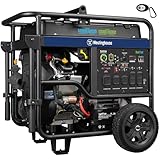
- Best for high starting loads: A 6,500–7,000-watt conventional generator from a brand such as Westinghouse or DuroMax. This class can handle more demanding combinations, but is a poor choice if you need to carry the generator up stairs or work close to neighbors.
Model specifications vary by version and market. Use the generator’s nameplate and manual—not a family name or advertised peak figure—to confirm output, receptacles, weight, and runtime before buying.
As an Amazon Associate we earn from qualifying purchases at no extra cost to you.


Compare the numbers that matter
| Generator or class | Rated running watts | Approx. dry weight | Typical fuel tank | Best fit |
|---|---|---|---|---|
| WEN 56235i inverter | 1,900 W | About 39 lb | About 1.1 gal | Chargers, lights, and a modest single tool |
| Honda EU3200i inverter | 2,600 W | About 59 lb | About 1.2 gal | Portable, quieter power for a small crew |
| Champion 5,000 W-class open-frame | About 4,000–5,000 W, depending on model | Often 100–130 lb | Often 3.4–4.0 gal | More tool capacity when noise and lifting are manageable |
| Westinghouse or DuroMax 6,500–7,000 W-class | About 5,200–7,000 W, depending on model | Often 120–160 lb | Often 4–5 gal | Higher loads and less frequent relocation |
These are representative specifications, not a claim that every model in a brand’s lineup matches the figures. Inverter generators generally adjust engine speed to demand, which can reduce fuel use and noise at light loads. Conventional generators often deliver more watts per dollar, but commonly run at a steadier, louder speed. Runtime figures are especially hard to compare: tank size, load, and test conditions all matter. Look for runtime at a stated load, such as 25% or 50%, rather than relying on a headline maximum.
Will it run your tools together?
First add the running watts of everything you expect to operate at the same time. Then account for motor startup: saws, compressors, shop vacuums, and some dust extractors can briefly demand substantially more power than their running draw. The tool nameplate or manual is the best source for amperage and startup requirements.
For a quick estimate on a 120-volt tool, watts are approximately volts multiplied by amps. A 12-amp saw therefore draws about 1,440 watts while running. If a 9-amp dust extractor is also running, the combined estimate is 2,520 watts—already too close to the rated capacity of a 2,600-watt generator once startup surge and other loads are considered. Run one motor tool at a time, or step up to a generator with ample rated output and confirmed surge capacity.
Do not treat peak watts as usable continuous power. Also check whether the generator provides the voltage and receptacles your equipment requires. A 240-volt outlet is useful only if the generator is rated to supply the necessary 240-volt load; some dual-voltage models split their capacity between 120- and 240-volt circuits.
Choose by budget, transport, and frequency
| Your situation | Practical choice | Trade-off to accept |
|---|---|---|
| Under roughly $500; occasional use; mostly chargers and lights | Small inverter, around 1,800–2,000 running watts | Limited capacity for saws or simultaneous motor loads |
| Roughly $700–$1,500; frequent small-site work; one tool at a time | 2,500–3,500 running-watt inverter | Higher purchase cost and limited headroom for multiple tools |
| Roughly $500–$1,000; crew needs several loads; generator stays on a cart or truck | 5,000-watt-class conventional generator | More noise, fuel use at light loads, and lifting effort |
| Regular heavy loads; infrequent movement; 240-volt equipment | 6,500–7,000-watt-class model with suitable outlets | Bulk, noise, and greater fuel consumption |
These are broad U.S. market price ranges; sales, features, and regional availability can move them considerably. If the generator will be carried by one person, prioritize actual weight and handles over wheel-kit photos. A 120-pound unit may be “portable” in a listing but awkward to lift safely into a truck.
Noise, outlets, and safe placement
Inverter generators are usually the better neighbor near residential work, though “quiet” does not mean silent. Compare decibel figures only when the manufacturer specifies distance and load; measurements taken under different conditions are not directly equivalent. An open-frame model may be acceptable for outdoor construction, but not for a tight indoor renovation or a noise-sensitive site.
For outlets, look for enough 120-volt receptacles for your planned cords, plus GFCI protection where appropriate. A 30-amp outlet does not make every connected tool safe to run at once: the generator’s rated output and the circuit limits still apply. Use outdoor-rated, grounded extension cords sized for the load and length, and keep connections dry and off the ground.
Never run a fuel-burning generator indoors, in a garage, or near doors, windows, or air intakes. Place it outdoors, well away from occupied spaces, following the manual’s clearance guidance. Carbon monoxide can accumulate without warning. Use a properly installed transfer switch for building wiring; never backfeed a house through a receptacle.
Ownership costs and maintenance that protect the budget
A low purchase price can be offset by fuel, oil, and downtime. A useful comparison is cost per working hour: divide fuel cost per gallon by the generator’s gallons per hour at your typical load, then add scheduled oil and filter costs. Manufacturer runtime data at a stated load can help estimate consumption, but actual use will vary. A generator that is oversized and idles through a light load may burn more fuel than a smaller inverter doing the same job.
Oil changes, air-filter cleaning, and spark-plug service are routine; follow the model’s maintenance schedule and service intervals. Dust is especially hard on air filters at woodworking sites, so inspect them more often in dusty conditions. Keep sawdust clear of cooling openings, let the engine cool before refueling, and use fresh fuel. For seasonal storage, follow the manual’s instructions for draining or stabilizing fuel; stale gasoline is a common cause of difficult starts and carburetor problems.
For most carpenters, the decision comes down to the heaviest tool and the number of motors that must run together. Buy enough rated watts to cover that real load with starting headroom. If portability and lower noise matter most, choose an inverter; if the job demands more simultaneous power and the generator can stay on wheels, a conventional 5,000-watt-class unit is often the better budget fit.