Our Top Picks


What's inside
As an Amazon Associate I earn from qualifying purchases. This post may contain affiliate links at no extra cost to you.
Framing is the least forgiving work in carpentry for tools. Everything gets dropped, rained on, buried in mud and used harder than the manufacturer intended. The kit reflects that.
A working framing crew tool list is shorter than most people expect and heavier than they hope. There is no room in a truck for a tool that does one job occasionally, and no patience on a crew for a tool that needs babying. What survives is a handful of machines that run hundreds of cycles a day, a layout kit that decides whether the building is actually square, and a few hand tools that nobody has improved on in fifty years.
As an Amazon Associate we earn from qualifying purchases at no extra cost to you.


This guide walks the kit the way a foreman explains it to a new hire: what comes off the truck, why that tool and not the alternative, and where the money is genuinely worth spending. The difference between a crew that moves and a crew that fights its tools all day is almost never the brand on the housing.
Sections
Cutting
The criterion that separates good from bad: power delivery under load in wet lumber, and a sight line you can follow without leaning over the blade. Everything else on the spec sheet is secondary.
Circular saw — worm drive or rear-handle cordless. This is the tool that never stops.
The rear-handle layout puts your hand behind the blade rather than beside it, which means you push through the cut instead of steering it, and you can see the line on the waste side without craning. A good one has a flat, stiff shoe that has not been tweaked in a fall, a depth lever you can move with gloves on, and a guard that returns on its own every time. A bad one bogs in soaked pressure-treated stock, and a saw that bogs is a saw that kicks. If you go cordless, judge it on how it behaves at the end of a battery rather than on the first cut of the morning.
Miter saw — a 12-inch on a stand, for repetitive cuts at the pile.
The stand matters as much as the saw. A 12-inch head on a folding stand with long, adjustable outfeed and a repeat stop turns rafter tails and cripples into a production line; the same saw on two blocks of scrap is slower than a circular saw and less accurate. Single bevel is enough for most framing. Sliding heads buy you crosscut width for stair stringers and wide trim, at the cost of weight and one more thing to knock out of alignment in the truck.
Reciprocating saw — demolition, corrections, cutting things in place.
Look for tool-free blade change, an orbital setting you can switch off for metal, and a shoe that pivots. Then buy blades in bulk. Almost every complaint about a recip saw is really a complaint about a worn blade, and the same is true of circular saws: a 24-tooth framing blade cuts wet lumber cleanly and a fine finish blade in the same material burns, wanders and overheats.
Rear-handle circular saws
Worm-drive or cordless rear-handle. More torque and better sight lines than a sidewinder for framing work.
Fastening
The criterion that separates good from bad: cycle after cycle without a jam once the tool is dusty, cold and half-charged. Raw driving power is rarely the limit; reliability is.
Framing nailer — cordless has taken over on most crews. No compressor, no hoses, faster setup.
Before you commit, decide on collation, because it locks in your nail supply for years. Plastic-strip magazines throw plastic shards and hold fewer nails per strip; paper-tape magazines hold more and are gentler on the eyes, but paper turns to mush if the strips get wet in the box. Full round head nails are required by some jurisdictions and by many engineered connectors, so check what your inspector and your hanger schedule expect before you buy into clipped head. On the tool itself, the details that earn their keep daily are tool-free depth adjustment, a dry-fire lockout, a jam release you can clear without a wrench, and a nose that will actually reach into a bay.
Impact driver — structural screws, ledgers, hangers.
A standard quarter-inch hex impact driver covers almost everything; long structural screws in dense material are where a mid-torque impact wrench with an adapter starts to make sense. Multi-speed models are worth the small premium because the lowest setting stops you snapping heads off small fasteners.
Palm nailer — joist hangers and tight spots where a framing nailer will not fit.
Cordless framing nailers
Removing the compressor and hose from a framing site saves setup time every single morning.
Layout
This is where framing accuracy comes from and where crews cut corners at their peril.
- ✔ 25-foot tape with a stiff standout — you measure alone constantly
- ✔ Speed square and a framing square
- ✔ Chalk line with permanent chalk for layout, temporary for finish
- ✔ Laser level or a good rotary laser for long runs
- ✔ Plumb bob or a laser plumb for posts
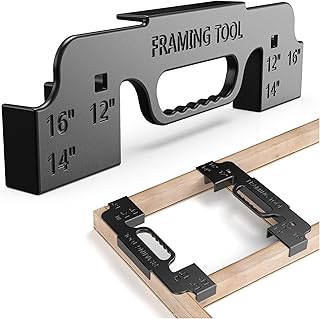
Standout is the spec to shop on for a tape. A blade that stands out a long way unsupported lets you measure alone across an opening instead of walking back for a helper, and that happens fifty times a day. The related discipline is sticking to one tape for one building: tapes from different makers can disagree by a hair at the hook, which is invisible on a stud and obvious across a long wall.
With lasers, judge them on what you can actually see. Green beams read better in daylight than red at the same power, but on an exterior deck or a long footing run neither is enough — that is what a detector and a pulse mode are for. Self-levelling range and lock-out for transport matter more than extra beam lines. A laser that stays out of level because nobody locked the pendulum before the drive home is worse than no laser at all.
Laser levels for framing
Self-levelling cross-line lasers have become cheap enough that there is no reason to work without one.
Hand tools that still earn their place
A 20–22oz framing hammer with a milled face, a flat bar, a cat’s paw, a utility knife, a sharp chisel for hinge and notch work, and lineman’s pliers for wire and stubborn nails.
Hammer weight is a personal decision that your elbow makes for you eventually. Heavier heads sink nails in fewer strokes and punish your joints; lighter titanium heads move the mass into the swing rather than the shock, which is what you are paying for. Handle material changes the feel more than the marketing admits: hickory absorbs shock and can be replaced, steel and composite survive over-strikes that snap wood. Keep the flat bar and the cat’s paw as separate tools — using a bar as a nail puller bends it, and a bent bar never sits flat again.
Framing hammers
Milled face for grip on nail heads, straight or curved claw by preference. Titanium heads reduce fatigue at a price.
Safety kit
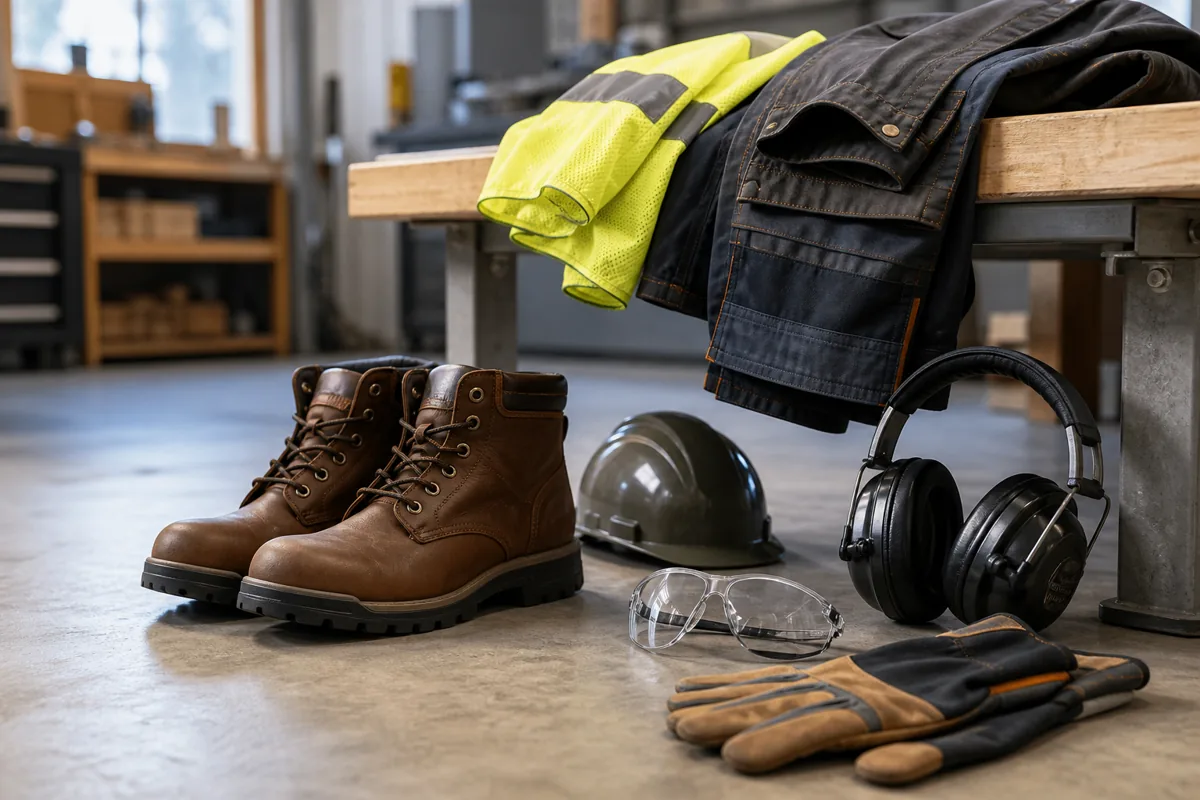
This is the part of the list that is not a preference. The trigger height for fall protection in residential work is lower than most crews assume, so look up the current rule for your jurisdiction rather than guessing from what the last crew did.
- ✘ Never work at height without proper fall protection — this is the leading cause of death in the trade
- ✘ Eye protection during all nailing and cutting
- ✘ Hearing protection — nailers and saws exceed safe levels
- ✘ Gloves for handling lumber, off for tool operation
What separates a good pick from a bad one at each price band
Entry tier
At the bottom of the market you are buying capability, not durability. Expect thin stamped shoes, plastic depth adjusters and bases that go out of square in a drop. It is a workable place to buy a recip saw, a palm nailer, a chalk line or a spare square. It is a bad place to buy a framing nailer, because a nailer that jams every fortieth nail will cost you more in stopped work than the tool saved.
Mid tier
This is where most working framers should live. The step up buys machined and cast components instead of stamped, real dust and moisture sealing, serviceable brushless motors and a parts supply that still exists in five years. Battery platform matters more than the individual tool here — pick one system and stay in it, because chargers and packs quietly become the most expensive part of the kit.
Professional tier
The top band buys speed, comfort and rebuildability rather than new abilities: titanium hammers, laser accuracy you can trust at distance, nailers that run all day in the cold, saws with the guts for wet engineered lumber. Worth it if the tool is in your hands eight hours a day. Hard to justify if it is in the truck four weekends a year.
Common mistakes
- Buying a large combo kit for the two tools you wanted and paying for four you will never charge.
- Running two or three battery platforms at once, which doubles chargers and guarantees the wrong pack is always the charged one.
- Cutting with dull or wrong-tooth blades, then blaming the saw for burning and wandering.
- Skimping on layout tools while spending heavily on cutting tools — layout errors compound through the whole frame.
- Storing tools wet. Rust in a gang box kills more squares, bars and chucks than abuse does.
- Trusting a square, tape or laser that has been dropped without checking it first.
Who this kit suits, and who should skip parts of it
Production framers on new builds should read the whole list as mandatory and lean toward the professional tier on the nailer, the circular saw and the miter saw stand. Remodellers and small GCs can drop the rotary laser for a good cross-line unit and will get more use out of the recip saw and the flat bar than out of raw cutting speed. Anyone framing a deck, garage or shed a few times a year should buy the circular saw, impact driver, tape, square and hammer, and rent the nailer and the miter saw — renting twice a year costs less than owning a nailer you never learn to trust.
Buying priority for a new framer
Circular saw, impact driver, tape and square first. Nailer next — borrow or rent until you can buy a good one. Miter saw and lasers after that. Do not buy a full kit at once; buy what stops you working.
That last sentence is the whole method. The tool that is currently costing you time, accuracy or a trip back to the truck is the one to replace, and the tool you think looks good on the shelf usually is not.
FAQ
Cordless or pneumatic nailer? Cordless for mobility and small crews; pneumatic still wins on sustained speed for large production framing.
Worm drive or sidewinder? Worm drive for framing — more torque, better in wet lumber, better sight line. Heavier, and you will feel it.
How many batteries? Six on a working framing kit, minimum, with a fast charger in the truck.
Do I still need a compressor? Not for framing nails if you go cordless, but a compressor still earns its spot the moment you add a roofing nailer, a stapler or a finish gun to the same job. Many crews keep one in the truck and simply stop unrolling hose for framing.
See framing tools →