Our Top Picks


What's inside
As an Amazon Associate I earn from qualifying purchases. This post may contain affiliate links at no extra cost to you.
No trade has been changed more by cordless tools than plumbing. Press connections replaced a great deal of soldering, compact drills replaced awkward corded ones, and band saws replaced hacksaws for good.
What has not changed is the shape of the work. You are still on your side in a vanity cabinet, still working above your head in a ceiling, still trying to fit a tool into a space designed by someone who never had to service it. That is why buying criteria for plumbing tools look nothing like the criteria for framing or cabinet work. Raw power is rarely the constraint. Head length, weight in one hand, and the ability to make a joint without an open flame are the constraints, and a kit chosen on torque figures alone will disappoint on the first service call.
As an Amazon Associate we earn from qualifying purchases at no extra cost to you.




Below is the kit in the order most plumbers actually build it, with what separates a good buy from a bad one in each price band, and who can reasonably skip each item.
Sections
1. Press tool
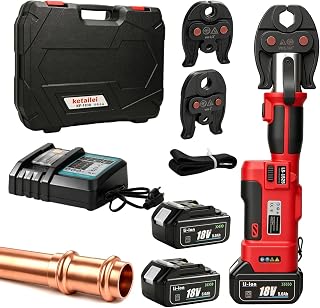
The big one. A cordless press tool makes copper and PEX connections in seconds, with no flame, no flux and no fire watch. Expensive, and it changes what a one-person crew can do in a day.
The criterion that separates good from bad: whether the jaws and rings cover the sizes and materials you actually install, on a tool you can get serviced locally. The tool body is only the entry fee. Jaws are sold per size and often per material, so price the working set — the sizes you touch every week — before you compare tools. Then check the service path. Press tools have a manufacturer service and calibration interval stated in press cycles or years, and the tool counts down to it for you. Ask whether the seller or a nearby service centre handles that, and whether loaner tools exist, because a press tool away for service is a week of soldering.
At the bottom of the market you are looking at manual and battery crimp or clamp tools for PEX only. They are cheap, they work, and for a PEX-only remodel business they may be the whole answer. The middle band is where most residential plumbers land: a compact battery press covering the small copper and PEX sizes that make up the majority of house work, light enough to hold overhead in a joist bay. The top band buys full-size tools with interchangeable jaw sets for larger diameters and more materials, which is commercial and mechanical territory. The bad buy in any band is an off-brand tool with no published service interval and no jaw availability — and note that fitting manufacturers warrant their systems only when connections are made with approved tooling, so unlisted jaws can quietly void the part of the job you cannot go back and inspect.
Most failed presses are preparation failures, not tool failures: pipe cut out of square, burr left inside, no depth mark, a damaged or dry sealing element, or a jaw that never fully closed because it was cocked on the fitting. Skip the purchase entirely if you make a handful of connections a month. Rent it for the repipe, keep the torch, and revisit when the volume is there.
Cordless press tools
Significant investment. If you make connections daily, the time saved and the elimination of hot work make the maths straightforward.
2. Compact drill and impact driver
Under sinks, in cabinets, in crawlspaces. Length matters more than torque — a 12V sub-compact drill will get more work done in plumbing than a full-size one.
The criterion that separates good from bad: head length first, then weight in one hand, then power. A sub-compact head is meaningfully shorter than a full-size 18V drill, and that difference is the whole reason it gets used. Look for a brushless motor if you drill all day on one charge, a chuck that grips hole-saw arbors without slipping, a belt hook, and a light that actually points at the bit rather than into your knuckles. A right-angle attachment or a small right-angle drill covers the cabinet backs and stud bays the drill cannot reach.
Cheap brushed combo kits with the smallest batteries are fine as a van spare. The practical buy is a mid-band brushless kit with two batteries — one compact for tight quarters, one higher-capacity for the drilling — because runtime and balance matter more than a headline torque number. Premium money buys quieter hydraulic-style impact drivers, worth it in occupied houses, and better clutches. The common mistake is buying the biggest drill first and never buying the small one, then using an impact driver for hole saws and wondering why arbors keep shearing.
12V sub-compact drill kits
The most-used cordless tool in the trade. Short head, light body, adequate power for the work.
3. Compact band saw
Cutting copper, PVC and threaded rod cleanly. No sparks, no heat, minimal burr. Once you own one, the hacksaw stays in the van.
The criterion that separates good from bad: cut capacity and blade selection, not motor speed. Compact models handle common residential pipe and rod; deep-cut models exist for larger diameters and bundled strut, at a real cost in weight. Bi-metal blades and variable speed are the two features worth paying for. Match tooth count to wall thickness using the old rule of at least three teeth in the cut: fine-tooth blades for thin-wall copper and conduit, coarser for solid stock like threaded rod. Too few teeth on thin wall strips teeth and grabs; too many on solid stock loads up and burnishes.
Register the shoe on the pipe before the blade touches it, support the offcut so nothing pinches the blade, and let the saw’s weight do the feeding — pushing is what twists blades off the wheels. Buy blades in multipacks with the tool. Everyone doing copper, steel or rod should own one; a PEX-only remodeler with good shears can wait, though rod alone often justifies it.
Compact cordless band saws
Square cuts with almost no deburring. Buy spare blades — they are the consumable that matters.
4. Drain cleaning
A cordless drain snake for sinks and small lines; a sectional or drum machine for main lines. Inspection cameras have also come down enough in price that many one-person operations now carry one.
The criterion that separates good from bad: cable diameter and length matched to the line you are clearing. Undersized cable in a big line balls up and knots; oversized cable in a small line kinks or damages the trap arm and fittings. For branch lines, judge a cordless snake on cable quality, whether the drum is enclosed enough to contain the mess, whether it has forward and reverse, and how easily the cable can be replaced — that cable is a consumable, like a blade. For inspection cameras the useful specs are screen readability in a dark crawlspace, how well the cable pushes without coiling back, and a self-levelling head, because documenting the line for a customer is half the value.
Cordless snakes suit service and repair work and pay for themselves quickly on kitchen and lavatory calls. Skip them if you are new construction only. The mistakes that hurt here are running a cable with unsuitable gloves, snaking after a customer has poured caustic drain cleaner, and reaching for a small machine on a main because it is already in your hand.
Cordless drain snakes
For sink and tub lines. Larger drum machines remain a separate purchase for mains.
5. Hand tools that have not been replaced
- ✔ Adjustable wrenches and a good pipe wrench pair
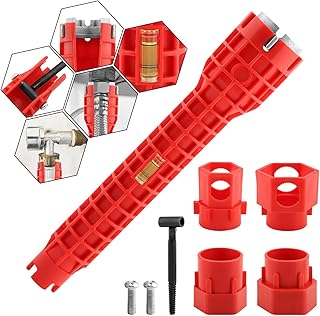
- ✔ Basin wrench — nothing else reaches those nuts
- ✔ Tubing cutters, small and standard
- ✔ PEX crimp/clamp tools if you work with PEX
- ✔ Torch kit — still needed where press is not appropriate
- ✔ Channel locks in two sizes
Buy pipe wrenches with replaceable hook and heel jaws; aluminium bodies save your shoulder on service calls, ductile iron takes more abuse in a rough gang box. A telescoping basin wrench earns its space the first time you meet a faucet nut behind a deep sink. Keep spare cutter wheels — a dull wheel work-hardens copper and leaves the burr the band saw was supposed to make unnecessary. With PEX, buy the tool that matches the fitting system you install and that your inspector accepts; crimp, clamp and expansion tools are not interchangeable, and owning the wrong one is a common and avoidable expense.
Plumbing hand tool sets
Pipe wrenches, basin wrench, tubing cutters, channel locks. The tools that never became cordless.
Platform advice
Milwaukee dominates this trade for a reason: the M12 range is deep, and the press tools, drain machines and inspection cameras are all on the same platform. If you are starting a plumbing kit from scratch, that ecosystem is the pragmatic choice.
The reason platform matters more in plumbing than in most trades is that the specialist tools are all battery tools. If your press tool, snake and camera take the same pack, you charge one thing in the van and you can buy bare tools from then on. Committing twice is the most expensive mistake in this article. If you already own another 18V system, keep it for drilling through joists and studs and add a compact platform for the plumbing-specific tools rather than replacing everything.
Buying order on a limited budget
- Sub-compact drill and impact driver kit with two batteries — used on every job, every day.
- Hand tools: pipe wrenches, basin wrench, tubing cutters, channel locks.
- Compact band saw plus a multipack of blades.
- Cordless drain snake, if you take service calls at all.
- Press tool, once your weekly connection count makes the maths obvious.
FAQ
Is a press tool worth it for a small operation? If you do more than a handful of connections a week, yes — and it eliminates hot-work permits and fire watch entirely.
Do I still need to solder? Yes, occasionally. Keep the torch kit.
12V or 18V for the main drill? 12V for most plumbing work; keep an 18V for drilling through joists and studs.
How many batteries should I carry? Two minimum per platform, three once a press tool or snake shares the packs, and mix capacities: compact packs for tight cabinets, larger ones for drilling and pressing.
See plumbing tool kits →