What's inside
As an Amazon Associate I earn from qualifying purchases. This post may contain affiliate links at no extra cost to you.
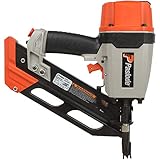
The best compact framing nailer for most tight jobsites is the Paslode CFN325XP because its short 12-inch body, low weight, strong driving performance, and narrow nose make it easier to maneuver between studs than heavier full-size cordless guns.
That is not the best choice for every crew, however. A compact framing nailer has to balance more than overall length: magazine capacity, nail angle, battery weight, recoil, depth adjustment, and access around joists can matter more than a fraction of an inch. The comparison below focuses on those practical differences.
As an Amazon Associate we earn from qualifying purchases at no extra cost to you.


Sections
Compact framing nailer comparison
| Model | Power source and angle | Approx. length | Approx. weight | Magazine capacity | Best fit |
|---|---|---|---|---|---|
| Paslode CFN325XP | Fuel cell and 18V battery; 30° | 12 in. | About 7.2 lb with battery and fuel cell | Up to 30 nails | Remodeling, overhead work, and cramped framing |
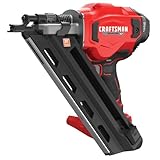
| Milwaukee M18 FUEL 2745-20 | 18V battery; 30° | About 12.5 in. | About 9.4 lb bare tool | Up to 51 nails | Frequent cordless framing and high production |
| Metabo HPT NR1890DR | 36V MultiVolt battery; 21° | About 12.5 in. | About 9 lb bare tool | Up to 47 nails | Users already invested in 21° plastic-collated nails |
| Senco F-35FRHXP Fusion | 18V battery; paper-collated 34° | About 13 in. | About 8.4 lb | About 34 nails | Fast cordless work without fuel cells |
| Compact pneumatic framing nailer | Compressor; commonly 21° or 28° | About 19–21 in. | About 7–9 lb, hose excluded | About 64–100 nails | Shop work where hose access is not a problem |
Weights and dimensions can vary by battery, magazine configuration, and manufacturer measuring method. Battery-operated models are listed separately from their batteries where manufacturers publish a bare-tool figure; the Paslode is commonly specified as a ready-to-use weight because its fuel system is part of normal operation.
Head-to-head: which compact nailer handles tight access best?
Best overall: Paslode CFN325XP
The Paslode’s advantage is not the largest magazine or the longest battery runtime. It is the combination of a short nose-to-rear profile, low working weight, and good balance close to the grip. In a framed wall, that makes it easier to place the nose between adjacent studs, under blocking, or against a joist where a bulky battery housing would otherwise hit first.
The 30° paper-collated nail system also keeps the magazine relatively narrow. Its trade-offs are fuel cells, a smaller nail load, and recurring consumable cost. It is particularly attractive for punch-list framing, remodeling, roof repairs, and overhead fastening where fatigue matters more than maximum shots between reloads. Typical street pricing is in the upper hundreds of dollars for a kit, with fuel cells and nails adding to ownership cost.
Best for production: Milwaukee M18 FUEL 2745-20
The Milwaukee is a better choice when the work is measured in hundreds of fasteners rather than a handful of awkward placements. Its 30° magazine holds up to about 51 nails, and its brushless cordless design avoids both a compressor hose and fuel-cell management. The tool is heavier than the Paslode, especially after installing a high-capacity M18 battery, but the weight is acceptable for floor-level framing.
Its larger rear battery area can be noticeable in a 14½-inch stud bay or when fastening the underside of joists. Choose it when you value magazine capacity, a broad existing M18 battery supply, and consistent cordless operation more than the lowest possible weight.
Best for 21° nails: Metabo HPT NR1890DR
The Metabo HPT is a sensible compact option for a crew already using 21° plastic-collated full-round-head nails. That nail format is widely available and generally loads quickly, while the tool offers selectable sequential or contact firing and tool-free depth adjustment.
Its roughly 9-pound bare-tool weight means it is not the easiest model for extended overhead work. The 21° magazine is also somewhat wider in certain positions than a 30° paper-collated magazine. In open wall framing, however, the larger nail capacity and conventional plastic-collated ammunition can make it faster to keep supplied.
Best battery-only alternative: Senco Fusion F-35FRHXP
The Senco uses a battery-driven compressed-air system rather than a fuel cell. That gives it a familiar pneumatic-like firing response without a compressor, hose, or gas cartridge. It is a useful middle ground for contractors who dislike fuel-cell maintenance but still need a cordless framing tool.
Its body is longer than the shortest Paslode setup, and 34° paper-collated nails are not always interchangeable with the exact nail types stocked for another brand. Confirm nail length, collation angle, and head style before buying. The Senco makes the most sense when the crew already owns compatible batteries or values a hose-free tool for interior work.
Decision matrix for tight jobsites
| Your situation | Recommended direction | Why |
|---|---|---|
| Occasional remodeling and limited storage | Paslode CFN325XP | Small, light, and easy to carry without a compressor |
| Daily framing with long runs of wall | Milwaukee 2745-20 or Metabo HPT NR1890DR | Larger magazines reduce reload interruptions |
| Many overhead fasteners | Paslode or another tool under about 8 lb ready to fire | Lower arm fatigue and easier positioning |
| Very narrow access between studs | 30° compact cordless model | Angled magazines and short bodies usually leave more clearance |
| Existing compressor and stationary shop work | Compact pneumatic nailer | Lower tool cost and large nail capacity can outweigh hose inconvenience |
| Already own M18 or MultiVolt batteries | Choose the matching cordless platform | Battery compatibility can save more than a small difference in tool price |
How much does magazine capacity matter?
Suppose a wall requires 240 framing nails. A 30-nail magazine requires at least eight loading cycles, while a 51-nail magazine requires at least five. The larger magazine therefore saves three reload events, but it does not automatically make the job faster: each reload may take only 10 to 20 seconds, whereas awkward repositioning or fatigue can consume much more time.
For a short repair, the lighter 30-nail tool is usually the better trade. For repeated sheathing or production framing, the larger magazine becomes more valuable. Remember that the final few nails in a magazine may not be usable on some tools, so practical capacity can be slightly lower than the published maximum.
What to check before buying
- Actual working length: Measure from the nose to the farthest point of the installed battery or fuel housing. A short tool with a large battery may still be difficult to turn inside a stud bay.
- Balance: Hold the tool by its normal grip and point it horizontally. A nose-heavy tool strains the wrist; a rear-heavy one can collide with framing when you rotate it.
- Nail availability: Confirm the required angle, collation material, diameter, and length range. A tool is not a bargain if the correct nails are difficult to source locally.
- Trigger modes: Sequential firing is preferable for controlled placement. Contact firing can speed production but requires more deliberate handling.
- Depth adjustment: Tool-free adjustment is important when switching between softwood, engineered lumber, and sheathing. Overdriving can weaken the connection or damage the surface.
- Nose design: A narrow, visible nose helps you place nails beside existing fasteners and close to corners.
Durability and ownership realities
The parts most likely to need attention are the driver blade, nose contact elements, magazine feeder, and depth-adjustment mechanism. Repeated dry firing can accelerate driver wear, while paper and plastic fragments can accumulate around the feed path. Keep the magazine free of broken collation and inspect the driver tip when nails begin sitting proud or sinking inconsistently.
Do not use framing nails outside the manufacturer’s specified length or diameter range. Do not force a jammed strip through the magazine, and remove the battery or disconnect the air supply before clearing one. On pneumatic tools, drain compressor moisture regularly and use the manufacturer-approved air treatment. On fuel-cell tools, store fuel and batteries according to the instructions and keep the combustion air path clean.
A practical maintenance routine is simple: brush debris from the nose after each workday, inspect the contact tip, check magazine screws and fasteners, and test depth on scrap lumber whenever the material changes. If a cordless tool starts leaving frequent un driven nails despite a charged battery and correct ammunition, stop increasing the depth setting; inspect for a jam, worn driver, damaged contact mechanism, or a power-system issue.
Final recommendation
Choose the Paslode CFN325XP when access, low fatigue, and maneuverability are the deciding factors. Choose the Milwaukee 2745-20 for heavier daily production and a larger nail load, or the Metabo HPT NR1890DR when 21° nails and that battery platform fit your work. A compact pneumatic nailer remains the value option for shop-based framing, but its hose and compressor reduce the access advantage that defines the best compact framing nailer for a genuinely tight jobsite.