What's inside
As an Amazon Associate I earn from qualifying purchases. This post may contain affiliate links at no extra cost to you.
The best Milwaukee brushless reciprocating saw for most demolition work is the M18 FUEL SAWZALL 2720-20, while the lighter M18 FUEL HACKZALL 2719-20 is easier to control in tight spaces and the M18 FUEL SUPER SAWZALL 2821-20 is the stronger choice when orbital action and maximum cutting speed matter more than compactness.
As an Amazon Associate we earn from qualifying purchases at no extra cost to you.


Sections
Milwaukee brushless reciprocating saws compared
All of the models below use Milwaukee’s brushless motor platform, but they are not interchangeable in handling. Stroke length affects how much material each cycle removes; strokes per minute affect how quickly the blade works; mass, shoe design, and vibration control determine how tiring the tool feels during a long cut.
| Model | Battery platform | Stroke length | Variable speed | Approx. bare weight | Best fit |
|---|---|---|---|---|---|
| M12 FUEL HACKZALL 2520-20 | M12 | 5/8 in | 0–3,000 SPM | About 4.0 lb | Light repairs, pruning, tight spaces |
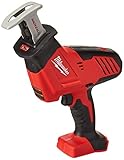
| M18 FUEL HACKZALL 2719-20 | M18 | 7/8 in | 0–3,000 SPM | About 5.0 lb | One-handed access and lighter demolition |
| M18 FUEL SAWZALL 2720-20 | M18 | 1-1/4 in | 0–3,000 SPM | About 7.4 lb | General demolition and remodeling |
| M18 FUEL SUPER SAWZALL 2821-20 | M18 | 1-1/4 in | 0–3,000 SPM | About 8 lb | Fast heavy cutting and frequent jobsite use |
Weights can vary slightly by revision, shoe configuration, and whether a listed specification includes a blade or battery. The figures above are useful for comparing handling, not for calculating shipping weight.
Head-to-head: which Milwaukee Sawzall should you choose?
M18 FUEL HACKZALL 2719-20: best compact Milwaukee brushless sawzall
The 2719-20 has a shorter 7/8-inch stroke than a full-size SAWZALL, but that is part of its advantage. Its narrower body and lower weight make it more manageable between studs, beneath cabinets, around plumbing, and above shoulder height. It is a particularly good fit for electricians, plumbers, maintenance workers, and homeowners who do occasional cutting.
Its limitation is leverage. With thick framing lumber, cast iron, large steel tube, or repeated demolition, the shorter stroke and smaller form factor generally cut more slowly than the full-size M18 models. It is also less comfortable for long two-handed cuts if you need to force the blade through heavy material.
M18 FUEL SAWZALL 2720-20: the balanced choice
The 2720-20 combines a full 1-1/4-inch stroke with up to 3,000 strokes per minute and Milwaukee’s anti-vibration technology. That combination makes it the most versatile option in this comparison: capable of cutting dimensional lumber, nails, PVC, copper pipe, sheet metal, and many demolition materials without the bulk of the largest model.
For a remodeling crew that wants one cordless reciprocating saw, this is the sensible middle ground. It has enough stroke length for rapid rough cutting, while its variable-speed trigger allows slower starts in finished areas. It is still a substantial tool, so a compact battery is preferable for overhead work and a higher-capacity M18 battery is preferable for repeated demolition.
M18 FUEL SUPER SAWZALL 2821-20: best for speed and demanding demolition
The SUPER SAWZALL keeps the 1-1/4-inch stroke and 3,000-SPM maximum but adds a more aggressive overall design, including selectable orbital action on applicable versions. Orbital movement can make the blade remove wood faster because it increases the cutting action on the return stroke. It is useful for framing lumber, roof decking, plywood, and other wood-heavy demolition.
Orbital action is not automatically better. It can produce a rougher cut, increase blade chatter, and be less suitable for metal, finish carpentry, or cuts close to surfaces you want to protect. Turn it off for cleaner control, metal cutting, and delicate work.
M12 FUEL HACKZALL 2520-20: best when minimum size matters
The M12 FUEL HACKZALL is the easiest model to carry and store. Its 5/8-inch stroke is appropriate for small pipe, thin metal, trim, branches, and light repair work. It is not the right substitute for an M18 SAWZALL when the job involves repeated nail-embedded lumber or thick steel. Choose it because it is convenient, not because it matches full-size cutting speed.
Cut speed, vibration, and battery endurance
A longer stroke does not guarantee a faster cut in every material. Blade tooth design, pressure, material thickness, and technique matter just as much. A long, coarse wood blade can outperform a short-stroke saw with an unsuitable fine-tooth blade, while a fine metal-cutting blade may be slower but last longer in steel.
- Wood demolition: The 2720-20 and 2821-20 are the fastest choices, especially with a demolition blade and, where appropriate, orbital action.
- Metal: Use a bi-metal or carbide-grit blade, moderate trigger speed, and steady pressure. Orbital action should normally be disabled.
- Finish-sensitive work: The 2719-20 or M12 HACKZALL offers better positional control, but a reciprocating saw is still a rough-cut tool rather than a finish saw.
- Vibration: Anti-vibration mechanisms reduce transmitted movement, but they do not eliminate fatigue. Let the shoe rest firmly against the work instead of gripping harder.
Battery runtime has no single reliable number because cutting nail-embedded timber consumes far more energy than cutting thin PVC. As a practical planning estimate, a healthy M18 5.0Ah battery may support roughly 20–40 minutes of intermittent heavy cutting, or dozens of short cuts, depending on material and blade condition. A 8.0Ah or 12.0Ah High Output pack can extend working time substantially, but it also makes the saw heavier. Keep a second charged pack available when demolition is continuous.
Decision matrix by situation
| Your situation | Recommended model | Why |
|---|---|---|
| Occasional homeowner use and limited storage | M12 FUEL HACKZALL | Smallest system and adequate for repairs |
| Plumbing, electrical, or maintenance work | M18 FUEL HACKZALL | Compact access with more M18 capacity |
| One saw for general remodeling | M18 FUEL SAWZALL 2720-20 | Best balance of stroke, control, and versatility |
| Frequent framing and heavy demolition | M18 FUEL SUPER SAWZALL | High cutting speed and aggressive wood performance |
| Overhead work or long periods of positioning | M18 FUEL HACKZALL | Lower weight reduces arm fatigue |
Price, tool-only packages, and buying value
Milwaukee reciprocating saw price varies mainly by battery platform, kit contents, and promotions. As a general 2026 market range, tool-only M12 and compact M18 models often fall around $130–$220, the full-size M18 FUEL SAWZALL around $180–$280, and the SUPER SAWZALL around $250–$400. Kits with batteries and a charger commonly cost $100–$250 more, depending on battery capacity.
“Milwaukee Sawzall tool only” is usually the better purchase if you already own compatible M12 or M18 batteries. A tool-only package also avoids paying for a small battery that may be inadequate for demolition. On the other hand, a kit can be good value if you need your first battery, charger, and saw together. Seasonal Milwaukee Sawzall deals commonly reduce kit prices or bundle an additional battery; compare the battery capacity rather than judging a promotion by the headline discount.
The term “M18 Sawzall” generally refers to the full-size M18 family, especially the FUEL SAWZALL models. Check the exact model number before ordering because “HACKZALL” and “SAWZALL” describe noticeably different sizes and cutting behavior.
Ownership realities: blades, cleaning, and common mistakes
The blade is usually the first consumable to wear, not the brushless motor. Keep separate blades for clean wood, nail-embedded demolition, metal, and carbide-heavy materials. A dull blade increases heat, slows the cut, drains the battery, and encourages excessive force that can damage the workpiece and increase vibration.
- Choose the shortest blade that still reaches through the material, because excess blade length flexes and vibrates.
- Set the shoe firmly against the surface before increasing trigger speed.
- Use slow, controlled speed to start metal cuts and avoid snagging.
- Clear dust and chips from the shoe, blade clamp, and air passages after use.
- Remove the battery before changing blades or cleaning around the clamp.
Do not twist the tool sideways while the blade is engaged. Side loading is a common cause of bent blades and premature blade-clamp wear. For clean trim or cabinet work, use a jigsaw or oscillating tool instead; a reciprocating saw excels at access and demolition, not polished edges.
Final verdict
Choose the M18 FUEL SAWZALL 2720-20 if you want the strongest all-round answer. Pick the M18 FUEL HACKZALL 2719-20 for access and lower fatigue, the SUPER SAWZALL 2821-20 for maximum demolition productivity, and the M12 FUEL HACKZALL when compact size outweighs raw cutting capacity.