What's inside
- Quick picks by beginner situation
- What beginners should prioritize
- Metabo HPT NR83A5: simplest pneumatic starting point
- DEWALT DCN692B: best all-around cordless option
- Milwaukee M18 FUEL 2746-20: a good battery-platform choice
- Paslode CFN325XP: portable, but with more consumables
- Head-to-head comparison
- How to set up a framing nailer without wasting nails
- Ownership costs and maintenance
- Final recommendation
- Related Guides
- Quick picks by beginner situation
- What beginners should prioritize
- Metabo HPT NR83A5: simplest pneumatic starting point
- DEWALT DCN692B: best all-around cordless option
- Milwaukee M18 FUEL 2746-20: a good battery-platform choice
- Paslode CFN325XP: portable, but with more consumables
- Head-to-head comparison
- How to set up a framing nailer without wasting nails
- Ownership costs and maintenance
- Final recommendation
- Related Guides
As an Amazon Associate I earn from qualifying purchases. This post may contain affiliate links at no extra cost to you.
The best framing nailer for beginners is the Metabo HPT NR83A5 if you already own a compressor, or the DEWALT DCN692B if you want a cordless tool with no hose or fuel cell to manage.
Those two choices suit different kinds of first-time users. The Metabo HPT is lighter, mechanically simple, and inexpensive to feed with standard 21-degree plastic-collated nails. The DEWALT costs more, but its battery operation makes setup easier for occasional repairs, shed building, and framing in places where dragging a compressor is inconvenient.
As an Amazon Associate we earn from qualifying purchases at no extra cost to you.


Sections
- Quick picks by beginner situation
- What beginners should prioritize
- Metabo HPT NR83A5: simplest pneumatic starting point
- DEWALT DCN692B: best all-around cordless option
- Milwaukee M18 FUEL 2746-20: a good battery-platform choice
- Paslode CFN325XP: portable, but with more consumables
- Head-to-head comparison
- How to set up a framing nailer without wasting nails
- Ownership costs and maintenance
- Final recommendation
- Related Guides
Quick picks by beginner situation
| Situation | Best choice | Why it fits |
|---|---|---|
| You already have a 3–5 CFM compressor | Metabo HPT NR83A5 | Light, proven pneumatic design; simple depth and jam access |
| You have no compressor | DEWALT DCN692B | Cordless operation and adjustable firing modes |
| You want maximum portability | Paslode CFN325XP | Works without a compressor or electrical outlet |
| You prefer Milwaukee batteries | Milwaukee M18 FUEL 30° Framing Nailer 2746-20 | Strong cordless performance if you already own M18 packs |
| You need the lowest tool cost | A basic 21° pneumatic nailer | Often available for roughly $150–$250, before compressor cost |
What beginners should prioritize
A framing nailer is not difficult to operate, but poor controls can make a first project frustrating. Look for a tool with tool-free depth adjustment, a visible low-nail indicator, a clear nose for jam removal, and a trigger that can be changed between sequential and contact firing. Sequential mode is the better starting point because the nailer fires only after you release and press the trigger for each nail.
Nail compatibility matters more than a small difference in driving speed. Most framing nailers accept nails from about 2 to 3-1/2 inches long, but the collation angle and nail-head style must match the magazine. A 21-degree nailer generally uses plastic-collated full-round-head nails. A 30-degree nailer uses paper-collated nails and often accepts clipped-head or offset-round-head designs, depending on the model and local building requirements.
Metabo HPT NR83A5: simplest pneumatic starting point
The NR83A5 is a strong choice for a beginner who owns, or is willing to buy, a compressor. It uses 21-degree plastic-collated nails, commonly in the 2- to 3-1/4-inch range, and typically holds about 64 to 74 nails depending on the magazine configuration. Its tool weight is approximately 7.7 pounds.
Its main advantage is predictable operation. Connect the hose, set the compressor within the manufacturer’s pressure range, load the strip, and adjust depth with the tool-free dial. Pneumatic nailers also avoid battery charging, electronic controls, and fuel-cell expiration. That makes fault-finding easier: if the gun does not fire, check air pressure, the hose connection, the nail strip, and the safety nose.
The drawback is the compressor system. A small trim compressor may run the tool intermittently but can struggle during continuous framing. For reliable work, use a compressor that can deliver roughly 3 CFM or more at 90 PSI, with a tank around 4 gallons or larger. A longer hose adds convenience but also adds weight and can catch on studs.
DEWALT DCN692B: best all-around cordless option
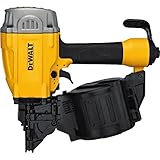
The DEWALT DCN692B accepts 30- to 34-degree paper-collated nails, generally from 2 to 3-1/2 inches long, with a magazine capacity of about 55 nails. It weighs roughly 9 pounds without the battery. It uses DEWALT 20V MAX batteries and has selectable sequential and contact firing modes.
For beginners, the useful features are not just the absence of a hose. The tool provides tool-free depth adjustment, a stall-release lever for clearing a jammed driver, and a mode selector that makes it easy to begin with single-shot firing. Its balance is acceptable for wall framing, although the battery and motor make it feel heavier than a pneumatic nailer after several hours overhead.
Choose this model when setup time matters more than minimum weight. A battery nailer is particularly convenient for short jobs: framing a partition, repairing a deck structure, or building a small outbuilding. The battery cost is reasonable if you already use DEWALT tools; buying batteries and a charger solely for one nailer makes the cordless premium much larger.
Milwaukee M18 FUEL 2746-20: a good battery-platform choice
The Milwaukee 2746-20 is another 30-degree cordless framing nailer. It accepts common 2- to 3-1/2-inch paper-collated nails and holds approximately 45 nails. Its bare-tool weight is around 9 pounds, with the battery adding more. It is designed for the M18 battery system and offers sequential and contact actuation.
Its practical advantage is platform compatibility. If you already own M18 batteries, a bare tool can be more economical than switching systems. The adjustable depth control is straightforward, and the nailer provides a dry-fire lockout to reduce the chance of driving the mechanism with an empty magazine.
Compared with a pneumatic tool, it has more start-up delay and more weight. Compared with a gas-powered nailer, it avoids fuel cells. Pick it for repeated work when you value cordless convenience and already have the battery ecosystem, rather than because it is the lightest beginner option.
Paslode CFN325XP: portable, but with more consumables
The Paslode CFN325XP uses a fuel-cell-and-battery system and accepts 30-degree paper-collated nails, commonly from 2 to 3-1/4 inches. It weighs approximately 7.2 pounds before accounting for consumables, making it notably easier to carry than many battery-only framing nailers.
It is useful for remote repairs and punch-list work because it does not require a compressor. However, beginners must manage two consumables: the rechargeable battery and the fuel cell. Fuel cells have a finite shelf life, may perform differently in cold weather, and add an ongoing cost. The tool also needs ventilation because combustion gases are produced during operation.
For occasional users, this can be a better portable solution than carrying a compressor. For frequent framing, a battery-only or pneumatic tool usually has simpler long-term logistics.
Head-to-head comparison
| Model or type | Power system | Nail angle and length | Approx. capacity | Approx. bare weight | Beginner concern |
|---|---|---|---|---|---|
| Metabo HPT NR83A5 | Pneumatic | 21°, 2–3-1/4 in. | 64–74 | 7.7 lb | Requires a suitably sized compressor |
| DEWALT DCN692B | 20V battery | 30–34°, 2–3-1/2 in. | 55 | About 9 lb | Heavier; battery and charger may be extra |
| Milwaukee 2746-20 | M18 battery | 30°, 2–3-1/2 in. | 45 | About 9 lb | Best value mainly for M18 owners |
| Paslode CFN325XP | Fuel cell and battery | 30°, 2–3-1/4 in. | About 30 | About 7.2 lb | Fuel cells add cost and storage concerns |
How to set up a framing nailer without wasting nails
1. Match the nails before loading
Confirm the angle, collation material, nail length, diameter, and head style in the manual. Do not force a 21-degree plastic strip into a 30-degree paper-collated magazine. The strip may appear to fit while causing misfeeds or jams.
2. Set the tool for sequential firing
With the battery removed or air disconnected, select sequential mode if available. This requires the nose to contact the work before the trigger is activated. It provides better control while you learn placement and reduces accidental double firing.
3. Start at a conservative depth
Drive one nail into a scrap of the same material. Adjust the depth wheel in small increments until the head is flush with the surface without crushing the wood or sinking deeply enough to weaken the connection. Changes in wood hardness and nail length can require a new adjustment.
4. Clear jams safely
Disconnect air or remove the battery first. Open the magazine, engage the manufacturer’s nose-release or stall-release mechanism, and remove the bent nail with pliers if necessary. Never put fingers in the nose while the tool is connected to power.
Ownership costs and maintenance
A pneumatic setup has the lowest ongoing nailer cost, but the real entry price includes a compressor, hose, filter, fittings, and oil if the model requires lubrication. A basic compressor package can bring the total beginner setup to roughly $300–$600. A cordless tool kit commonly lands around $400–$700, while a bare tool is less if you already own compatible batteries. Gas-powered systems often cost roughly $500–$800 initially and continue to require fuel cells.
For example, suppose a cordless setup costs $550 and you use it for ten projects. That is $55 per project before nails. A pneumatic setup costing $400 used for the same ten projects is $40 per project, but the compressor may also serve staplers, finish nailers, and blow-off work. The cheaper nailer is not automatically the cheaper system.
Keep the magazine free of plastic or paper debris, inspect the driver blade for mushrooming, and check the depth-adjustment mechanism when the tool begins sinking nails inconsistently. Pneumatic users should drain the compressor tank after use and protect the hose from sharp framing edges. Battery users should store packs away from extreme heat and avoid leaving a battery connected to the nailer during transport.
Final recommendation
Buy the Metabo HPT NR83A5 for the simplest, lightest, and most economical first framing nailer when a capable compressor is available. Buy the DEWALT DCN692B when portability and uncomplicated setup matter more than weight. Choose the Milwaukee 2746-20 if you already own M18 batteries, and choose the Paslode CFN325XP when minimum dependence on electricity and compressed air outweighs fuel-cell expense.