What's inside
As an Amazon Associate I earn from qualifying purchases. This post may contain affiliate links at no extra cost to you.
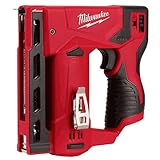
The Milwaukee M12 stapler kit — model 2447-21, built around the M12 3/8 in. crown stapler — bundles the tool with one M12 REDLITHIUM battery (usually a compact CP1.5 or CP2.0 pack), an M12 charger, and a soft carrying bag; it makes sense to buy the kit instead of the bare tool (2447-20) only when you actually need the battery and charger, and the stapler itself only makes sense if your work runs on T50-style 3/8 in. crown staples from 1/4 to 9/16 in. leg length. Here’s how to judge each piece of the kit before buying.
As an Amazon Associate we earn from qualifying purchases at no extra cost to you.



Sections
What’s in the box, and why the bundle contents vary
Not every listing labeled “milwaukee m12 stapler kit” is identical. Milwaukee has shipped the kit with different compact batteries over its life, and some retailer bundles swap the battery or drop the bag. Before comparing prices, verify three things in the listing: the battery’s amp-hour rating (1.5 vs 2.0 vs 4.0 Ah changes real-world value by $40–$70), whether a charger is included at all, and whether staples are in the box — they usually aren’t.
| Component | Typical kit (2447-21) | What to check |
|---|---|---|
| M12 3/8 in. crown stapler | Yes — same tool as bare 2447-20 | Identical across kit and bare tool; no “kit-only” version |
| M12 battery | 1 × compact pack, usually CP1.5 or CP2.0 | Amp-hours printed on pack; XC4.0 bundles exist but are uncommon |
| M12 charger | Standard M12 charger | Standard unit, not the rapid charger — charge times differ noticeably |
| Bag/case | Soft contractor bag | Some promo bundles omit it |
| Staples | Usually none | Budget $6–$10 for a starter assortment |
Price-wise, the bare tool commonly sells in the $100–$130 range and kits in the $150–$200 range. If you already own two or more M12 batteries and a charger, the bare tool is almost always the better buy.
Judging the bundled battery and charger
The stapler draws very little per shot — there’s no compressor and no ramp-up delay — so even the smallest M12 pack drives a surprising number of staples. Milwaukee rates the tool at roughly 1,500 staples per charge on a compact battery under favorable conditions; expect less when sinking 9/16 in. legs into hardwood or OSB. Practical estimates by pack size:
| Battery | Capacity | Est. staples per charge | Approx. charge time (standard charger) | Handling note |
|---|---|---|---|---|
| CP1.5 | 18 Wh | ~700–900 | ~30 min | Lightest; fine for fabric work |
| CP2.0 | 24 Wh | ~1,000–1,400 | ~45–60 min | Best balance of weight and runtime |
| CP2.5 High Output | 30 Wh | ~1,300–1,700 | ~50–60 min | Marginal gain over 2.0 for this tool |
| XC4.0 | 48 Wh | ~2,200–2,800 | ~75–90 min | Adds bulk under your grip during overhead work |
| XC6.0 | 72 Wh | 3,000+ | ~2 hrs | Overkill unless it’s all you own |
The takeaway: if the kit you’re looking at ships with a CP1.5, plan on adding a CP2.0 eventually — not because you’ll drain the small pack mid-task, but because a two-battery rotation means the charger never gates your work. If the kit includes a CP2.0, that’s the sweet spot for upholstery and light fastening.
A quick capacity check for your own workload: re-covering a dining chair seat typically takes 60–120 staples. A CP2.0 pack at ~1,200 staples per charge covers roughly 10–15 seats; a full four-seat dining set with dust covers and welting uses maybe 400–500 staples total. Material cost stays trivial either way — generic T50 staples run roughly $5–$8 per 1,000, so a chair seat costs under a dollar in fasteners.
Staple compatibility: what fits and what to buy
The tool runs standard T50-type flat-crown staples — 3/8 in. (10 mm) crown, leg lengths from 1/4 to 9/16 in. The magazine holds about 85–90 staples, one full stick. Arrow T50, Stanley TRA700-series, and store-brand equivalents all fit; branding matters less than crown width and leg length. It does not accept brad nails, 18-gauge narrow-crown staples, or 71-series fine-wire staples — the last point matters, because professional upholsterers often prefer fine-wire staples for visible show fabric, and this tool can’t shoot them.
Because drive depth on this stapler is effectively fixed by power rather than a fine depth dial, leg length is your main control:
- 1/4 in. — fabric and thin material over softwood frames; least risk of blow-through on thin seat boards
- 5/16–3/8 in. — vinyl, leather, multiple fabric layers over plywood; the general upholstery default
- 1/2 in. — insulation, vapor barrier, screen material into studs
- 9/16 in. — maximum bite for housewrap or felt into soft lumber; expect occasional proud staples in hardwood
For outdoor or marine work, buy stainless T50s — plain steel staples rust-bleed through fabric within a season. One more practical note: on soft pine the tool can bury the crown slightly below the surface, so test leg length on scrap before committing to show fabric.
Where the M12 stapler fits — and where it doesn’t
The tool’s job is one-handed, hose-free light fastening at roughly 2.5–3 lb depending on battery. It excels at re-covering seats, attaching dust covers and webbing, auto and boat interiors, screening, insulation and vapor barrier, cabinet backs, and craft work. It’s genuinely capable into plywood, SPF framing, and most hardwoods at shorter leg lengths.
It’s the wrong tool for show-side upholstery that calls for 71-series fine wire, for finish trim (no brads), for structural sheathing (needs 16-gauge), and for high-volume roofing felt where a dedicated hammer tacker or pneumatic stays faster over a full day.
Which version to buy: a quick decision matrix
| Your situation | Best move |
|---|---|
| Own 2+ M12 batteries and a charger | Bare tool 2447-20 — the kit duplicates what you have |
| First Milwaukee tool, occasional upholstery/DIY | Kit with CP2.0 if available; add a second compact pack later |
| Daily upholstery or auto-trim work | Kit plus a spare CP2.0/XC4.0 for rotation; confirm T50 staples suit your fabric standard |
| Need fine-wire staples for visible show fabric | Skip — look at 71-series pneumatic staplers instead |
| One-off single project, no platform interest | A manual or corded T50 gun covers it for less; the M12 only pays off with repeated use |
Ownership realities: wear, jams, consumables
- No daily oiling — unlike a pneumatic, the driver mechanism is self-contained. Just keep the magazine channel free of dust and fabric lint, which is the most common cause of feed hiccups.
- What wears first: the driver blade tip and the magazine follower spring, typically after tens of thousands of shots. Both are serviceable parts rather than fatal failures.
- Jams are rare but cleared through the front latch with needle-nose pliers; remove the battery first — the tool fires the moment the nose is depressed.
- The steel nose can mark finished surfaces. A strip of painter’s tape on the workpiece protects veneer and lacquered frames.
- Common mistakes: 9/16 in. legs blowing through 1/4 in. plywood seat bottoms, under-seated staples in oak or maple at max leg length, and buying generic staples with inconsistent glue that shed sticks in the magazine.
FAQ
Is the milwaukee m12 stapler kit worth it over the bare tool?
Only if you need the battery and charger. The tool is identical in both, so the decision reduces to whether the bundle’s price premium is less than buying an M12 battery and charger separately — usually it is by a modest margin.
Will it drive staples into hardwood?
Yes, at shorter leg lengths. Expect flush seats in oak and maple up to about 3/8 in.; at 9/16 in. in dense hardwood you’ll occasionally need to tap staples home by hand.
Do Arrow T50 staples fit?
Yes — any standard 3/8 in. crown T50-type staple in 1/4 to 9/16 in. leg length fits, including Arrow, Stanley, and quality generics.
How does it compare to a pneumatic upholstery stapler?
It trades the pneumatic’s fine-wire staple compatibility and feather weight for total portability — no hose or compressor. For re-covers, auto interiors, and jobsite fastening it’s more convenient; for fine show-fabric upholstery the pneumatic’s staple type still wins.