What's inside
As an Amazon Associate I earn from qualifying purchases. This post may contain affiliate links at no extra cost to you.
A pouch for a tape, pencil, and knife does not need a dozen pockets. It needs to keep those three tools easy to reach without letting them fall out when you bend, climb, or squeeze past framing. The right choice depends mostly on how you work: a compact belt pouch suits quick measuring and marking, while a deeper carpenter’s pouch makes more sense if you also carry fasteners or a few hand tools.
As an Amazon Associate we earn from qualifying purchases at no extra cost to you.


Sections
Our Top Picks


What to look for
Start with the tape measure. Check that its clip fits over the pouch’s tape loop or pocket edge, and that you can pull the tape free with one hand. A loop that is too narrow is awkward; one that is too loose lets the tape swing or snag. If possible, try the pouch with your actual tape, since a compact 16-foot tape and a bulky 25-foot model sit differently.
The pencil pocket should hold a carpenter’s pencil without burying it. A narrow slot often grips a standard flat pencil well but may reject a thicker mechanical pencil. For a utility knife, look for a separate pocket with enough depth to retain it when you crouch. Do not count on a shallow open pocket to secure a folding knife or a knife with a loose belt clip.
Fit matters as much as pocket layout. A pouch that rides too low can catch on a bench or ladder; one that crowds your hip can make bending uncomfortable. Wear it on the side opposite your dominant hand if that makes drawing the knife and pencil easier, but keep sharp tools positioned so their edges cannot cut into your body or clothing.
Three useful pouch styles
| Style | Best for | Trade-off |
|---|---|---|
| Compact tape-and-utility pouch | Tape, pencil, knife, and perhaps a marker | Light and unobtrusive, but little room for extra gear |
| Small carpenter’s nail pouch | Measuring and marking plus screws, nails, or a small square | More capacity, with extra bulk and weight |
| Clip-on pocket or single-tool holder | Occasional belt carry or a very minimal kit | Inexpensive, but may shift or lack secure, separate storage |
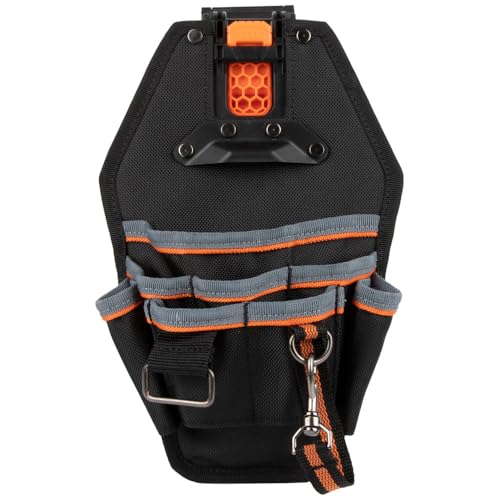
For a simple three-tool setup, a compact carpenter tool pouch is usually the best starting point. Look for a dedicated tape loop, a pencil slot, and a knife pocket rather than a large pouch with one undivided compartment. Loose tools tend to tangle, and a knife buried under a tape can be slow and unsafe to retrieve.
Materials and construction
Canvas and lighter woven fabrics keep weight down and are often comfortable for indoor finish work. They can wear through at corners or seams if dragged against rough lumber every day. Leather is durable and can soften with use, but it costs more, weighs more, and may need care if it gets wet. Heavy synthetic fabric can be a practical middle ground; inspect the stitching and reinforcement where the belt attaches, because that point carries the load.
For a pouch this small, closure design is a trade-off. Open pockets are fast to use, but a shallow knife pocket can spill its contents when you lean forward. A flap or snap adds security but can slow access and become annoying when you are repeatedly marking cuts. Prefer an open, properly deep tool pocket over a fussy closure that you will leave undone.
Check the belt attachment before buying. A sewn tunnel is stable on a compatible belt but may be difficult to move. A metal clip is quick to remove, though it can rotate or pull free on a thick belt. If you already wear a tool belt, confirm the pouch’s attachment width and the belt’s thickness; a mismatch can make even a well-made pouch wobble.
Choose by the work
For trim, cabinet installation, or punch-list work, a compact pouch keeps the essentials close without bumping into finished surfaces. A small carpenter’s nail pouch is a better fit if you regularly carry a handful of fasteners, a small square, or a marking knife as well. Avoid buying extra capacity just because it is available: an oversized pouch invites you to load it with items you rarely use.
If you only need a tape and pencil for occasional measuring, a basic clip-on holder or inexpensive fabric pouch is fine. Spend more when the pouch gets daily use, the seams are failing, or you need a layout that keeps sharp and fragile tools separated. A premium leather pouch will not improve accuracy; a secure tape and a pencil you can reach quickly will.
Check before buying
Read the pocket dimensions and product photos carefully, but treat listed capacity as a rough guide. A pouch advertised for multiple tools may still have narrow slots that do not fit your knife. If returns are easy, test it at home with your actual tape, pencil, knife, and belt. Walk, bend, and sit in it. The tape should not swing into your leg, the knife should stay put, and the pencil should come out without a struggle.
Before carrying a blade, confirm that it is fully folded or retracted and retained securely. Replace a pouch when its knife pocket tears, its belt attachment loosens, or its stitching begins to pull apart. Those failures can turn a small, convenient kit into a dropped-tool hazard—especially on a ladder or around finished work.