What's inside
As an Amazon Associate I earn from qualifying purchases. This post may contain affiliate links at no extra cost to you.
A good carpenter’s pouch for a tape measure and pencils should do three things without fuss: keep the tape upright, make a pencil easy to grab, and stay out of the way when you bend, kneel, or climb. Many pouches fail because they are designed around carrying more tools than most measuring jobs require. They become bulky, let pencils fall through loose stitching, or place the tape too far behind your hip.
For basic layout work, a compact pouch is usually better than a full tool belt. Look for a firm tape sleeve, at least two narrow pencil slots, a drainage opening, and a belt loop wide enough for the belt you actually wear. The best choice depends on whether you work from a leather belt, a nylon tool belt, or a dedicated carpenter tool belt with a tape measure pouch.
As an Amazon Associate we earn from qualifying purchases at no extra cost to you.

Sections
Our Top Picks
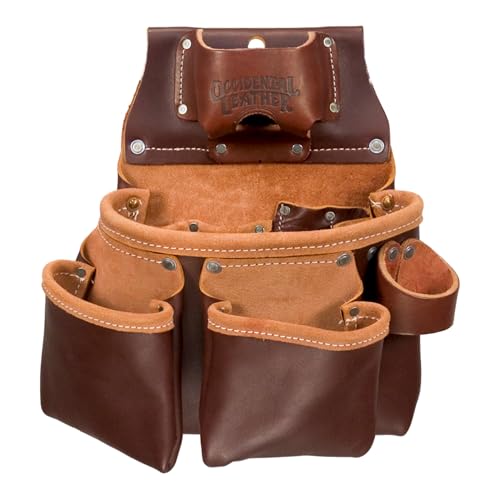 Occidental Leather 3 Pouch Pro Tool Bag withRight Hand6.25 x 0.82 x 0.51 inches0.15 poundsCheck on Amazon
 Occidental Leather OxyLights 3 Pouch Tool Bag withRight Hand6.25 x 0.82 x 0.51 inches0.15 poundsCheck on Amazon
What to Look For in a Carpenter Tool Pouch
Tape retention matters most. A tape pocket should hold the case securely while leaving enough of the tape exposed to pull it out with one hand. A pocket that is too deep makes the tape awkward to retrieve; one that is too loose lets it jump out when you climb a ladder. A useful target is a pocket roughly 2 1/2 to 3 1/2 inches deep, depending on the tape case.
Check the opening rather than trusting the product photos. A rigid or semi-rigid rim is easier to use than soft fabric that collapses. Some pouches use a metal clip instead of a sleeve. Clips are fast and work well with compact tapes, but they can scratch finished surfaces and may release the tape when you lean against framing.
Pencil storage should be separate from the tape pocket. One narrow slot is enough for occasional work, but two or three slots are more practical if you carry a carpenter’s pencil, a mechanical pencil, and a marker. Slots should be at least about 1/2 inch deep. Very shallow loops lose pencils when you sit down, while deep, tight tubes can be difficult to empty when sawdust packs inside.
A small flat pocket is useful for a pencil sharpener, knife, or a few spare leads. Avoid pouches with a large open compartment unless you also carry a knife or small square. Loose contents migrate into the bottom and make the pencil slots harder to reach.
Best Pouch Types for Different Jobs
| Pouch type | Best for | Advantages | Drawbacks |
|---|---|---|---|
| Compact tape-and-pencil pouch | Trim work, cabinet installation, layout | Light, quick to access, low bulk | Limited room for a knife or square |
| Leather tape pouch | Daily framing and finish carpentry | Durable, stable, protects the tape | Heavier; usually costs more |
| Nylon utility pouch | General site work and occasional use | Affordable, washable, flexible | Can sag or collapse when partly loaded |
| Dedicated tool-belt pouch | High-volume framing and remodeling | Holds tape, pencils, knife, square, and fasteners | More bulk and weight than measuring work needs |
A compact tape measure and pencil pouch is the sensible choice for most finish carpenters. It keeps the tape near your front hip and does not interfere with a hand plane, chisel roll, or small parts pouch. If you spend most of the day framing, the extra capacity of a larger pouch is justified, but only if you regularly use what it carries.
Leather remains a strong choice where the pouch is worn every day. Thick leather resists abrasion from rough framing lumber and usually holds its shape better than inexpensive fabric. Its weaknesses are weight and break-in time. A new leather pouch can be stiff for the first few weeks, and wet leather should be dried naturally rather than placed against a heater.
Nylon is fine for homeowners, punch-list work, and anyone who wears a pouch only a few hours per week. A cheaper nylon pouch is not automatically a bad purchase. If the stitching is reinforced around the belt loop, the tape sleeve has a solid bottom, and the pencil slots do not stretch immediately, it can last for years under light use. The usual failure is not torn fabric; it is a belt loop pulling loose or a soft pocket allowing the tape to fall out.
Belt Fit and Position
Measure your belt before buying. Many pouches claim to fit belts up to 2 inches wide, but a thick leather belt may be closer to 1/4 inch thick and too stiff for a narrow loop. A pouch that slides along the belt is irritating; one that cannot be moved without removing the belt is worse.
Position the pouch just behind your dominant hand, normally near the front of the hip. This lets you pull the tape with your dominant hand while holding a pencil or workpiece with the other. If you carry a hammer, do not place the tape pouch where the hammer handle strikes it. On a ladder, a front-mounted pouch can press into your abdomen, so shifting it slightly to the side is often more comfortable.
Suspension also affects comfort. A pouch loaded with a tape, knife, square, and fasteners can exceed 2 pounds. On a simple belt, that weight pulls the belt down and can make the pouch rotate. For heavier loads, use a leather carpenter tool pouch with a wide belt or suspenders. For tape and pencils alone, a lightweight pouch avoids the need for a full suspension system.
Common Problems and How to Avoid Them
Loose pencils are the most common nuisance. Test the slots with both a thick carpenter’s pencil and a standard round pencil. If the round pencil drops more than an inch when the pouch is shaken, it will probably disappear on a roof or ladder. A short piece of elastic can tighten an oversized loop, but replacing the pouch is cleaner if the problem exists from the start.
Sawdust and shavings collect in closed-bottom pockets. A small drainage hole helps, especially when the pouch is used around planing and chiseling work. Empty the pouch at the end of the day rather than forcing a tape measure into a pocket full of debris. Grit can jam the tape lock and scratch the blade.
Do not overfill a measuring pouch. Carry one tape, two pencils, a sharpener, and perhaps a marking knife. If you also need a combination square, utility knife, awl, and fasteners, move up to a broader site pouch such as a small carpenter tool pouch with a tape holder. The right pouch is the one that keeps essential tools visible and reachable, not the one with the most pockets.