What's inside
As an Amazon Associate I earn from qualifying purchases. This post may contain affiliate links at no extra cost to you.
A marking gauge and a pair of dividers are small tools, but they are awkward to carry. Their points can damage a tape measure, snag on clothing, or work through a thin pouch wall. The best pouch is not necessarily the largest tool belt pouch. It needs a stable pocket for long, narrow tools, enough depth to keep sharp ends contained, and an opening that can be reached without looking.
For most carpenters, a compact leather or heavy-duty nylon pouch with one deep main pocket and one or two smaller sleeves is the right starting point. A dedicated leather carpenter tool pouch works well when durability and a firm shape matter. A basic utility pouch is cheaper and fine for occasional work, but it needs to hold the tools upright rather than letting them lie across the opening.
As an Amazon Associate we earn from qualifying purchases at no extra cost to you.



Sections
Our Top Picks
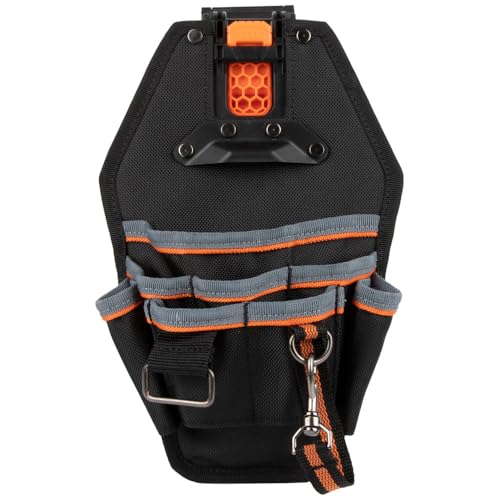
 Klein Tools 5125 Canvas and Leather 5-Pocket Tool5-Pocket8.5 x 2.25 x 3 inches0.6 PoundsCheck on Amazon


What the pouch must do
A marking gauge is usually 8 to 12 inches long, depending on its stock and beam. Dividers are shorter, but their pointed legs create the bigger carrying problem. The pouch should keep both tools vertical, with at least 2 inches of depth below the exposed handles or stocks. That prevents them from tipping out when you bend, climb, or turn quickly.
Look for an opening roughly 3 to 5 inches wide and a pocket depth of at least 6 inches. A pouch that is too deep is not automatically better: a marking gauge buried 10 inches down is slow to retrieve and can catch on other tools. The useful compromise is a deep pocket with a wide mouth, or separate sleeves that leave the handles exposed.
The material should resist puncture and hold its shape. Two layers of 1,000-denier nylon, thick leather, or reinforced canvas are suitable. Thin polyester fabric is a poor choice around divider points. Even when the points are closed, repeated rubbing can wear a hole into the bottom or side seam.
The best pouch types for these tools
| Pouch type | Best for | Advantages | Drawbacks |
|---|---|---|---|
| Small leather tool pouch | Daily bench and site use | Stays open, resists abrasion, protects tools | Heavier and usually more expensive |
| Nylon electrician or utility pouch | Lightweight belt carry | Low cost, many pockets, easy to replace | Soft models collapse and allow points to poke through |
| Dedicated measuring and marking pouch | Users carrying several precision tools | Separate sleeves reduce scratching and mixing | Can be bulky for only two tools |
| Tool roll | Transport between jobs or workshop storage | Good separation and compact storage | Slow to open on a ladder or during layout work |
A small leather pouch is the safest general recommendation. Leather around 4 to 6 ounces is stiff enough to stand open and usually lasts for years. It also gives divider points less opportunity to reach the wearer. Choose one with a belt loop at least 2 inches wide if you use a work belt rather than a narrow trouser belt.
A nylon pouch is the better value for light use, indoor trim work, or a spare layout kit. The cheaper option is perfectly adequate if the divider points have a protective cap and the pouch has a reinforced bottom. Avoid models with a floppy, single-layer front panel. They tend to collapse under a tape measure and make the marking gauge difficult to retrieve.
Pocket layout and capacity
Do not buy by the advertised number of pockets alone. A pouch with ten shallow sleeves may be worse for marking tools than one with two deep compartments. A useful layout includes a main pocket for the marking gauge, a narrow sleeve for dividers, and perhaps a smaller pocket for a pencil, knife, or marking awl.
Keep sharp tools separate from a tape measure. Dividers can scratch the tape blade and eventually cut its plastic case. They can also catch on the spring clip of a tape measure. If the pouch has only one large cavity, put the dividers in a leather or plastic point guard before carrying them with other tools.
Measure your actual tools before ordering. A marking gauge with a thick wooden stock may need a pocket at least 2 inches wide, while a compact metal gauge may fit a narrow sleeve. Allow about 1 inch of spare length above the pocket bottom so dust and chips do not pack tightly around the tool.
For a mixed layout kit, a multi-pocket leather tool pouch is more practical than a pouch marketed specifically for electricians. Electrician pouches often have loops sized for screwdrivers and pliers, but those narrow loops may not accept a broad marking-gauge stock.
Belt fit and access
The pouch should sit near your hip, not swing behind your leg. A loose pouch makes the marking gauge knock against door frames and can pull your belt sideways. A belt tunnel that fully surrounds the belt is more stable than a single snap or hook, especially when carrying a hammer and tape measure on the same side.
Check the pouch while wearing the belt you actually use. A tool belt 3 inches wide will not fit through every work pouch loop. Some loops claim to fit wide belts but are tight once the belt is loaded. You should be able to slide the pouch into position without forcing the stitching, but it should not lift over the belt when you pull out a tool.
Access matters more than maximum capacity. Put the gauge in the pocket closest to your hand and dividers in a separate sleeve beside it. The divider legs should face down if they are capped; if uncapped, use a point protector and make sure it cannot fall off inside the pouch. Never carry exposed divider points facing upward at belt height.
Features worth paying for
A reinforced bottom is the most important upgrade. It prevents point wear and gives the pouch enough stiffness to remain open. Riveted stress points, double stitching, and a smooth interior are also worthwhile. A metal tape-measure clip is useful only if it does not share space with the divider sleeve.
Drainage holes at the bottom help if the pouch is used outdoors, but they do not replace a tough base. They can also let fine sawdust enter from below. For site work, look for a pouch that can be wiped clean rather than one covered in open mesh.
If you carry only these two tools, a compact small carpenter pouch with a reinforced bottom is enough. If you also carry an awl, marking knife, pencils, a combination square, and a small block plane, step up to a wider pouch or a dedicated measuring and marking tool pouch. More capacity is useful only when the layout keeps each tool identifiable and protected.
Common buying mistakes
The most common mistake is choosing a pouch designed around a tape measure and hammer, then dropping precision tools into the leftover space. The gauge gets buried, dividers get scratched, and the pouch becomes a noisy collection of tools. Another mistake is trusting a product photo without checking dimensions; many “small” pouches are too shallow for a full-size wooden marking gauge.
Before committing, check the pocket depth, belt-loop width, bottom construction, and whether the opening stays open with one hand. If those four details are right, an inexpensive pouch can serve well. If any are wrong, a more expensive pouch will not fix the basic access and protection problem.