What's inside
As an Amazon Associate I earn from qualifying purchases. This post may contain affiliate links at no extra cost to you.
Long timber components expose the weaknesses of an ordinary tape measure quickly. A narrow blade that works well for cabinet parts can flop across a 4.8 m joist, kink at the first snag, or lose accuracy when the hook is bent. For roof rafters, floor joists, glulam beams and long studwork, the best tape is not simply the longest one. Blade width, standout, hook construction and readability matter more.
As an Amazon Associate we earn from qualifying purchases at no extra cost to you.


Sections
Our Top Picks
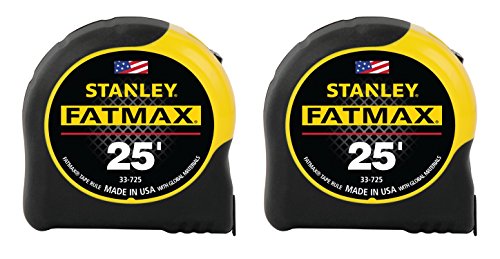 Stanley FMHT74038A FatMax 25 Foot Tape Measure 2PK7.6 m5.13 x 3.38 x 3.63 Inches1.2 PoundsCheck on Amazon


What makes a tape good for long timber
Look first for a blade around 27 to 32 mm (1.06 to 1.25 in) wide. The extra width gives the steel more resistance to sideways buckling, while a pronounced concave curve stiffens it further. A quality 25 mm blade may still be perfectly usable, but it generally needs more support from the timber and will collapse sooner when measuring between two distant points.
“Standout” is the useful specification here: the unsupported distance the extended blade can reach before folding. Real-world performance varies with the angle, wind and condition of the blade, but a stout 32 mm tape may manage roughly 3 to 4 m in favourable conditions. A compact 19 mm tape might manage closer to 1.5 to 2 m. Do not treat the advertised maximum as a guarantee, especially with a scratched or dirty blade.
For most carpentry work, a 7.5 m (25 ft) tape is the sensible starting point. It covers standard timber lengths while remaining compact enough for a tool belt. An 8 m or 10 m tape is useful for long beams and setting out walls, but the case is larger and heavier. A 10 m tape can become tiring when repeatedly pulled out, and its longer blade is more prone to kinking.
Blade features worth paying for
A clear, high-contrast scale is more valuable than decorative case features. Choose a blade with large markings every 10 mm or 1/16 in, depending on your working system, and prominent figures at 100 mm or 1 ft intervals. Both metric and imperial scales can be useful on mixed building work, but dual scales may make a narrow blade visually busy.
Look for a blade coating designed to resist abrasion, but remember that no coating makes steel immune to damage. Dragging the tape over rough concrete or sharp-edged timber eventually scratches the surface. Once the markings disappear near the hook, the tape becomes unreliable for short measurements even if the rest of the blade looks fine.
The end hook should move slightly on its rivets. That movement compensates for the hook’s thickness: it seats against the outside of an object for an external measurement and pulls outward for an internal measurement. A hook that is fixed, loose, or bent out of square introduces errors. On long timber, a hook with broad contact surfaces is easier to keep square against an end grain or sawn edge.
Magnetic hooks can hold to steel framing and some metal brackets, but they add bulk and are not especially helpful on ordinary timber. They can also grab unwanted screws or filings. For woodwork, a strong conventional hook is usually the better choice.
Which type should you buy?
| Type | Best use | Advantages | Limitations |
|---|---|---|---|
| 25 mm, 5–7.5 m | General carpentry and framing | Good balance of weight, readability and price | Less standout; easier to kink at long reach |
| 27–32 mm, 7.5–8 m | Joists, rafters, beams and sheet layouts | Stiffer blade, longer standout, clearer markings | Heavier and bulkier on a belt |
| 32 mm, 10 m | Long beams, wall plates and site setting out | Useful reach and high visibility | Heavy, awkward for repeated one-person work |
| Long tape or open-reel tape | Very long components and ground layout | Works beyond normal hand tapes; easy to read at distance | Slower, less convenient, and usually needs two people |
For a dedicated timber-framing tape, compare 32 mm wide-blade tape measures. For a lighter everyday option, a 25 mm 25 ft carpenter’s tape is often enough. The cheaper option is fine when most measurements are under 3 m, the timber is supported, and you are not relying on unsupported standout.
Accuracy and common failure modes
Do not assume a wide blade is automatically more accurate. The hook can be bent by dropping the tape, the blade can stretch or crease, and the case can shift after a hard impact. Check a new tape against a reliable rule over 1 m. Repeat the check with the hook pushed in and pulled out. A difference of more than a millimetre or two over a metre deserves investigation, particularly when making repeat cuts.
Kinking is the most damaging failure. A sharp crease permanently reduces standout and can make the blade rub against the case, wearing away the markings. Never force a blade back into the case after it has folded. Feed it in slowly, keeping it straight, and replace it when a crease affects the section you commonly use.
Another common error is measuring from a rough or angled timber end. The hook may sit on a splinter rather than the reference edge. Mark a clean pencil line, seat the hook firmly, and keep the blade aligned with the component. For long pieces, have a second person hold the far end or use a clamp, rather than trusting the blade to remain straight in the wind.
A better method for long timber
For measurements beyond comfortable arm’s reach, pull the blade slightly past the target, hook it securely, then walk the case back while keeping the blade along the timber’s edge. Read the scale only when the blade is straight and flat. If the distance approaches the tape’s maximum, measure in two stages from a clearly marked reference point instead of bending the tape around the component.
When transferring several identical lengths, use a stop block, story stick or marked straightedge where possible. A tape measure is excellent for establishing the first dimension, but repeatedly reading the blade invites cumulative errors. Keep the tape clean, retract it under control, and occasionally inspect the hook rivets and first 300 mm of blade—the areas that usually fail first.
If your work regularly involves timber longer than 8 m, buy a 100 ft open-reel tape measure rather than forcing a bulky hand tape to do the job. It will not replace a pocket tape, but it is more practical for beams, wall lines and site layout where two-person measuring is acceptable.