What's inside
As an Amazon Associate I earn from qualifying purchases. This post may contain affiliate links at no extra cost to you.
Measuring a long board alone is less about maximum tape length than control. A tape that bows, flips over, or refuses to lock can turn a simple 16-foot measurement into guesswork. For timber, the most useful features are a stiff blade, a reliable lock, a clear hook, and a case that is comfortable to manage with one hand.
For most carpentry, a 25-foot tape is the best starting point. It reaches common lengths of framing timber and sheet goods without becoming excessively bulky. If you regularly work with 20-foot boards, roof timbers, or long trim, a 30-foot model gives useful extra reach. A 16-foot tape is lighter and perfectly adequate for furniture and short stock, but it leaves little margin when measuring full-length timber alone.
As an Amazon Associate we earn from qualifying purchases at no extra cost to you.


Sections
Our Top Picks
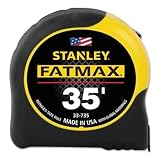
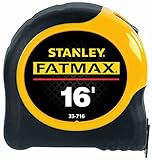
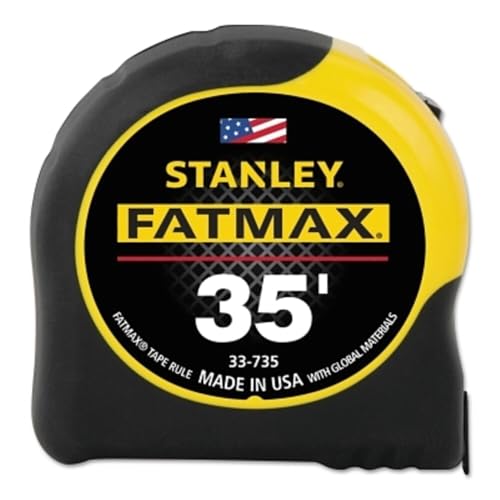
 Stanley 33-735-25 35ft. and 25ft. Fatmax Tape Measure25 feet300 x 1.25 x 0 inches2.8 PoundsCheck on Amazon


What makes a tape good for long timber
Blade standout is the headline specification. This is the distance the blade can extend horizontally before its weight makes it collapse. A claim of 10 feet is useful, but it is not a guarantee: a narrow blade with a light coating may fail earlier in real conditions, especially if the hook catches on rough-sawn timber. For one-person work, look for a tape advertised with at least 9 feet of standout, and preferably 10 feet or more for 25- or 30-foot models.
Blade width matters too. A 1-inch blade is a good compromise between stiffness and bulk. Wider 1-1/4-inch blades stand farther but make the case heavier and harder to fit in a tool pouch. Narrow 3/4-inch tapes are pleasant for light work, but their blades tend to buckle sooner when you are trying to reach the far end of a board.
The blade coating needs to survive sliding over timber. Matte, abrasion-resistant markings are easier to read than glossy markings in sunlight, and a nylon or similarly tough coating generally lasts longer than a thin painted finish. No coating survives repeated dragging over sharp knots and grit indefinitely, so do not treat a premium tape as indestructible.
Best tape measure types for solo measuring
| Type | Best use | Advantages | Limitations |
|---|---|---|---|
| 25-foot heavy-duty tape | General framing and carpentry | Good reach, stiff blade, manageable size | Heavier than a compact tape |
| 30-foot tape | Long joists, rafters, and boards | Extra reach and length margin | Bulkier; can be tiring on a tool belt |
| Wide-blade tape | Maximum standout | Stays extended farther in open air | Heavy and less convenient for small work |
| Compact 16-foot tape | Furniture, trim, and short stock | Light, cheap, easy to carry | Often folds before reaching long timber ends |
| Self-locking tape | Occasional one-handed measuring | Blade feeds out without holding a lock button | Less familiar control and some models retract slowly |
A 25-foot wide-blade tape measure is usually the safest purchase for a carpenter who wants one tape for most work. Choose a conventional thumb lock if you frequently need to stop the blade at an exact mark. A self-locking design can help when your other hand is holding the timber, but it adds another mechanism that can collect dust or fail.
Hook and lock details that prevent mistakes
The end hook should move slightly on its rivets. That movement compensates for the hook’s own thickness: when measuring from an outside edge, it pulls outward; when measuring inside a corner, it pushes inward. A hook that is fixed, bent, or packed with sawdust can introduce a consistent error of roughly 1/16 inch or more.
Look for a wide, reinforced hook with two or three secure rivets. A large hook is easier to catch on the end of a rough board, but it can snag in a narrow inside corner. Inspect the hook before buying if possible. It should sit square to the blade and have a clean edge rather than a thin, easily bent tab.
The lock should hold the blade without creeping. Test this by extending the blade several feet, locking it, and applying a light pull. If it slips, the reading can change while you move around the timber. The lock button should also be easy to operate with a thumb, not so stiff that it shifts the case as you press it.
How to measure a long board alone
Place the timber on stable supports so it cannot roll or sag. For a 16-foot board, two supports near the ends are normally workable, but a third support near the middle reduces flex and makes marking more accurate. Keep the board’s reference edge facing you and remove chips that could lift the hook.
Hook the tape on the end nearest you and extend the blade along the edge. Do not rely on a free-standing hook at the far end if the board is rough or windy. If the blade will not stand out the full distance, extend it in shorter controlled sections and use a pencil mark or a scrap block to hold the reading. A second method is to measure from one end to a convenient whole-foot point, mark it, then measure the remainder from that mark.
For a long timber, it is often more accurate to keep the tape blade aligned with the edge rather than stretch it diagonally across the face. A diagonal can add several sixteenths of an inch over a long length. Keep the tape flat, avoid twisting the blade, and read the mark directly above the pencil line rather than from an angle.
When a cheap tape is enough
A budget 25-foot tape is fine for rough cut lists, framing where the final piece will be trimmed, and occasional home projects. The savings are worthwhile if you use it only a few times a month. Replace it when the end hook is loose, the blade has developed a permanent kink, or the lock slips.
Pay more for a 30-foot heavy-duty tape measure when you measure long stock weekly, work in abrasive conditions, or need the blade to stand out beyond 9 or 10 feet. The extra cost usually buys a stronger case, better hook, and more durable blade coating—not perfect accuracy. Clean the blade after measuring treated or wet timber, and retract it slowly so the hook does not slam into the case.
If your work includes repeated measurements along the same long board, consider a carpenter measuring wheel as a companion, not a replacement. A wheel is fast for rough layout, but it is less dependable for precise joinery, short marks, and irregular timber ends. For accurate cuts, a controlled tape measurement followed by a sharp pencil or marking knife remains the better method.