What's inside
As an Amazon Associate I earn from qualifying purchases. This post may contain affiliate links at no extra cost to you.
For short timber components—cleats, blocking, trim returns, drawer parts and small frame members—the choice is less about maximum length than control. A tape measure is quick and compact. A folding rule is rigid and can be easier to place against a short edge or use as a depth gauge. Either can make accurate cuts; the better choice depends on how you work and what you need to measure.
As an Amazon Associate we earn from qualifying purchases at no extra cost to you.


Sections
Our Top Picks
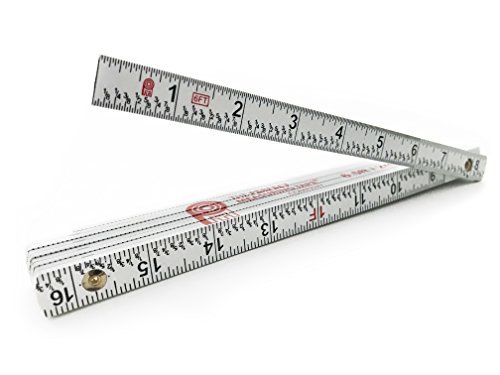 Perfect Measuring Tape Co. FR-72 Carpenter's Folding Rule2 m9.5 x 1.5 x 0.5 inches0.3 poundsCheck on Amazon


At a glance
| Task or condition | Tape measure | Folding rule |
|---|---|---|
| Repeated short measurements | Fast to extend and retract; easy to read if the blade stays straight | Rigid, but takes a moment to unfold and position |
| Measuring a depth or inside edge | Blade can bend or sag; hook movement can affect the reading | Can act as a stiff depth rod, though joint play matters |
| Carrying in a pocket or tool belt | Compact and convenient | Longer and bulkier when folded |
| Working around dust and rough handling | Blade and spring need care; a damaged hook is a concern | Joints and graduations can wear or loosen |
Where a tape measure wins
A tape is the practical default when components vary in length or you need to measure stock longer than the rule in your pocket. A common 16-foot tape covers most workshop and site carpentry tasks without being especially bulky. Its blade reaches across a board quickly, and the case is easy to clip to a belt.
For short parts, the tape’s weakness is that its blade is thin and flexible. If you pull it across a narrow piece, it can bow, twist or move before you mark. The end hook also has a small amount of intentional movement so it can account for its thickness when measuring from an edge or pushing against a surface. That movement is normal, but a bent hook or loose rivets can make readings unreliable.
For better results, keep the blade square to the timber and use the same measuring direction for a batch of parts. If the work allows it, hook the tape over the same end each time rather than switching between pulling and pushing. For a very short dimension, read the mark at the blade, not at an angle; parallax can shift your apparent reading by a millimetre or more. A 16-foot tape measure is enough for many home-shop jobs, and there is little benefit in buying a much longer one solely for short components.
Where a folding rule wins
A folding rule gives you a rigid length instead of a blade that can sag. That makes it useful for checking short pieces on a bench, transferring a depth, or measuring against a square corner where a tape’s hook is awkward. Some rules include a sliding extension for inside measurements; treat that feature as a convenience, not a substitute for checking the rule’s condition.
The trade-off is speed and bulk. You must unfold enough sections to reach the mark, then keep the joints straight. A worn hinge can introduce play, and a rule that is not fully opened can give a false reading. Check that the graduations are legible and that the rule lies straight when extended. For regular bench work, a wooden folding rule can be a steady alternative to a flexible tape, but it is less convenient to carry in a crowded tool belt.
Accuracy is in the method
Neither tool guarantees a precise cut by itself. A clear scale, a square reference edge and a fine mark matter as much as the measuring tool. On short timber, mark with a sharp pencil or marking knife, then use a try square to carry the line across the face. A thick pencil line can be around 1 mm wide, enough to spoil a tight fit if you cut on the wrong side.
For repeated components, avoid measuring every piece from scratch if you can use a stop block or a known reference. If each measurement is off by 1 mm, a run of six parts can show inconsistent ends even when every individual error seems small. Cut one piece, check it against the opening or mating part, and use it as a template only after confirming it is correct.
Before relying on a tape or rule for close work, compare it with a trusted square or another reliable scale over a short distance. Inspect a tape hook for bending and check that the blade returns without sticking. On a folding rule, check for loose joints and damaged ends. Do not use a tool with a visibly bent hook or a joint that shifts under light pressure for fine fitting.
Which one should you buy?
Choose a tape if you want one everyday measuring tool for both short parts and longer stock, especially if you work on site or wear a tool belt. It is the cheaper, more versatile option for many users, and a basic tape is fine for general framing, shelves and utility work. Replace it when the hook is damaged, the blade is kinked, or the markings are hard to read.
Choose a folding rule if most of your measuring happens at a bench and you value a rigid tool for short spans and depth checks. It is not automatically more accurate: worn joints, careless alignment and thick marks can defeat its advantage. If you already own a sound tape, you do not need to buy a rule just for occasional short cuts.
If you regularly make fine furniture parts, consider adding a small rule or a steel rule for close bench measurements rather than expecting a general-purpose tape to do everything. A 6-inch steel rule is easy to keep beside the work and useful for checking small dimensions, but it will not replace a tape for longer pieces. The sensible setup for many carpenters is one dependable tape for general work and a rigid rule only when the work calls for it.