What's inside
- Step 1: Check Which Nailers Are Actually in the Set
- Step 2: Confirm the Fasteners You’ll Feed It
- Step 3: Do the Compressor Math
- Campbell Hausfeld Set vs. a Craftsman Nail Gun Set
- Step 4: Verify Replacement Parts Before You Commit
- Ownership Reality: Maintenance That Actually Extends Life
- Which Set Fits Your Situation
- Quick FAQ
- Step 1: Check Which Nailers Are Actually in the Set
- Step 2: Confirm the Fasteners You’ll Feed It
- Step 3: Do the Compressor Math
- Campbell Hausfeld Set vs. a Craftsman Nail Gun Set
- Step 4: Verify Replacement Parts Before You Commit
- Ownership Reality: Maintenance That Actually Extends Life
- Which Set Fits Your Situation
- Quick FAQ
As an Amazon Associate I earn from qualifying purchases. This post may contain affiliate links at no extra cost to you.
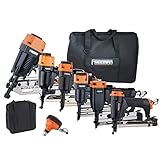
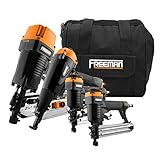
The right Campbell Hausfeld nail gun set is the one whose included nailers, fastener sizes, air demand, and parts support line up with the work you actually plan to do — the number of tools in the case matters far less than those four checks. Campbell Hausfeld has sold several configurations over the years: 2-in-1 brad nailer/stapler kits, two-piece brad-and-finish combos, and larger kits that add a framing nailer, usually bundled with a hose, fittings, oil, and a carry case. Here’s how to assess any of them before spending money.
As an Amazon Associate we earn from qualifying purchases at no extra cost to you.


Sections
- Step 1: Check Which Nailers Are Actually in the Set
- Step 2: Confirm the Fasteners You’ll Feed It
- Step 3: Do the Compressor Math
- Campbell Hausfeld Set vs. a Craftsman Nail Gun Set
- Step 4: Verify Replacement Parts Before You Commit
- Ownership Reality: Maintenance That Actually Extends Life
- Which Set Fits Your Situation
- Quick FAQ
Step 1: Check Which Nailers Are Actually in the Set
Set names like “4-piece kit” can be misleading — the count often includes the hose, fittings, or case as pieces. Read the tool list, not the headline. The useful distinction is which nailer types you get:
- 18-gauge brad nailer — trim, casing, light assembly, crafts. The workhorse of most CH kits.
- 16-gauge finish nailer — baseboards, door/window trim, cabinet face frames.
- 2-in-1 brad nailer/stapler — one tool that drives both brads and narrow-crown staples; great value if your work mixes trim with upholstery or screening.
- 21° framing nailer — studs, decking, fencing. Only worth paying for if you’ll actually frame; it’s the tool that dictates compressor size.
If the set contains two nailers and your projects are trim and cabinetry, you may already have everything you need — don’t pay for a framing nailer that sits in the case. Conversely, a brad-only kit will not hang a door or build a deck frame.
Step 2: Confirm the Fasteners You’ll Feed It
Every Campbell Hausfeld nail gun set uses industry-standard fastener sizes, which is good news — consumables are cheap and brand-agnostic. The trap is collation angle and gauge mismatches, so verify the magazine spec before buying, and before loading bulk packs of nails.
| Nailer type | Fastener | Typical length range | Approx. air use (SCFM @ 90 PSI) | Best for |
|---|---|---|---|---|
| 18-ga brad nailer | 18-ga brads, straight strip | 5/8 – 2 in | 0.3 – 0.6 | Trim, molding, thin stock |
| 16-ga finish nailer | 16-ga finish nails, straight | 1 – 2-1/2 in | 1.0 – 1.5 | Baseboard, casing, cabinets |
| Narrow-crown stapler / 2-in-1 | 18-ga staples, ~1/4-in crown | 1/2 – 1-1/2 in | 0.3 – 0.8 | Upholstery, screening, thin panels |
| Framing nailer (21°) | Plastic-collated full-head nails | 2 – 3-1/2 in | 2.5 – 4.0 | Studs, joists, deck frames |
Two checks that save real headaches: first, some CH 2-in-1 tools top out at shorter brads than dedicated brad nailers, so confirm the maximum length against your thickest trim. Second, if the kit includes a framing nailer, confirm its collation angle — CH units are typically 21° plastic-collated, which is the most common stick nail on shelves, but a stray 28° or 34° magazine forces you into a different nail supply.
Step 3: Do the Compressor Math
Most Campbell Hausfeld nailer kits are tool-only — the compressor is separate — so you must match the set’s hungriest tool to your compressor’s output. Operating pressure on these nailers is typically 70–120 PSI; nearly any compressor delivers that. The real constraint is airflow (SCFM) and tank reserve.
A worked example with a common 6-gallon pancake (about 0.8 ft³ of tank, delivering roughly 2.4–2.6 SCFM @ 90 PSI, topping out near 150 PSI): the usable free air stored between 150 PSI and a 110 PSI cut-in is roughly 0.8 × (40 ÷ 14.7) ≈ 2.2 ft³. A framing nail shot consumes about 0.09–0.1 ft³ of free air, so you get roughly 20 framing shots before the pump restarts. A brad shot uses around 0.02 ft³ — well over 100 shots per cycle. In practice:
- Brad/finish/stapler only: any 2–6 gallon compressor rated 1+ SCFM @ 90 PSI keeps up comfortably.
- Occasional framing: a 6-gallon pancake works if you pace yourself — a shot every few seconds while the pump recovers.
- Production framing or roofing pace: you want 8+ gallons or a twin-tank delivering 4+ SCFM, or you’ll spend the day waiting on recovery.
Also verify the kit ships with 1/4-in NPT quick-connect couplers and plugs (most do) and check hose length — 25 ft is standard, but it’s cheap insurance to confirm rather than discover a bare tool set.
Campbell Hausfeld Set vs. a Craftsman Nail Gun Set
The most common cross-shop is a Craftsman nail gun set, which is usually sold with a compressor — a fundamentally different bundle. Head-to-head:
| Campbell Hausfeld nailer kits | Craftsman compressor combo kits | |
|---|---|---|
| Typical contents | 1–3 nailers + hose, fittings, oil, case (no compressor) | 6-gal pancake compressor + 2–3 nailers + hose/fittings |
| Air supply included | No — BYO compressor | Yes — ~150 PSI max, ~2.6 SCFM @ 90 PSI |
| Nailers usually included | Brad, finish, or 2-in-1; larger kits add a framer | 18-ga brad + 16-ga finish + crown stapler |
| Fastener compatibility | Standard gauges; 21° framing collation | Standard gauges; no framing nailer in the common bundle |
| Typical price band | Roughly $80–$250 depending on tool count | Roughly $200–$350 with compressor |
| Best for | Buyers who own a compressor; framing-capable kits | From-scratch buyers doing trim/finish work |
The decision is simple: if you already own a capable compressor or need a framing nailer, a Campbell Hausfeld nail gun set is the more flexible buy — Craftsman’s popular bundles top out at finish-size tools. If you’re starting from zero and only do trim and cabinetry, the Craftsman all-in-one bundle removes the compressor guesswork entirely.
Step 4: Verify Replacement Parts Before You Commit
This is the check most buyers skip, and it matters more for CH than for bigger pro brands because many Campbell Hausfeld kits on the market today are older stock or secondhand. Before buying, locate the tool’s model number (on a label near the magazine), then confirm on the manufacturer’s parts portal or a tool-parts supplier that the wear items below are listed and orderable:
- O-ring and seal kits — the first thing to wear; symptoms are air leaks at the trigger or cap and weak driving.
- Driver bumper — degrades from dry-firing; a crumbling bumper causes double-fires and inconsistent depth.
- Driver blade — bends or chips on jams; replaceable on every CH nailer, but only if the part still exists.
- Trigger valve assembly — common leak point on tools stored wet.
If a used kit’s framer has a discontinued parts diagram with no O-ring kit available, treat it as disposable and price it accordingly — or walk away.
Ownership Reality: Maintenance That Actually Extends Life
- Oil daily. Unless the manual explicitly says oil-free, add 2–3 drops of pneumatic tool oil to the air inlet each morning. Skipping this is the number-one killer of budget pneumatic nailers.
- Drain the compressor tank after every session — water in the tank migrates into tools and rusts valves from inside.
- Never dry-fire. It hammers the bumper and driver blade with no nail to absorb the blow.
- Respect max PSI. Running 130+ PSI into a nailer rated for 120 accelerates seal wear noticeably.
- Clear jams correctly. Disconnect air first, open the nose latch, remove the strip — never pry at the driver channel.
Which Set Fits Your Situation
| Your situation | Right configuration | Why |
|---|---|---|
| Occasional DIY trim and repairs, small budget | CH 2-in-1 brad/stapler kit + any small compressor | One tool covers brads and staples; minimal air demand |
| Furniture and cabinet projects, regular use | Two-piece brad + 16-ga finish set + 4–6 gal compressor | Correct gauges for joinery-grade fastening |
| Deck, shed, or wall framing planned | Set including the 21° framing nailer + 8 gal or twin-tank | The framer dictates airflow — size the compressor to it |
| Found a used CH kit cheap | Buy only if O-ring kits and driver parts are still listed | Unserviceable pneumatics are throwaways |
| No compressor, trim-only work | Consider a Craftsman-style compressor bundle instead | One-box solution beats piecing a system together |
Quick FAQ
Do Campbell Hausfeld nailers work with generic fasteners?
Yes — they take standard 18-ga brads, 16-ga finish nails, narrow-crown staples, and 21° framing sticks, so you’re never locked into brand-specific consumables.
Do the nailers need oil?
Most CH pneumatic nailers are oil-lubricated: 2–3 drops of tool oil per day of use. Check the manual — if it’s marked oil-free, don’t add oil.
Is a used Campbell Hausfeld nail gun set worth buying?
Often yes at the right price — the mechanisms are simple and rebuildable — but only after confirming parts availability and firing each tool on your compressor to check for leaks and full-depth driving.