What's inside
As an Amazon Associate I earn from qualifying purchases. This post may contain affiliate links at no extra cost to you.
A combination square is one of the most useful layout tools in a carpenter’s kit. It marks 90° and 45° lines, checks an edge, sets out shoulder lines, and measures short distances without reaching for a tape. For timber work, the best square is not necessarily the largest or most expensive. It needs a straight rule, a head that locks firmly, clear graduations, and enough durability to stay accurate after being dropped on a site.
As an Amazon Associate we earn from qualifying purchases at no extra cost to you.



Sections
Our Top Picks
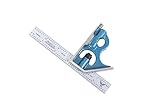
 Starrett Steel Combination Square with Square Head12"1 x 1.4 x 12.3 inches1.22 PoundsCheck on Amazon

What makes a good combination square
A combination square has a grooved steel rule, a sliding head, and a locking screw or nut. The head normally provides a 90° face, a 45° mitre face, a spirit vial, and a small scribe. The rule should slide smoothly but without noticeable side-to-side movement. If the head rocks on the rule, your layout can be out by several millimetres across a wide board.
For general carpentry, a 12-inch rule is the most useful size. It is long enough to check the width of common boards and sheet material, but still fits in a tool belt or apron pocket. A 6-inch square is handy for joinery, trim, and small stock. A 16- or 24-inch version can check wider workpieces, but it is less convenient and often more vulnerable to being knocked out of square.
Look for etched or deeply engraved graduations rather than shallow printed marks. Imperial markings are important for most North American plans, while a dual-scale rule is useful if you work from metric drawings. A thin, well-defined rule is easier to use for marking, but an excessively thin rule can bend if you use the square as a straightedge.
Best types for timber layout
The standard sliding-head square is the best all-round choice. It handles crosscuts, rafter layout, checking a plane’s work, and marking out mortises. A 12-inch combination square for carpentry gives the best balance of reach and portability.
A smaller 6-inch square is worthwhile if most of your work involves cabinet parts, mouldings, or narrow stock. It is easier to control with one hand and fits into a small tool pouch. The trade-off is limited reach: it cannot check the full width of a 2-by-10 board, and its short rule makes it harder to set out repeated marks quickly.
Combination squares with a cast metal head generally tolerate site abuse better than very light stamped heads. That does not automatically make them accurate. Inspect the machining and fit; a heavy square with a loose head is worse than a lighter square that locks solidly. For fine joinery, consider a precision combination square, but do not pay for machinist-level precision if you mainly mark framing timber.
| Square type | Best use | Main advantage | Main limitation |
|---|---|---|---|
| 6-inch combination square | Cabinetry, trim, small joinery | Compact and easy to control | Short reach on wide boards |
| 12-inch combination square | General carpentry and timber layout | Most versatile size | Can be bulky in a small pouch |
| 16- to 24-inch combination square | Wide stock and long crosscut marks | More reach in one tool | Heavier and easier to damage |
| Budget combination square | Occasional DIY and rough work | Low purchase cost | Greater risk of loose fit or poor markings |
How to check accuracy before buying
Do not assume a square is accurate because it is sold as a combination square. Set the head against a straight board edge and draw a line along the rule. Flip the square over, keeping the same head edge against the board, and draw a second line from the same point. The lines should overlap. If they form a narrow V, the square is out of square. A gap of 1/32 inch over 6 inches is already too much for careful joinery.
Check both the 90° and 45° faces. The 45° test is less forgiving because a small angular error becomes obvious on a mitre joint. Also slide the head along the rule while it is unlocked, then tighten it. It should clamp without shifting noticeably. Some inexpensive squares move slightly as the screw tightens; that makes repeat layout frustrating.
Examine the rule edges for burrs and the head for a flat reference face. A burr can hold the square away from the timber, producing a false line. If possible, check that the spirit vial is secure and readable, but treat it as a convenience rather than a reason to buy the tool. The vial does not make the square more accurate for marking.
When a cheaper square is fine
A budget square is perfectly adequate for rough framing, shelving, garden projects, and occasional home repairs if it passes the flip test and the head locks without play. You may need to replace it sooner if it lives in a damp tool bag or gets used as a pry bar. A cheap square that is accurate today can become unreliable when the rule or head wears.
Spend more when you mark expensive hardwood, build furniture, cut joinery, or need repeated settings. Better squares usually have cleaner graduations, smoother sliding action, more consistent machining, and a locking mechanism that is less likely to strip. These features save time rather than merely improving theoretical accuracy.
For site work, a heavy-duty 12-inch combination square is a sensible upgrade. For a small bench kit, a 6-inch woodworking combination square may be all you need. Do not buy a long square solely for its claimed precision; length helps reach, but it also magnifies handling errors.
Using and maintaining the square
Hold the reference face firmly against the timber and mark with a sharp pencil or knife. A blunt pencil can push against the square and leave a line several millimetres away from the intended point. For joinery, knife the line first, then deepen it with a pencil if it must remain visible.
Keep the rule and head clean, especially after working with resinous softwood. Fine sawdust can prevent the head from seating properly. Wipe the steel dry after use and apply a tiny amount of light oil to the rule if it will be stored in a damp workshop. Never use the rule to lever boards or scrape glue. Those jobs can bend the edge or damage the graduations, turning a reliable layout tool into a source of repeated errors.