What's inside
As an Amazon Associate I earn from qualifying purchases. This post may contain affiliate links at no extra cost to you.
Sections
Our Top Picks



What Makes a Good Dovetail Chisel?
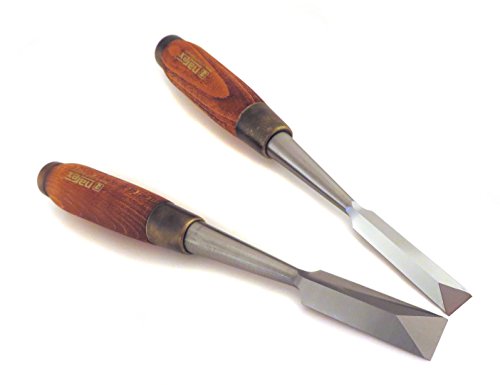
Cutting timber dovetails by hand does not require a large chisel set. It requires a few chisels that can reach into the corners, hold an edge through end grain, and tolerate a controlled tap with a mallet. The best general choice is a bevel-edge bench chisel with a blade width matched to the joint.
A chisel for dovetails should have relatively thin side bevels. Wide bevels can prevent the blade from entering the acute corner between a pin and the baseline. The bevels do not need to be completely flat or polished, but they should leave enough clearance to pare cleanly without bruising the adjoining face.
As an Amazon Associate we earn from qualifying purchases at no extra cost to you.


For most furniture-sized work, a 6 mm (1/4-inch), 10 mm (3/8-inch), 12 mm (1/2-inch), and 18 mm (3/4-inch) set covers nearly everything. A 6 mm chisel is particularly useful for narrow pins and cleaning the corners of half-blind dovetails. A 12 mm chisel is the everyday size for chopping waste and paring tails. Larger sizes are useful for removing waste quickly, but are less important than people often assume.
The Best Chisel Types for the Job
| Chisel type | Best use | Main advantage | Limitation |
|---|---|---|---|
| Bevel-edge bench chisel | General dovetail chopping and paring | Good access into corners | Thin edges can be damaged by careless prying |
| Butt chisel | Small dovetails and shallow joinery | Short, rigid, and easy to control | Usually available in fewer sizes |
| Pairing chisel | Paring end grain and trimming baselines | Long blade gives excellent reach and control | Not intended for striking |
| Mortise chisel | Heavy waste removal in large dovetails | Strong and resistant to twisting | Thick sides are poor in tight corners |
A normal bevel-edge bench chisel is the sensible starting point. Look for a blade around 3 to 5 mm thick in the medium sizes, with side bevels that do not flare excessively. A traditional English-pattern chisel with a socket handle is comfortable under a mallet, while a modern tang-handle chisel is often lighter and easier to find in matched sets.
Butt chisels are worth considering if you make small boxes, drawers, or jewellery chests. Their short blades reduce flex and fit well in confined spaces. They are not automatically sharper or more accurate than full-length bench chisels, so their value is mainly in compactness.
Pairing chisels are excellent for the final paring cuts, particularly across the end grain at the base of a tail. Do not strike a long, fine pairing chisel unless the maker specifically allows it. A 25 to 38 mm blade can be useful, but it is a specialist purchase rather than a first chisel.
Recommended Sizes and Sets
For a first purchase, a four-piece bevel-edge bench chisel set in 1/4, 3/8, 1/2, and 3/4 inch sizes is generally more useful than a large set containing every size. Check that the set includes a genuinely narrow chisel. Some inexpensive sets begin at 1/2 inch, which leaves you poorly equipped for small pins.
If you already own ordinary bench chisels, buy a good 1/4-inch chisel individually and spend the remaining money on sharpening equipment. A sharp, accurately honed inexpensive chisel will outperform a premium chisel with a rounded edge. For a typical 20 mm-thick drawer side, the 1/4-inch and 1/2-inch sizes will do most of the work.
For large joinery in 25 to 35 mm timber, add a 3/4-inch or 1-inch chisel. A quality 1/4-inch bevel-edge chisel is usually a better specialist purchase than a complete premium set.
Steel, Handles, and Durability
Chisel steel matters less than heat treatment and edge geometry. A well-made carbon-steel or chromium-alloy chisel should hold a useful edge through several dovetail joints. Harder steel may stay sharp longer, but it can take more time to sharpen and may chip if struck at a poor angle or twisted in a knot.
Wooden handles are comfortable and easy to replace. They suit controlled mallet work and provide useful feedback when paring. Plastic or composite handles usually tolerate harder striking and rougher site conditions. The trade-off is that some feel bulky during delicate paring.
A metal striking cap is unnecessary for ordinary dovetail work. It adds weight and encourages using the chisel as a heavy-duty cold chisel. If you need to chop large amounts of waste, use a dedicated mortise chisel rather than abusing a thin bevel-edge blade.
How to Use Chisels Without Damaging the Joint
Remove most waste with a coping saw, fret saw, or router before chopping. Chisels are for establishing the baseline, cleaning corners, and removing the last waste, not for excavating an entire cavity from solid timber. Leaving 1 to 2 mm of waste before the baseline reduces breakout and saves the edge.
When chopping, place the bevel toward the waste when starting a cut. Take shallow cuts, especially in softwood, because a deep cut can split below the baseline. At the final baseline, pare with the flat back against the reference surface and take several light cuts. Do not lever sideways in the corner; that is a common cause of bent edges and crushed pins.
Use a wooden or lightweight urethane mallet. A 300 to 450 gram mallet is enough for most furniture dovetails. Strike the chisel squarely and let the cut advance in 1 to 3 mm steps. If the chisel stops moving, withdraw it and clear the waste instead of increasing the force.
Sharpening and Maintenance
Set a primary bevel around 25 degrees and add a small 30-degree secondary bevel. The exact angle is less important than keeping it consistent. Hone the back flat for at least the first 20 to 30 mm near the cutting edge. A wire edge left on the back will make paring feel rough and can tear the corner of the joint.
For general timber, hone through roughly 1,000 grit and then 4,000 to 8,000 grit if you want a cleaner paring edge. Re-hone as soon as the chisel begins to push rather than cut. Waiting until it is visibly blunt means removing more steel and increases the temptation to use excessive force.
Keep chisels in a roll or rack so the edges cannot contact other tools. Wipe carbon-steel blades after use, particularly when working green or damp timber. A thin coat of camellia oil or a similar rust preventative is sensible in an unheated workshop.
What to Buy
For most users, the best-value setup is a modest four-piece bevel-edge set, one narrow 1/4-inch chisel, a reliable honing guide or sharpening stone, and a suitable mallet. A basic woodworking chisel set with wooden handles is perfectly adequate if the backs are reasonably flat and the edges can be sharpened without excessive grinding.
Pay extra for better fit, thinner side bevels, and comfortable handles rather than decorative cases or unusually large sets. The cheaper option is fine for occasional dovetails, softwood projects, and learning. Upgrade when the blades repeatedly lose their edge, the sides obstruct tight corners, or the handles become unpleasant under sustained chopping. Those are practical limitations; a higher price alone does not make a dovetail more accurate.