Our Top Picks
 Westinghouse 12500 Watt Dual Fuel Home Backup PortableWGen9500DF27.2 x 26.1 x 26.5 inchesCheck on Amazon
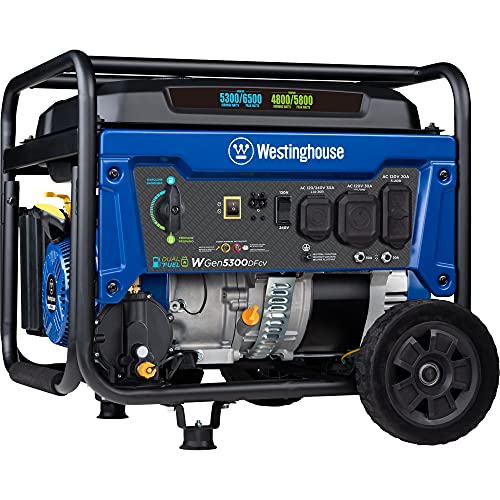 Westinghouse 6500 Watt Dual Fuel Home Backup Portable21 x 18 x 19.09 inches135.6 PoundsCheck on Amazon
 Oxseryn Power Equipment 4400 Watts Inverter Generator Gas19 x 15.6 x 19.1 inches56 poundsCheck on Amazon
 WEN 6800-Watt Dual Fuel RV-Ready Electric Start Portable22.8 x 16.6 x 19.7 inches99.2 poundsCheck on Amazon


What's inside
As an Amazon Associate I earn from qualifying purchases. This post may contain affiliate links at no extra cost to you.
A dead outlet in a workshop is not just an inconvenience. It is a half-glued panel with a curing clock, a dust collector full of shavings, and a router bit stalled in a cut. Choosing a backup generator for workshop use is a different problem from buying one for a house, because shop loads are spiky, motor-driven, and often single-phase 240V. The criterion that separates a useful generator from an expensive noisemaker is not peak wattage on the box. It is whether the unit can absorb a motor inrush without sagging voltage, and whether it can do so cleanly enough to run anything with a circuit board inside.
This guide walks the decision the way a good counter salesperson would: figure out the real load first, then the fuel, then the connection method, then the noise and emissions ratings that decide whether the thing is legal and tolerable where you live.
As an Amazon Associate we earn from qualifying purchases at no extra cost to you.


| Generator class | Typical running watts | Best for | Watch out for |
|---|---|---|---|
| Inverter, portable | 1,600 to 2,400 | Cordless chargers, lights, a single small tool | Not enough for a table saw or dust collector |
| Inverter, mid-size | 3,000 to 4,500 | One 15A benchtop machine plus lights and vac | Single 120V circuit limits total draw |
| Open-frame portable | 5,000 to 7,500 | Contractor saw, 120V dust collector, heaters | Loud, often higher THD, needs outdoor placement |
| Large portable / dual fuel | 7,500 to 12,000 | 240V machines, cabinet saw, welder duty | Weight, fuel burn, needs a transfer switch |
| Standby, permanently installed | 10,000 to 24,000+ | Whole-shop automatic backup | Permit, gas line or propane tank, pro install |
Sections
Start With Starting Watts, Not Running Watts
The number that decides success or failure is surge capacity, sometimes labeled starting or peak watts. Induction motors on saws, jointers, planers, compressors, and dust collectors draw several times their running current for a fraction of a second at startup. A 1.75 HP cabinet saw motor might run near 1,600 watts and demand three to five times that during spin-up.
Practical method: list every machine you might run, note the nameplate amps and volts on each, multiply amps by volts to get running watts, then add a surge allowance of roughly triple the largest single motor. You do not need to add surge for every tool, because you will never start them all at once. Add the running watts of everything that stays on such as lights, shop heater, air cleaner, and battery chargers.
The second criterion is voltage stability under load. A generator that dips below about 10 percent of nominal voltage during a motor start will make that motor run hot, hum, or refuse to spin up at all. Manufacturer spec sheets that list voltage regulation, usually as a percentage, are telling you something useful. Sheets that only list peak watts are telling you very little.
Power Quality: Total Harmonic Distortion
Anything with a microprocessor, a variable-speed drive, a soft-start module, or a switching power supply cares about waveform. The industry shorthand is total harmonic distortion, or THD. Inverter generators typically advertise under 3 percent THD, which is the safe zone for battery chargers, CNC controllers, laser engravers, digital calipers on a bench supply, and modern VFD-driven lathes. Conventional open-frame generators often land somewhere in the 8 to 25 percent range, which is fine for a resistive heater or an old brush motor and risky for electronics.
If your shop is mostly cast iron and brushed motors, a conventional unit saves money. If you own a VFD lathe, a CNC router, or a plasma cutter, treat low THD as a requirement rather than a bonus.
Mid-size inverter generators, 3000 to 4500 watts
This is the sweet spot for a one-person shop that runs a single machine at a time. You get clean sine wave output for chargers and controllers, an enclosed case that keeps noise manageable, and enough surge headroom for a benchtop planer or a 120V dust collector. Verify the 120V receptacle amp rating before you assume you can run two heavy tools together, and expect to make choices about what runs simultaneously.
Picking A Backup Generator For Workshop 240V Machines
The dividing line here is simple: does your shop have any 240V equipment? Cabinet saws, larger jointers, wide-belt sanders, most welders, and many compressors do. If the answer is yes, you need a generator with a genuine 240V outlet, typically an L14-30 twist-lock rated for 30 amps, or a 50 amp 14-50R on larger frames.
Two details trip people up. First, some dual-voltage generators split output so that using the 240V outlet reduces what is available on the 120V side. Read the panel diagram. Second, a 30 amp 240V outlet delivers about 7,200 watts, so a generator advertising 7,500 running watts may already be near its outlet limit before it is near its engine limit.
Welders deserve their own note. Stick and MIG machines have duty cycles and inrush characteristics that punish undersized generators, and many welder manufacturers publish a minimum generator size in their manuals. Follow that number rather than a general wattage rule.
Fuel Type, Runtime, And Storage Reality
Gasoline units are cheapest to buy and the worst to store, because ethanol-blended fuel degrades in months and gums carburetors. If you choose gas, plan on stabilizer, a fuel shutoff, and a monthly exercise run.
Propane runs cleaner, stores indefinitely, and is the pragmatic choice for a generator that sits idle most of the year. It gives up roughly 10 percent of rated output compared to gasoline, so size up accordingly. Dual-fuel models let you keep propane as the storage fuel and switch to gasoline when you need maximum output.
Natural gas, only available on permanently installed standby units, removes refueling entirely. That convenience arrives with a permit, a licensed installer, and a gas line sized by a professional.
- ✔ Sizing to surge watts prevents motor damage and nuisance shutdowns
- ✔ Inverter output under 3 percent THD protects VFDs, chargers, and CNC controls
- ✔ Dual-fuel gives long storage life without giving up peak power
- ✔ A properly installed transfer switch makes shop backup a two-minute operation
- ✘ True 240V capable units are heavy, often 200 pounds or more
- ✘ Open-frame generators are loud enough to strain residential noise ordinances
- ✘ Every generator needs periodic exercise runs and oil changes to stay reliable
- ✘ Running a full shop, dust collection, and heat at once usually needs standby-class capacity
Connection: Transfer Switch Or Nothing
This is the section where doing it wrong hurts people. Never backfeed a generator into a shop circuit through a dryer cord or a double-male extension cord. That practice energizes the utility side, can kill a line worker, and is a code violation everywhere in the US.
The legitimate options are three. A manual transfer switch, installed beside the shop subpanel, mechanically prevents utility and generator power from ever connecting at the same time. An interlock kit accomplishes the same isolation inside an existing panel at lower cost, where the panel manufacturer offers a listed kit. An automatic transfer switch pairs with a standby generator and handles the changeover without you being present.
Look for equipment listed to UL 1008 for transfer switches and confirm the installation is done to the current National Electrical Code, with Article 702 covering optional standby systems. Most jurisdictions require a permit and an inspection. Cord-and-plug operation with individual extension cords is legal and fine for a small shop, as long as the cords are properly gauged for the run length and the generator lives outdoors.
On that last point: carbon monoxide kills people every storm season. Generators belong outdoors, well away from doors and windows, never in a garage or shed even with the door open. Many current models include CO shutoff sensors built to ANSI/PGMA G300 or certified to UL 2201. Treat that certification as a requirement on any unit that will be used near an occupied building.
Dual fuel 240V portable generators, 7500 to 9500 watts
If you run a cabinet saw or a 240V dust collector, this class is the entry point. Look for an L14-30 outlet, electric start, a CO shutoff sensor, and a documented surge rating that comfortably exceeds triple your largest motor. Pair it with a manual transfer switch or interlock kit at the subpanel and you have real shop backup rather than a cord-and-hope arrangement.
Noise And Emissions Ratings To Check Before You Buy
Noise is measured in dBA at a stated distance, most often 23 feet, and the distance matters as much as the number. An enclosed inverter around 55 to 60 dBA is conversational. An open-frame contractor unit in the mid-70s is closer to a shop vac running nonstop, and many residential ordinances cap sustained noise well below that at the property line. If you have neighbors, this constraint often decides the purchase before wattage does.
On emissions, every new generator sold in the US carries EPA certification. California requires CARB compliance, and several retailers will not ship non-CARB units to California addresses. If you live there, or in a jurisdiction that mirrors California rules, filter for CARB compliant models first so you do not fall in love with something you cannot buy.
Finally, check the engine and warranty story. Runtime figures are usually quoted at 25 or 50 percent load, so real-world runtime under shop load will be shorter than the box claims. Look for a low-oil shutdown, an hour meter for maintenance tracking, and readily available filters and spark plugs.
Frequently Asked Questions
What size backup generator do I need for a one-car-garage woodworking shop? For a shop running one machine at a time plus lights, a vacuum, and chargers, the 3,000 to 4,500 watt inverter class usually covers it. Add a shop heater or a 240V machine and you move into the 7,500 watt and up bracket. Always size to triple the surge of your largest motor, not to the sum of all nameplate ratings.
Can I run a dust collector and a table saw at the same time on a portable generator? Sometimes, but only if the total running watts plus one motor surge fits inside the generator’s capacity and the outlet you are using is rated for the combined amps. Start the dust collector first, let it come up to speed, then start the saw. Staggering starts is what makes marginal setups work.
Is an inverter generator worth the extra cost for a shop? If you own anything with a variable-speed drive, a digital controller, or a battery charger you care about, yes. Under 3 percent THD is meaningful protection, and the noise reduction alone is often worth it in a residential setting. A shop of purely brushed and induction motors can get by with a conventional unit for less money.
Work the list in order: total the loads, add surge for the biggest motor, decide whether 240V is in play, pick the fuel that matches how often you will actually run it, then confirm CO shutoff certification and a legal connection method. Get those five right and the model number almost picks itself.
Check prices on Amazon →