What's inside
As an Amazon Associate I earn from qualifying purchases. This post may contain affiliate links at no extra cost to you.
For site carpentry, your bag choice comes down to one question: do you need to see and grab tools instantly, or do you need to keep them protected and contained while you move? An open tote and a zipped tool bag solve different problems, and most carpenters who have done a few first and second fix jobs end up owning both for different reasons.
As an Amazon Associate we earn from qualifying purchases at no extra cost to you.


Sections
Our Top Picks
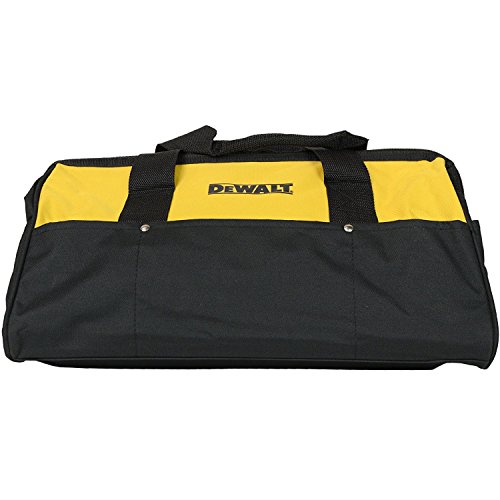 DEWALT DCBAG3 Heavy-Duty Ballictic Nylon 18 1/2-Inch Tool11.88 x 21 x 2.75 inches3 poundsCheck on Amazon


How each bag actually works on site
An open tote is a rigid or semi-rigid bucket with a central handle and vertical pockets around the outside. The best carpentry versions have a flat bottom, a hard base, and 20 to 30 pockets tiered by height. You stand it on the floor or on scaffold boards and everything is visible. A 16-inch tote typically holds 15-20 hand tools plus pencils, a tape, and a square. A 20-inch tote will hold a No.4 or No.5 plane flat on the bottom with chisels and saws around the edges.
A zipped bag is fully enclosed. It usually has a wide U-shaped zip that opens the top completely, with internal dividers and external pockets. Capacity is measured more like luggage: a 18-inch zipped bag is around 35-40 litres, a 22-inch is 45-55 litres. You can throw it in the van, stack materials on top of it, and carry it through rain without worrying. Tools do not fall out if the bag tips over, and no one can see what is inside.
On a domestic site where you are moving room to room, the open tote wins for speed. On a larger site with shared vans, site boxes, and weather exposure, the zipped bag wins for security and protection.
Capacity, weight, and what you will actually carry
Carpentry hand tools get heavy fast. A basic site kit — 4 chisels, block plane, tape, combination square, sliding bevel, marking gauge, hammer, utility knife, 2 pencils, small level, and a nail puller — weighs 6-8 kg before you add the bag itself. An empty open tool tote in 16-inch size weighs 1.8-2.5 kg, a zipped bag of similar length weighs 2.2-3.5 kg because of zips, padding, and extra fabric.
That matters because an open tote has no shoulder strap on most models. You carry it by hand. Once total weight passes 10-12 kg, a hand carry gets tiring over distance — from van to third floor, or across a muddy plot. Zipped bags almost always include a padded shoulder strap, which distributes 12-15 kg far more comfortably for a 100-200 metre carry.
If you carry hand planes or longer tools, measure first. Most open totes will take a 350mm combination square or a tenon saw upright in the centre. Most zipped bags will not take anything longer than about 420mm internally unless you leave the zip open. For a full site kit that includes a jack plane, a cordless drill, and fixings, a zipped bag will swallow more volume, but you will spend more time digging.
| Feature | Open Tote | Zipped Tool Bag |
|---|---|---|
| Access time | 2-3 seconds, tools visible at a glance | 10-20 seconds, unzip and search |
| Typical usable capacity | 15-25 litres, limited by open top | 35-55 litres, fully enclosed |
| Carry comfort over 50m+ | Poor when loaded over 10kg, hand carry only | Better, shoulder strap standard |
| Weather resistance | None, tools exposed to rain and dust | Good, water-resistant base and zipped lid |
| Security on shared site/van | Poor, everything visible and easy to grab | Better, contents hidden and contained |
| Tip-over risk | High, tools spill if knocked | Low, zip keeps everything inside |
Protection and tool damage
This is the biggest trade-off and where beginners get it wrong. An open tote offers almost no protection. Chisel edges knock against squares and plane soles, dust and plaster get into everything, and a single rain shower on a scaffold will leave surface rust on a plane sole overnight if you do not wipe it down. You can mitigate it with blade guards and a habit of oiling, but the bag itself does nothing for you.
A zipped bag protects cutting edges and measuring tools far better. Dividers keep a 150mm or 300mm combination square from getting knocked out of square, and a padded compartment keeps a Veritas or Lie-Nielsen marking gauge from bouncing around. If you are transporting chisels without individual guards, a zipped bag is the safer choice.
Failure mode to watch for: open totes with thin canvas or stitched pockets will sag and let chisels punch through the bottom of the pocket within 6-12 months of daily use. Zipped bags fail at the zip. Fine site dust — MDF dust is the worst — clogs the coil zip and the slider starts to separate behind you, especially on budget bags where the zip is a #8 coil rather than a #10. Once a main zip fails, the bag is effectively scrap unless you sew in a replacement.
Speed and workflow
Site carpentry is repetitive: measure, mark, cut, fix. The time you lose opening and closing a bag adds up. In time studies on first fix, carpenters retrieve a tool 80-120 times per day. At 5 seconds extra per retrieval for a zipped bag, that is 7-15 minutes of lost time daily just opening a bag.
That is why many site carpenters run a hybrid system. The zipped tool bag stays in the van or site box with stock, spare blades, battery chargers, and tools you need twice a day. The open tote comes into the house or onto the scaffold with the 10-12 tools you need for the next two hours. When you move to a new area, you restock the tote from the zipped bag.
A tool belt changes the equation too. If you wear a belt with hammer, tape, square, and knife always on your body, the bag becomes secondary storage and speed matters less. If you do not wear a belt — common for second fix and finishing — the tote becomes your primary bench and speed matters a lot.
Durability and what actually breaks
Do not judge by marketing denier numbers. Judge by construction. On open totes, look for a hard polypropylene base, riveted handles, and pockets made from 1680D polyester or leather, not 600D. Handles stitched only to fabric will tear at 12-15 kg load after a few months. A steel handle bar that runs through the body is worth paying for.
On zipped bags, inspect the zip brand and the base. YKK or equivalent chunky zips last. Thin coil zips do not. A moulded waterproof base with feet keeps the bag dry on damp concrete and stops the underside rotting. Stitching should be double-stitched at stress points. A bag with a single-stitched shoulder strap anchor will fail at 10 kg if you swing it into a van repeatedly.
Price reality: a decent open tote that will last 3+ years of daily site use costs $45-85. A decent zipped bag that will last the same costs $60-110. Below $30 for either, expect pocket blowouts or zip failure within a year. The cheaper option is fine if you are a weekend user or your kit lives in a dry workshop and rides in your car boot. For daily site use, the extra $30 is cheaper than replacing a dropped block plane or a bent square.
Which should you buy for site carpentry?
Buy an open tote if your work is mostly inside one property at a time, you work alone or in a small crew, you value speed, and your van is secure. It is the better bench. Pair it with chisel guards and a habit of covering it with a dust sheet or bin bag when you leave the room.
Buy a zipped bag if you share transport, work on open sites in all weather, leave tools in a van overnight, or need to carry fixings, drills, and hand tools in one bag. It is the better vault. Choose one with a wide mouth opening — you want to see everything with the zip fully open, not fish through a slit.
Most full-time site carpenters end up with both and spend less than $150 total. Use a 16-inch or 18-inch tote for daily carry and a 20-inch to 22-inch carpenter tool bag organizer for transport and overnight storage. If you must buy only one, and you are on and off sites with hand planes and marking tools you care about, the zipped bag is the safer first purchase. If you are fitting kitchens, hanging doors, or doing second fix where you are in one room for hours, the open tote will make you faster every single day.