What's inside
As an Amazon Associate I earn from qualifying purchases. This post may contain affiliate links at no extra cost to you.
A fixed-layout belt is one solid rig: belt, pouches, and holders are sewn or riveted together and stay where they are. A modular system is a base belt or harness with detachable pouches, holsters, and suspenders that clip, slide, or MOLLE onto the belt. Both carry the same tools, but they handle weight, workflow changes, and wear very differently. For carpentry, where you might be framing one day and trimming with chisels and a block plane the next, that difference matters more than it does for a single-trade setup.
As an Amazon Associate we earn from qualifying purchases at no extra cost to you.


Sections
Our Top Picks
 Klein Tools 55918 Electrician Tool Belt for useMedium Tool Belt42.5 x 5 x 0.5 Inches1.1 poundsCheck on Amazon


What each system actually is
A fixed-layout belt is typically a 2- to 3-inch wide leather or nylon belt with two large pouches (often 6 to 10 pockets each) permanently attached. Good leather versions weigh 2.5 to 4 lbs empty, nylon versions 1.8 to 2.8 lbs. There is nothing to configure. You put it on, load it, and work. Stitching, rivets, and leather are the structural elements, so failure points are obvious: stitching blows out at pocket bottoms, rivets pull through worn leather, and the belt holes stretch.
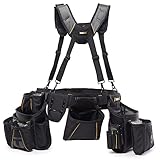
A modular system starts with a padded base belt, usually 3 to 5 inches wide with a plastic or metal buckle and an inner/outer belt design. Pouches attach with belt loops, clips, or a PALS/MOLLE grid. A typical setup is a base belt (1.2 to 1.8 lbs) plus two pouches (0.6 to 1.2 lbs each) plus a hammer loop and tape holder. Empty weight ends up similar at 3 to 5 lbs, but the weight is spread wider and you can strip pouches off completely. The trade-off is complexity. You have more buckles, clips, and hook-and-loop to manage, and any of those can be a failure point if they are cheap plastic.
Weight, comfort, and mobility
If you carry a full site kit — 16 oz hammer, Speed square, 25 ft tape, utility knife, 4-6 chisels in a roll, marking knife, 6-inch combo square, pencils, and fasteners — you are at 8 to 12 lbs on your hips. On a fixed belt, that load hangs from two points. After 4-6 hours, pressure on the iliac crest is the limiter, especially with a narrow unpadded belt.
Modular systems win on comfort if you use them correctly. The padded outer belt distributes load over 4-6 inches of height, and most systems are designed to add suspenders that transfer 30-50% of the weight to your shoulders. For anyone over 180 lbs or working overhead, suspenders are not optional — they prevent the belt from sagging and keep pouches from swinging when you bend.
Mobility is the opposite story. A slim fixed leather belt stays close to your body and snags less when you crawl under joists or work in tight kitchens. A modular rig with three or four pouches is wider and bulkier. If you work in finished interiors and need to kneel, squat, and slide past cabinets, a low-profile fixed belt is less annoying. If you are mostly on open framing or first-fix work where you stand and move lumber, the bulk matters less.
Customization and workflow
This is the real reason to go modular. Carpentry workflows change by task:
For framing or decking, you want a large fastener pouch, a speed square holster, and a hammer loop on your dominant side. For trim and hand-tool work, you want that fastener pouch gone and a slim pouch for a set of marking tools, a chisel sleeve, and a block plane holster. A fixed belt cannot do both without carrying dead weight and bulk all day.
With a modular tool belt system you can reconfigure in under a minute. Keep a framing pouch loaded with nails/screws, a trim pouch with pencils, shims, and coping saw blades, and swap them on the belt. You can also run a single pouch and a tape holster for punch-list work instead of wearing the full rig. That saves about 2-3 lbs and a lot of heat in summer.
The downside is decision fatigue and setup time. If you never reconfigure, modular is just a heavier, more expensive fixed belt. And if pouches use proprietary clips, you are locked into one brand’s ecosystem. Look for systems that use standard 2-inch belt loops or PALS so pouches from different makers still fit. Mills, Occidental, Diamondback, and ToughBuilt all have slightly different spacing — test fit before you commit.
Durability and failure modes
Leather fixed belts last the longest if you maintain them. Expect 7-12 years of daily use before the main pockets blow out. Nylon fixed belts last 3-6 years before edge fraying and buckle cracking. Repair is simple: a leather shop can restitch a pocket for $15-30.
Modular systems fail differently. The base belt usually outlasts the pouches. Common failures after 12-24 months of hard use: hook-and-loop losing grip (especially in dust), plastic side-release buckles cracking in cold, and thin nylon at MOLLE slots tearing when overloaded with a hammer and pry bar on one pouch. Metal Cobra-style buckles and double-layer 1000D nylon solve most of this but add $40-80 to the price. Zippers on closed pouches are the next weak point — they jam with sawdust. Open-top pouches with no zippers last longer on site.
If you work outdoors year-round or in wet conditions, synthetic modular pouches dry faster and do not rot. Leather holds up better to sharp tools — chisels and marking knives will cut through 500D nylon quickly, while 8-10 oz leather shrugs it off. If you carry chisels on your belt often, choose leather pouches or add a leather liner.
Cost and value
| Feature | Fixed-Layout Belt | Modular System |
|---|---|---|
| Typical cost (belt + 2 pouches) | $45–$110 nylon, $120–$250 leather | $90–$160 base belt, $35–$85 per pouch, $160–$350 total |
| Weight empty | 1.8–4.0 lbs | 3.0–5.0 lbs (belt + 2 pouches) |
| Reconfiguration time | None — what you buy is what you carry | 30–90 seconds to swap pouches |
| Comfort over 8 hours | Good if padded; poor with narrow belt | Very good with padded belt + suspenders |
| Best for | One consistent workflow, tight spaces | Multiple workflows, heavy loads, crew work |
| Repair / replacement | Restitch or replace whole belt | Replace single pouch; belt stays |
Price is where honesty helps. A $60 nylon fixed belt is perfectly fine for a weekend woodworker or a trim carpenter who carries six tools and does not need to haul fasteners all day. You do not need a $300 modular rig to hold a tape, square, knife, and pencils. The modular advantage only pays off if you actually swap configurations at least weekly or need to scale up and down during the day.
Long-term cost also favors modular for pros who wear out pouches. Replacing a single $45 pouch is cheaper than replacing a $180 sewn belt because one pocket blew out. For occasional use, that math does not matter — you will not wear either out.
Which should you buy
Choose a fixed-layout belt if your kit rarely changes, you work in finished spaces where bulk catches on everything, and you prefer simplicity. A stitched leather fixed belt is the buy-it-once option for hand-tool-heavy work. If you go this route, look for a wide, padded belt with a roller buckle and pouches with reinforced bottoms and metal rivets at stress points. A classic leather carpenter tool belt in the $150-220 range will outlast two cheap nylon rigs and protect chisel edges better.
Choose modular if you switch between framing, general carpentry, and trim, if you want suspenders for long days, or if you share pouches across a crew. Start with a padded base belt and two pouches — one for fasteners and one for hand tools — then add a dedicated holder for your tape and square. Avoid buying a five-pouch starter kit. You will end up removing half of it after the first week.
Fit matters more than brand. Load any belt with 10 lbs and walk, kneel, and bend for five minutes in the store. If the belt rides down, the buckle digs, or pouches bounce, it will be unwearable by lunch. For modular, check that pouches stay put when you yank a hammer out one-handed. For fixed, check that you can reach the bottom of every pocket without fishing. The right belt is the one you forget you are wearing until you need a tool — and it is there, exactly where your hand expects it.