What's inside
As an Amazon Associate I earn from qualifying purchases. This post may contain affiliate links at no extra cost to you.
If you need to weld where there’s no mains power, the fastest path is an engine-driven welder-generator—a single machine that produces both welding current and auxiliary AC power for grinders, lights, and compressors. For most mobile fabrication and farm repair work, a unit in the 200–300 amp class with 9,000–11,000 watts of auxiliary power hits the sweet spot between capability, fuel use, and portability.
As an Amazon Associate we earn from qualifying purchases at no extra cost to you.
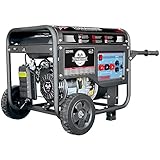


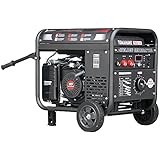
Sections
How a Generator Welding Machine Works
An engine-driven welder (sometimes called a welder/generator or welding machine generator) pairs a gasoline or diesel engine with a generator that serves double duty: it delivers welding output for stick, MIG (with a wire feeder), TIG, or flux-core work, and it runs standard 120V/240V outlets for your power tools. That means one machine replaces both a standalone generator for welding machine duty and a separate welder—which is why they dominate fence-line repair, pipeline, and farm work.
The key buying decision isn’t the brand—it’s matching welding amperage and auxiliary wattage to what you actually do.
Match the Output to Your Process
Welding output determines what processes and material thicknesses you can handle. Use this as a baseline:
- Stick (SMAW): The most forgiving process off a generator. 200 amps handles 1/8″ and 5/32″ 7018 and 6010 rods on steel up to about 3/8″. Pipeline work often wants 250+ amps and 6010 capability.
- MIG / flux-core: Requires a voltage-sensing wire feeder (engine-driven units are CV-capable on multi-process models). Budget 200–250 amps for general fabrication.
- TIG: Look for a dedicated DC TIG output with high-frequency start; AC TIG for aluminum is only available on a few higher-end machines.
Also check the duty cycle. A machine rated “250A at 40%” welds four minutes out of ten at full output. At 150 amps, most 250A-class machines run near 100% duty cycle—fine for farm and repair work, but pipeline welders need sustained output.
Sizing Auxiliary Power for Your Tools
A common mistake is buying for welding amps and forgetting the tools. Add up the running watts of what you’ll power simultaneously, then check surge watts for motor-starting loads:
| Tool | Running Watts | Starting Watts |
|---|---|---|
| Angle grinder (7″ or 9″) | 1,500–2,500 | 3,000–5,000 |
| Wire feeder (suitcase) | 200–400 | — |
| 1 HP air compressor | 1,500–2,000 | 4,500–6,000 |
| Work lights / radio / chargers | 300–800 | — |
If your crew runs a grinder while someone welds, you want at least 9,500W auxiliary—many machines throttle back auxiliary power at high weld output, so check the spec sheet for “watts available while welding.”
Best Options by Situation
Best all-around: Lincoln Electric Ranger 260MPX
The long-running benchmark among lincoln welding generator options. Around 260 amps of multi-process output (stick, TIG, MIG/flux-core with a feeder), roughly 9,500W of clean auxiliary power, and a Kohler gas engine. Weighs about 600 lbs—truck-bed or trailer territory, not a carry-around unit. Typical market price: mid-$4,000s to mid-$5,000s.
Best for tight spaces: Lincoln Ranger Air 260MPX
Adds an integrated air compressor (around 30 CFM-class for plasma cutting and air tools), eliminating a second machine. Same welding class as the standard Ranger but roughly 100+ lbs heavier. Worth it if plasma cutting or air tools are daily needs.
Best diesel / high-hour use: Miller Bobcat 265 or diesel variants
Miller’s Bobcat line competes directly with the Ranger: ~260A multi-process output, ~9,500–11,000W auxiliary, quieter operation, and remote start/stop options. Diesel versions cost more upfront but pay off past ~1,000 hours/year on fuel economy and engine life. Expect $5,000–$7,000 gas, $8,000+ diesel.
Budget / occasional use: 225A-class AC stick machines
Entry-level engine drives (often Lincoln Ranger 225 or similar older designs, and import equivalents) run roughly $2,500–$3,500. They stick-weld well and provide 8,000–9,000W auxiliary, but typically lack DC TIG and true CV output for MIG—fine for farm repair, limiting for a welding business.
Alternative: separate generator + inverter welder
If you already own a quality 7,500W+ generator, a 200A inverter stick/TIG welder (which draws roughly 6,000–7,500W input at full output) can run off it. This combo is lighter and more flexible—use the generator alone for tools—but less fuel-efficient and adds a second machine to maintain.
Decision Matrix
| Your situation | Recommended class | Typical price range |
|---|---|---|
| Occasional farm/fence repair, stick only | 225A gas engine drive | $2,500–$3,500 |
| Mobile fab/repair business, all processes | 260A multi-process (Ranger 260MPX, Bobcat 265) | $4,500–$6,500 |
| Pipeline / structural, high duty cycle | 300A+ diesel (e.g., Miller Big Blue class) | $10,000+ |
| Need plasma cutting + air tools on site | 260A w/ integrated compressor | $6,000–$7,500 |
| Shop-based, occasional remote jobs | 7,500W generator + inverter welder | $1,500–$2,500 total |
Ownership Realities
- What wears first: Engine consumables—oil (every 50–100 hours), air filter, spark plugs. Welding-side brushes/slip rings on some designs need inspection around 500 hours.
- Fuel: A 260A gas unit burns roughly 1–1.5 gal/hour under mixed welding loads; expect a full day of intermittent welding per 10-gallon tank.
- Weight planning: These machines run 500–700+ lbs. Budget for a truck bed, trailer, or crane-lift eye—two people cannot safely lift one.
- Common mistake: Letting the engine sit for months. Stale fuel and a dead battery kill more job-site mornings than any welding fault. Run it monthly or use fuel stabilizer.
FAQ
Can I run an arc welding generator machine indoors? No—it’s a combustion engine. Use it outdoors or with proper exhaust venting.
Is a welding machine with generator output safe for electronics? Modern units like the Ranger MPX and Bobcat produce clean power (low total harmonic distortion) rated for laptops and battery chargers—check the THD spec if that matters to you.
Gas or diesel? Gas for under ~1,000 hours/year; diesel for daily commercial use, better fuel economy, and longer engine life.
What size generator for welding machine use if I go the separate route? Minimum 7,500W running / 9,500W surge for a 200A inverter welder at moderate output; 10,000W+ if you want to weld near max amperage.