What's inside
As an Amazon Associate I earn from qualifying purchases. This post may contain affiliate links at no extra cost to you.
Sections
Best Generator-Welder Combos: Choose by Output, Fuel, and Job-Site Needs
For most crews, the best generator welder combination is a fuel-powered engine drive sized for the welding amperage and auxiliary tools they actually use—not simply the model with the highest advertised watts. The Miller Bobcat 225 is a practical all-rounder for stick and light auxiliary power, the Lincoln Electric Ranger 330MPX offers more welding headroom and generator capacity, and the engine-driven Miller Big Blue 400 Pro is better suited to heavier, longer-duty work.
Specs vary by year, configuration, and market. The comparison below uses representative manufacturer-published ratings; confirm the exact model’s output, fuel tank, and weight before buying. Generator output figures are maximum ratings where noted, not a promise that every outlet can supply that much continuously.
As an Amazon Associate we earn from qualifying purchases at no extra cost to you.

Quick comparison
| Model | Rated welding output | Auxiliary generator output | Fuel and tank | Approx. weight | Best fit |
|---|---|---|---|---|---|
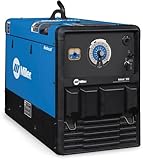
| Miller Bobcat 225 | 225 A, DC | 11,000 W peak; about 9,500 W continuous | Gasoline; 12 gal | About 501 lb | General repair, farm, and mobile fabrication |
| Lincoln Electric Ranger 330MPX | Up to 330 A, DC | About 11,000 W peak; verify continuous rating for the specific version | Gasoline; about 12 gal | About 510 lb | More amperage, multi-process flexibility, and job-site power |
| Miller Big Blue 400 Pro | 400 A, DC | About 12,000 W peak; verify continuous rating by configuration | Diesel; about 15 gal | About 1,000 lb | Heavy-duty work and long shifts where diesel is available |
Weights are approximate machine weights, generally before adding fuel, leads, and accessories. “Peak” generator watts are useful for short startup surges; continuous watts are the more relevant figure for running tools. Check the operator’s manual and nameplate for the exact model you are considering.
Which one suits your work?
Choose the Bobcat 225 for a versatile service-truck machine
The Bobcat 225’s 225-amp output covers common stick-welding repair and fabrication jobs, while its generator can run many job-site tools. It is a sensible middle ground when one machine needs to weld regularly but also power lights, grinders, or a small compressor. It is not a lightweight portable generator: at roughly 500 lb, it typically belongs on a properly rated truck, trailer, or skid.
Pick it when your work is mostly moderate-amperage welding and you value a well-established service network. If you routinely need more than 225 amps, run multiple high-draw tools, or weld at high output for long periods, step up rather than assuming the generator rating makes up for limited welding output.
Choose the Ranger 330MPX when welding headroom matters
The Ranger 330MPX provides higher maximum welding amperage than the Bobcat 225 while keeping the machine in a similar weight class. That extra capacity can be useful for larger electrodes, thicker material, and jobs that benefit from more process options. Its advertised generator output is substantial, but compare the continuous rating and outlet limits against the equipment you intend to run.
This is the stronger fit for a contractor who needs a broad capability range without moving to a much heavier diesel unit. The trade-off is cost and complexity: more capability is only worth paying for if the work regularly uses it.
Choose the Big Blue 400 Pro for sustained heavy work
The Big Blue 400 Pro is in a different class: 400 amps and a diesel engine make it a better match for demanding industrial or pipeline-style work than for occasional household repairs. Diesel can be convenient for fleets already fueling diesel equipment, and the larger machine is built around higher-output work. Its roughly 1,000-lb weight makes transport, loading, and secure mounting a serious part of the purchase decision.
Consider it when high welding output and long shifts are routine, not as a general-purpose upgrade for a small shop. The initial cost, transport requirements, and maintenance needs can outweigh the extra amperage on lighter-duty jobs.
Match the machine to the job, not the headline number
| Your situation | What to prioritize | Likely direction |
|---|---|---|
| Occasional repairs; one operator | Moderate welding output, simple service access, reasonable purchase cost | Bobcat 225 or comparable 200–250 A engine drive |
| Mobile contractor using grinders and lights too | Continuous generator watts, outlet layout, welding duty cycle | Bobcat 225 or Ranger 330MPX, selected by actual load and amperage needs |
| Thicker material or larger electrodes most days | Welding amperage and duty cycle at the required setting | Ranger 330MPX or another 300 A-class machine |
| Heavy production or long remote shifts | High-output duty cycle, diesel logistics, service support, lifting plan | Big Blue 400 Pro or equivalent 400 A-class diesel engine drive |
| Frequent loading by hand or limited vehicle capacity | Actual operating weight and handling method | Consider a separate welder and portable generator, or a lighter solution |
Check generator capacity with a worked load example
Suppose you want to run a 1,500 W grinder, 800 W of lights, and a 2,000 W compressor. Their running loads total 4,300 W. The compressor motor may need substantially more power during startup, so the total running watts alone do not settle the question. Check the compressor’s starting requirement and the generator’s surge rating, then allow headroom rather than planning to operate at the machine’s limit.
Also check the outlet circuit. A machine’s total generator rating may be split among several outlets, each with its own amperage limit. A large advertised wattage does not mean one receptacle can deliver the entire output. For welding and generator use at the same time, consult the manual: some engine drives restrict auxiliary power depending on welding load or operating mode.
Fuel, runtime, and ownership trade-offs
Gasoline machines can suit contractors who already keep gasoline on-site and want a familiar fuel supply. Diesel models may make more sense for fleets with diesel storage and heavy daily use. Runtime depends on load, engine speed, tank size, and maintenance condition; a tank-capacity figure by itself cannot predict hours between refills. Ask for the manufacturer’s runtime at a stated load, and compare like with like.
Budget beyond the purchase price. New engine-drive machines span a broad market range—from several thousand dollars for smaller units to well over $10,000 for higher-output professional models, depending on configuration and region. Add welding leads, a running-gear or mounting setup, service, fuel, and consumables. A used machine may cost less upfront, but engine hours, maintenance records, and generator output under load matter more than a clean exterior.
Common wear points include engine air and fuel filters, belts, battery connections, electrical receptacles, and welding leads. Keep cooling air passages clear, follow the engine’s oil and filter schedule, and inspect cables for heat damage or damaged insulation. Avoid running the machine with blocked airflow or loose electrical connections; both can cause overheating and unreliable output. For a used unit, have a qualified technician check welding output and generator voltage under load before purchase.
Final buying check
- Choose welding amperage based on your common electrode, material thickness, and duty cycle—not the rare maximum setting.
- Compare continuous generator watts, startup surge, and outlet limits with your actual tools.
- Confirm fuel availability and runtime at a comparable operating load.
- Include machine weight, lifting points, vehicle capacity, and transport equipment in the decision.
- Verify the exact model-year specifications, warranty, and local service support before ordering.
For mixed repair work, a 225-amp gasoline engine drive is often the practical starting point. Move to a 330-amp class when higher welding output is a regular requirement, and choose a 400-amp diesel machine when sustained heavy work justifies its size and ownership cost.