What's inside
- The best digital tape measure depends on whether you need a physical tape, a fast electronic readout, or both.
- Three types, three different jobs
- Compare the options that matter
- Choose by the job, not by the longest feature list
- Readouts, units, memory, and accuracy
- Battery life and ownership costs
- Quick buying checklist
- The best digital tape measure depends on whether you need a physical tape, a fast electronic readout, or both.
- Three types, three different jobs
- Compare the options that matter
- Choose by the job, not by the longest feature list
- Readouts, units, memory, and accuracy
- Battery life and ownership costs
- Quick buying checklist
As an Amazon Associate I earn from qualifying purchases. This post may contain affiliate links at no extra cost to you.
Sections
- The best digital tape measure depends on whether you need a physical tape, a fast electronic readout, or both.
- Three types, three different jobs
- Compare the options that matter
- Choose by the job, not by the longest feature list
- Readouts, units, memory, and accuracy
- Battery life and ownership costs
- Quick buying checklist
The best digital tape measure depends on whether you need a physical tape, a fast electronic readout, or both.
For everyday carpentry, a digital tape measure with a conventional blade, clear fractional display, and a lockable readout is the most versatile choice. A laser distance meter is better for long room dimensions and solo layout work, while a digital measuring wheel suits long outdoor runs. These tools solve different problems, so compare measuring method, stated accuracy, units, memory, and power before choosing.
Three types, three different jobs
- Digital blade tape: A retractable metal blade measures like a standard tape; an electronic display can show the blade measurement, convert units, or perform calculations. Best for trim, cabinetry, and short-to-medium layout work. Features vary considerably by model.
- Laser distance meter: Measures distance electronically between the instrument and a target. It is quick for room dimensions, ceiling heights, and other measurements where extending a blade is awkward. It does not replace a blade for marking small parts or measuring around edges.
- Digital measuring wheel: A wheel records distance as it rolls along a surface. It is useful for long, ground-level runs, but is less appropriate for precision joinery or uneven paths.
“Digital tape measure” is often used for all three. Check the measuring method before buying: a screen alone does not mean a tool has a retractable tape blade.
As an Amazon Associate we earn from qualifying purchases at no extra cost to you.


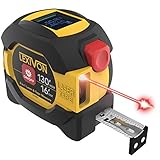

Compare the options that matter
The table gives representative specifications for established laser and wheel models. Specifications can vary by version and market; check the manufacturer’s current listing before purchase. The Milwaukee model shown is a digital measuring wheel, not a retractable blade tape. A single universal accuracy figure is not available for digital blade tapes as a category, so assess the specific model’s stated tolerance and test it against a trusted reference.
| Tool | Measuring method and range | Display, units, and memory | Power and best fit |
|---|---|---|---|
| Bosch GLM 50 C laser measure | Laser; up to 50 m (164 ft) | Color display; metric and imperial settings; stores up to 30 measurements | Two AAA batteries; indoor room and layout measurements |
| Leica DISTO D2 laser measure | Laser; up to 100 m (330 ft), under favorable conditions | Display with multiple measuring functions; stores up to 10 measurements | Two AAA batteries; longer indoor measurements and feature-rich layout work |
| Milwaukee 12 in. digital measuring wheel (series 26-22) | Rolling wheel; measures ground distance rather than point-to-point range | Digital distance readout; check the specific version for units and stored readings | Battery-powered; long floor, site, or landscaping runs |
| Digital blade tape, by specification | Retractable blade; common blade lengths are 16, 25, or 30 ft | Look for large, backlit digits, selectable fractions/decimals, unit conversion, and memory if needed | Usually a replaceable battery; short, direct measurements and marking out stock |
Advertised maximum laser range is not a guarantee of reliable readings in every setting. Bright sun, a small or reflective target, vibration, and an oblique angle can make aiming harder. For woodworking, the practical question is often whether the tool reads consistently across the distances you use, not whether its maximum range is impressive.
Choose by the job, not by the longest feature list
| Your situation | Best fit | Why |
|---|---|---|
| Cutting trim, sheet goods, or cabinet parts | Digital blade tape, or a quality standard tape if electronic features add little value | The blade can hook or butt against an edge, and the measurement is immediately available at the workpiece. |
| Measuring a room alone, including wall-to-wall spans | Laser distance meter with a clear display and measurement memory | It avoids holding a long tape under tension and lets you record several dimensions quickly. |
| Estimating a long fence line, floor, or site run | Digital measuring wheel | Rolling is efficient over distance, provided the route is reasonably smooth and the needed precision is appropriate. |
| Occasional home projects on a tight budget | Basic digital blade tape, or a conventional tape plus a simple laser | A premium screen and extensive memory are hard to justify if you only take a few measurements each month. |
| Repeated room surveys or installation work | Laser meter with memory, unit conversion, and a tripod or reference-point option | Consistent setup and stored readings reduce transcription and repositioning errors. |
Readouts, units, memory, and accuracy
Display and unit options
A backlight helps in cabinets, basements, and dim interiors; large digits matter when you need to read the tool at arm’s length. For woodworking, check whether the display can show fractions such as 1/16 in. or 1/32 in. A decimal-only readout may require conversion before you mark a cut. If a tool offers both imperial and metric units, test the switching method before relying on it in a fast workflow.
Memory and calculation features
Memory is most useful when you measure several rooms or openings in sequence. A stored list can prevent repeated trips to the work area, but it is not a substitute for labeling each reading. Write down “north wall” or “cabinet opening” as you go; a screen full of unlabeled numbers can create more confusion than it saves. Area and volume functions can help estimate flooring or paint quantities, but verify unusual shapes and subtract openings separately.
Accuracy in real work
Accuracy depends on the tool and the setup. With a blade tape, keep the blade straight, use the same hook position, and avoid reading a bent or damaged edge. With a laser, square the instrument to the target and use a flat, clearly visible surface. If the measurement affects an expensive cut, take it twice and compare. For a digital blade tape, compare its display with the blade’s printed scale over a known distance; do not assume the electronics correct a loose hook, a bowed blade, or poor technique.
Battery life and ownership costs
Battery life is difficult to compare across products because manufacturers use different test conditions, and frequent backlight use, Bluetooth, or continuous measuring can shorten runtime. Many compact laser meters use AAA batteries; digital blade models may use coin cells or other replaceable batteries. Check whether the battery is readily available, whether the display warns when power is low, and whether the tool shuts down automatically. A dim or unstable display is a reason to replace the battery before trusting a critical reading.
On a retractable blade, the hook, blade coating, and return spring are common wear points. Keep the blade clean and dry, retract it under control, and replace a tape that has a bent hook or unreadable markings. Avoid letting a laser meter fall onto its lens or measuring edge; dust the lens with a soft cloth rather than an abrasive cleaner. On a wheel, inspect the tread and axle for packed dirt, since debris can change rolling behavior.
Quick buying checklist
- Confirm the measuring method: blade, laser, or wheel.
- Choose a range that covers your real tasks, not just the maximum on the box.
- Check fractional display, backlight, unit switching, and memory limits.
- Look for a stated accuracy or tolerance for the exact model, and consider how you will verify it.
- Check battery type, replacement availability, and low-battery behavior.
- For a laser, consider target visibility and whether the tool can measure reliably from corners or reference edges.
For most woodworking benches, a readable digital blade tape is the practical first choice. Add a laser meter when room-scale measurements are frequent, or a wheel for long ground runs. Matching the tool to the measurement—and confirming important readings—matters more than having the most functions.